
2025 Billiard Table Industry Trends: From Entertainment to Competition, How Are Intelligence and High-End Customization Reshaping the Market?
When billiards meets smart sensors, this century-old sport is undergoing a silent revolution.
The opening data of 2025 has energized industry players: the domestic billiard table market has surpassed 18 billion yuan, a year-on-year increase of 23.7%. More intriguing is the structural shift—sales of high-end billiard tables priced above 30,000 yuan have surged by 41%, far outpacing mass-market models. Behind these numbers, billiard tables are evolving from entertainment props in game rooms into quality symbols that combine competitive attributes with home aesthetics.
1. Smart Technology: Giving Every Shot a "Data Memory"
Over the past two years, the most exciting innovations in the billiard table industry have occurred beneath the surface you can't see. Leading brands have introduced smart billiard tables with pressure sensor arrays embedded in the slate seams, capable of precisely capturing the 3D coordinates of the cue ball's impact point. Paired with overhead high-definition cameras, the system can automatically make foul calls, tally scores, and even generate shot force curves.
A billiard hall owner crunched the numbers: traditional tournaments required three referees on rotation, but now smart tables automatically announce scores and replay disputed shots, cutting operational costs by 30%. For casual enthusiasts, the AR-assisted training system is even more appealing—through virtual trajectory lines projected onto the table surface, beginners can visually grasp shot angles and cue ball positioning, noticeably improving practice efficiency. This "digital coach" model is pushing billiards from empiricism to data-driven play.

2. Material Revolution: The Craft Obsession from "Playable" to "Superior Play"
When consumers are willing to pay the price of a car down payment for a billiard table, their pickiness about materials is only natural. In the 2025 high-end market, imported Italian slate has become almost standard—this rock, sourced from specific quarries in the Alps, is ground under constant temperature for 72 hours to achieve a flatness error within 0.05 millimeters, equivalent to the diameter of a human hair. Combined with patented cushion technology, rubber rebound has improved to 92%, turning "pocketing without spitting out" from folklore into a physical law.
More subtle upgrades lie in the unseen base layers. Multi-layer solid wood frames, treated with steam heat, maintain a moisture content stable at 8%-10%, resisting deformation even during the humid rainy season in the south. A billiard equipment reviewer conducted an extreme test: placing a high-end table in an environment with a 20°C temperature fluctuation for a week resulted in a tabletop flatness change of only 0.02 millimeters. This obsession with precision is the core logic behind why professional players are willing to pay for "consistent feel."
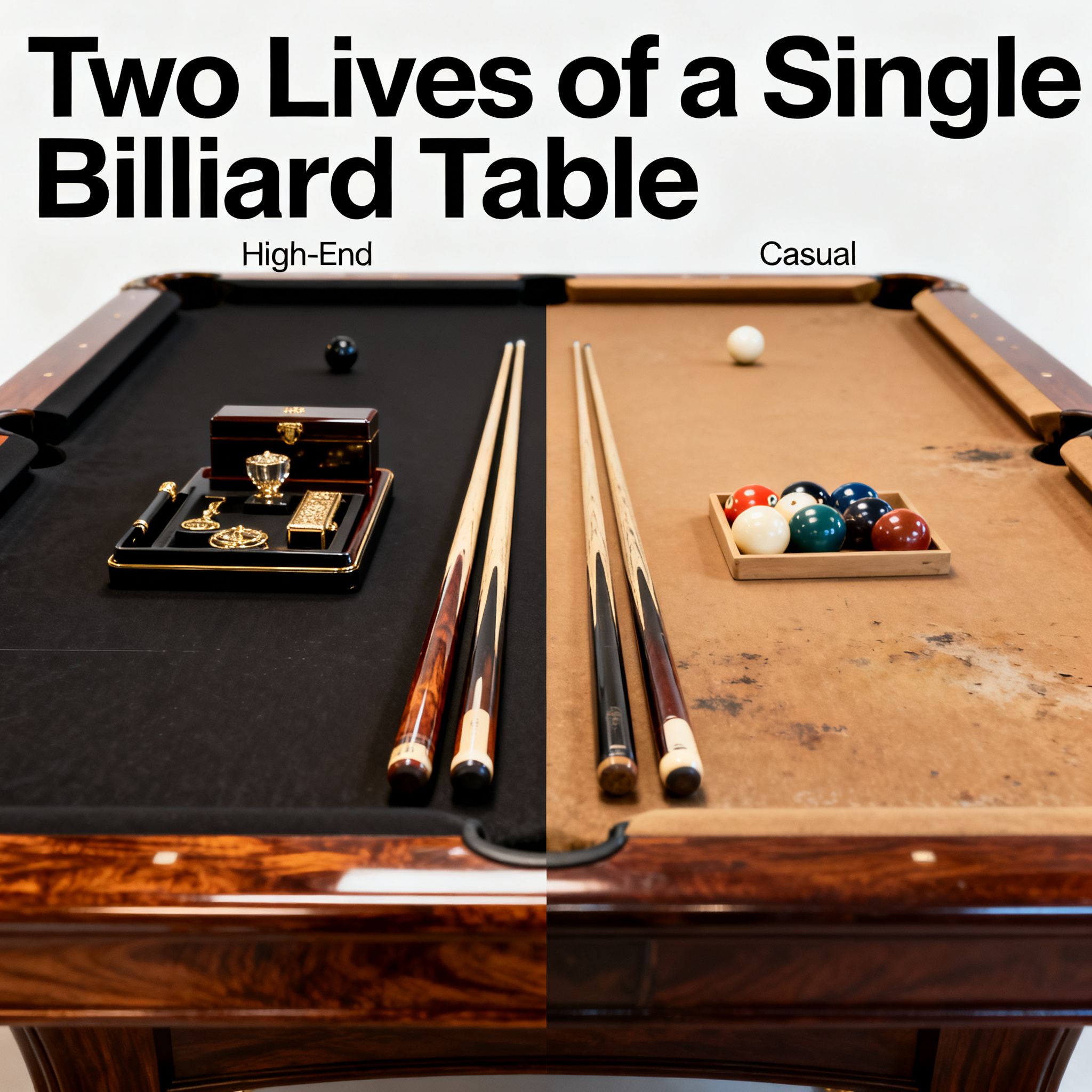
3. Scenario Diversification: Two Lives of a Single Billiard Table
Market segmentation has become unprecedentedly clear in 2025. On one end are high-end home models: walnut veneers, hidden wine cabinets, adjustable ambient lighting—the table becomes the social center of the living room. A brand's "Executive Series" even integrates a temperature-controlled cigar humidor and Bluetooth speakers, turning a billiard table into a piece of furniture that blends sport and business. The user profile for these products is clear: high-net-worth individuals aged 35-50, who are buying the ease of "replicating a club experience at home."
On the other end are professional club models, where the competitive focus shifts to durability and tournament adaptability. Leading chain billiard halls have begun adopting modular leg designs that allow quick height adjustments to meet different event standards; the cloth uses imported Belgian wool-blend material, with wear resistance improved from 800,000 to 1.2 million cycles. An industry report notes that the equipment replacement cycle for professional halls has shortened from 7 years to 4 years, pushing manufacturers to invest continuously in material science.
Buying Guide: Don't Let Trends Become Marketing Gimmicks
Faced with a dazzling array of "smart" and "high-end" labels, consumers need a clear checklist. If the budget is within 30,000 yuan, prioritize slate thickness (no less than 45mm) and cushion elasticity; smart features can be a bonus rather than a must-have. Only when the budget exceeds 50,000 yuan is it worth paying for add-ons like sensor systems and AR modules—after all, the maintenance costs of these electronic components are often glossed over in sales pitches.
Another often-overlooked point is scenario fit. For home use, measure elevator/staircase dimensions; for clubs, assess foot traffic and usage frequency. A billiard hall owner in a second-tier city once complained to me that, in pursuit of a "top-tier" setup, they purchased a tournament-grade table, only to find cloth wear exceeded expectations, and maintenance costs made the profit statement look ugly. The sensible choice is to match product specifications to usage intensity, rather than blindly chasing the highest specs.
Looking back from 2025, billiard tables have long transcended the stereotype of "a green cloth on four legs." They are both precision instruments in the arena and statements of taste in the living room. As smart technology makes the sports experience quantifiable, and as material craftsmanship makes feel inheritable, this age-old industry is retelling its story in a modern language. For consumers, the value of understanding trends lies not in chasing fads but in seeing clearly: for every premium you pay, are you getting a genuine improvement in experience, or are you merely paying for a concept?