
Billiard Table Buying Guide: From Size to Material, Everything You Need to Know Without Pitfalls
Billiard Table Buying Guide: From Size to Material, Everything You Need to Know Without Pitfalls
Bringing the joy of a pool hall into your home is a dream for many. But when it comes to actually placing the order, plenty of people find themselves overwhelmed by the dizzying array of specs and prices: What size should I get? Is there a big difference between slate and MDF? Why can two tables both labeled "Chinese Eight-Ball" range from $400 to $4,000? Don't worry—this guide breaks down every aspect of billiard tables in plain terms, so you can spend wisely and buy with confidence.
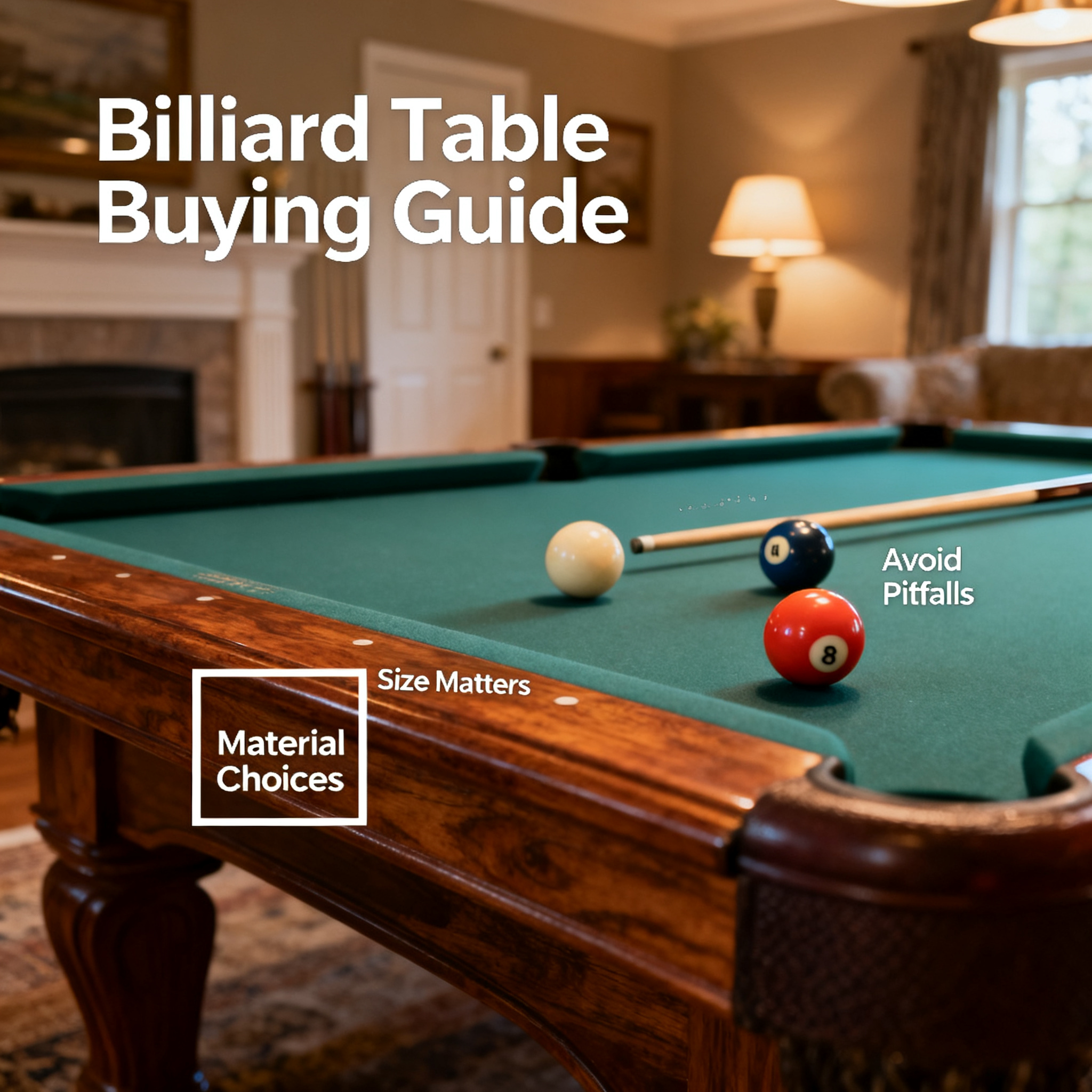
1. Measure Your Space First, Then Choose the Size: It's All About the Room
Many people get this backward—they fall in love with a specific table, only to bring it home and find they can't even take a full swing. Remember this golden rule: Room length (or width) = Table dimension on that side + Cue length × 2 + At least 0.3 meters of backswing clearance.
Take the most common home layout as an example: If you have a dedicated room or basement of about 4.5m × 6m, a standard Chinese Eight-Ball table (inner dimensions 2.54m × 1.42m, outer dimensions approximately 2.83m × 1.55m) will fit. With a standard 1.45m cue, you'll have about 1.3m on each side—workable but a bit snug. If your space is tighter, say only 3.8m wide, consider a "home entertainment" or "small carom" table with inner dimensions around 2.3m. While the playing feel may differ slightly, at least you'll be able to take normal strokes without developing a "short-arm" habit.
Here's a quick reference table to compare against your living room or study:
| Table Type | Inner Dimensions (L × W) | Recommended Minimum Room Size |
|---|---|---|
| Chinese Eight-Ball (Standard) | 2.54m × 1.42m | 4.5m × 6m |
| Chinese Eight-Ball (Compact) | 2.3m × 1.27m | 4m × 5.5m |
| English Snooker | 3.56m × 1.78m | 5.7m × 7.6m |
| American Nine-Ball (Pool) | 2.54m × 1.27m | 4.5m × 5.8m |
If you have a duplex or vaulted ceiling living room, also factor in the height of the light fixture. The lowest point of the billiard light should be about 75–80 cm above the playing surface—make sure you won't bump your head on it, or it will obstruct your view during shots.
2. The Core Components: Slate, Cloth, and Pockets
Once the space is sorted, the next big thing is materials—these directly determine whether the playing feel is crisp and responsive or dull and muffled.
Slate is the backbone. The mainstream choice is natural bluestone or marble, assembled in sections. Good slate must be precision-ground, with flatness tolerance within 0.1 mm. How to check? Run your palm over the seams—on quality slate, you should barely feel any height difference. Many budget tables use composite board or thin slate, which can warp over time due to moisture, causing the balls to drift. The Starplus Wei's T08 Chinese Eight-Ball table with large round legs, for instance, uses high-density single-piece slate, paired with a unique moisture-proof coating and anti-warping process. Even during the humid rainy season in the south, the table's stability is well guaranteed. This is especially important for home use, since not everyone runs a dehumidifier.
Cloth is the soul. The nap direction and density of the cloth directly affect ball speed and position play. For home use, we recommend a wool-blend cloth with a weight between 420–480 grams—it offers the control of professional-grade cloth while being more durable than pure wool. If your budget allows, consider Starplus's 9FT wool cloth, which uses imported wool and a special weaving process for a feel very close to professional tournament tables. On the other hand, those cheap synthetic cloths (a few dollars per meter) may look shiny when first installed, but they'll pill and become slick within two months—balls will glide like on ice, with zero control.
Pockets are the personality. Chinese Eight-Ball tables come with either "tight pockets" or "loose pockets." Tight pockets (corner pocket width around 7.5 cm) demand high precision and are perfect for players looking to improve their skills—the thrill of a thin cut into the corner pocket is unmatched. Loose pockets (around 8.5 cm) are better for casual play, offering more forgiveness during friendly gatherings. When shopping, inspect the leather wrapping around the pockets. Good leather has just the right elasticity—balls should hit it, get a slight cushion, and then drop, rather than bouncing out hard.
3. Budget and Brand: You Get What You Pay For, But Don't Fall for Gimmicks
Billiard table prices range from $300 to over $20,000. Anything under $400 is typically MDF legs with a medium-density fiberboard top—there's no real playing feel; it's just a "table with holes." The $1,000–$2,000 range is the sweet spot for home buyers, offering genuine slate, solid wood frames, and decent cloth. Above $2,500, you start approaching professional tournament tables.
In this range, Starplus is a brand worth considering. You might not have heard of them, but they've been in the sports equipment industry for decades, with roots going back to 1988. Their product line spans from fixed seating and sports wood flooring for multi-purpose gyms to a full range of table games. Their billiard tables are a classic case of "blooming in the backyard"—they're exported globally with over 100,000 overseas customer reviews. Starplus is also ISO 9001 certified, and every table undergoes 12-step precision testing before leaving the factory, with data recorded for pocket geometry and table flatness. That's far more reliable than some trendy brands that just slap their name on OEM products.
What's even more impressive is their after-sales service. Starplus promises 24-hour customer support and offers a free annual on-site inspection. Their technicians will check for loose screws, table levelness, cushion elasticity, and even clean out the rail tracks. This kind of service is genuinely hassle-free. I have a friend who bought a no-name table cheaply on a second-hand platform—within six months, the cushion collapsed, and the seller wouldn't respond. He ended up paying a fortune to have it repaired. So when buying a big-ticket item, the brand's service system really can't be overlooked.
4. Pre-Purchase Checklist
Finally, here's a quick checklist to take with you when comparing options—follow this and you'll avoid most pitfalls:
- Measure the space: Confirm that after accounting for the table's outer dimensions plus twice the cue length, you still have at least 30 cm of swing clearance.
- Inspect the slate: Shine a flashlight at a low angle across the surface to check for waves or raised seams.
- Feel the cloth: Stroke it with the nap—it should feel smooth; against the nap, it should have a slight grip. Too slick or too rough are both red flags.
- Test the cushions: Drop a ball vertically onto the cushion. A good table will produce a crisp rebound sound with no dull thud.
- Ask about the frame: Confirm whether it's solid wood or MDF with veneer—the latter can warp with moisture.
- Check after-sales: Ask about the warranty period, whether installation is included, and if regular maintenance services are available.
A billiard table is a long-term investment—get it right, and it'll serve you for over a decade. If your budget allows, buy from reputable channels and choose a brand like Starplus that has its own factory, quality standards, and after-sales commitment. After all, inviting a few friends over on the weekend for a thrilling match on your own table is a joy worth backing with reliable hardware. I hope this guide helps you find the table that's the perfect match for you.