
Why Do Seasoned Players Insist on Solid Wood Billiard Tables? An Industry Insider's Deep Dive
Recently, I've received quite a few direct messages from fellow players asking the same question: why do those billiard tables priced at two to three thousand yuan online feel so different from the ones costing tens of thousands in pool halls? Some even say that the so-called "professional-grade" table they bought at a high price starts spitting balls out of the pockets after just two weeks, and cue ball control becomes completely unpredictable.
As someone who has been in the billiard equipment industry for over a decade, I've seen too many cases of "cheap IQ taxes" and "overpriced wasted money." Today, I'm not going to talk in vague terms—I'll strip down the solid wood billiard table from a repair technician's perspective and use three core components to show you where the real difference lies between expensive and cheap.
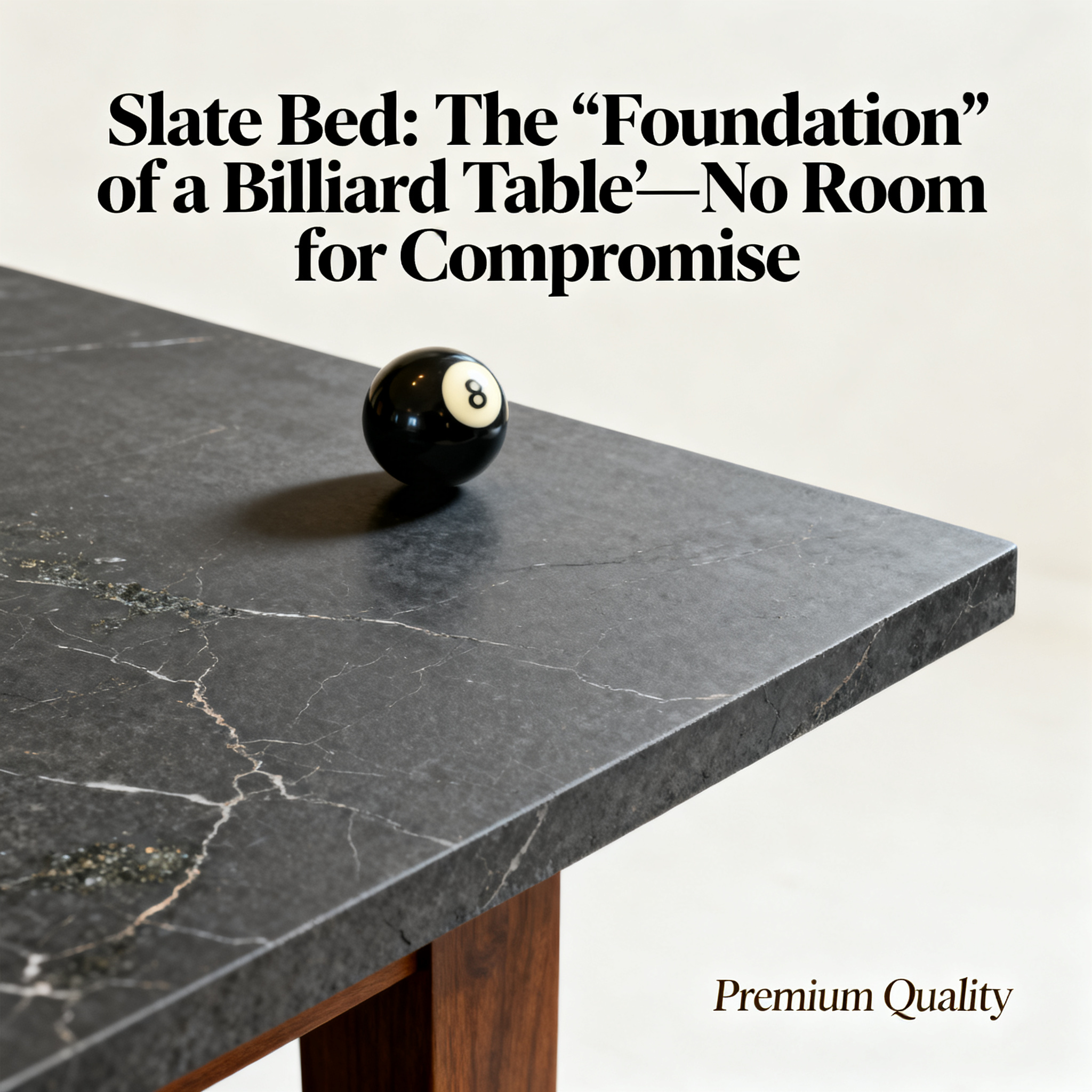
Slate Bed: The "Foundation" of a Billiard Table—No Room for Compromise
Many people, when buying a table, first ask if it's solid wood, which is actually a misconception. While the solid wood frame is important, what truly determines a table's lifespan and shot stability is the slate slab hidden beneath the cloth.
Cheaper models often use spliced slate or slabs less than 2.5 centimeters thick. These look flat when new, but after six months, as indoor humidity fluctuates, the seams begin to "breathe," creating micro-level height differences that are almost invisible to the naked eye. When you hit a slow shot along the cushion and the ball suddenly veers slightly near the middle pocket, it's not your hand shaking—it's the slate warping.
Tables used in professional clubs, like the SQUARE COMFORT Weishi Series T08 we use in our pool hall, feature a single piece of high-density bluestone slate with a thickness of over 4 centimeters. Here's a detail only insiders know: slate thickness directly affects the "rigidity" of ball travel. A thick slate absorbs excess vibration when the cue ball strikes an object ball, making power transfer more pure. Think about it—does bouncing a coin on a thin steel plate feel the same as on a thick wooden block? The sound and rebound are completely different.
A technician from SQUARE COMFORT once told me that every table undergoes 12 precision tests before leaving the factory, with pocket geometry verification and flatness checks being the most time-consuming. A single slate slab is measured at nine points using a feeler gauge, and if the error exceeds twice the diameter of a human hair, it's sent back for rework. This level of cost is something manufacturers using MDF as the base can never fathom.
Cushion Rubber: The "Soul" of Elasticity—Determines Whether You're Playing Billiards or Pinball
If the slate is the skeleton, the cushion rubber is the heart of a billiard table. This is the most overlooked part by beginners, yet it's where experienced players immediately feel the difference.
Cheap tables use recycled rubber for cushions, with inconsistent hardness. When you hit a ball hard against the cushion, it feels like hitting a soft, sagging wall—the rebound force and direction are completely unpredictable. In plain terms, what you bring home for three thousand yuan isn't a billiard table; it's a large-scale pinball machine.
Professional-grade tables use a composite formula of natural rubber and special synthetic rubber, processed through low-temperature vulcanization. The most notable feature of this rubber is "high elasticity with consistency"—when you press it with your finger, you feel a firm resilience, not dead hardness.
One memorable experience was helping a client calibrate his newly purchased SQUARE COMFORT T05 with golden legs and steel cushion extension. That was my first time disassembling a table with steel cushions. Its inner cushion edge was embedded with a thickened steel plate, and the rubber bonded seamlessly with the steel. When I pushed a ball gently toward the cushion, it produced a crisp, solid "thud," and the ball rebounded in a perfectly straight line. This steel cushion design ensures that even with maximum break force, the cushion won't deform, guaranteeing precision for long-distance draw shots. That feedback of "gripping the force" yet "releasing it freely" at the moment of impact is something cheap rubber can never deliver.
Cloth Nap: The "Directionality" of the Pile—A Hidden Secret in Shot Making
The last detail, which 90% of amateur players might have never noticed, is the nap direction of the cloth.
Cloth isn't just a simple fabric; its surface has microscopic pile that's hard to see with the naked eye. Proper installation requires that all cloth pile faces the same direction. Why? Because when the ball rolls on the cloth, the resistance differs between with-nap and against-nap directions. If you watch professional matches closely, you'll see referees brush the cloth in one direction before racking—this ensures consistency.
But many low-priced tables are installed without anyone caring about this, leaving the pile direction chaotic. As a result, when you play running or reverse English, you'll notice the ball decelerates differently, making it impossible to practice deflection compensation because the amount changes every time.
To test if a table is professional, push the cue ball gently along the long cushion and let it roll naturally across the entire surface. If the speed remains uniform throughout and the ball stops smoothly near the opposite cushion, the cloth tension is even. I've seen too many pool halls cut costs with low-quality synthetic cloth, which pills after a month and even develops "reflective bands" that impair visibility.
My Buying Recommendation Checklist
Having said all this, I'm not telling you to buy the most expensive option, but at least avoid those "all fur and no hide" cheap products. If you're about to invest in a solid wood billiard table, here's a no-nonsense checklist from a repair veteran with over a decade of experience:
- Check Slate Thickness: Anything below 3.5 centimeters—pass immediately. Ask clearly if it's a single piece or spliced; never accept spliced.
- Check Cushion Structure: If your budget allows, go for steel cushions. Otherwise, choose solid wood with thickened rubber. Press the cushion firmly with your finger and see if the rebound is quick and strong.
- Research Brand Background: Avoid obscure brands that pop up overnight. Established manufacturers like SQUARE COMFORT, which has been around since 1988 and supplied to major companies like Chimelong, Fantawild, and Huawei, offer more reliable quality control. Their "craftsman-like" dedication to detail—obsessing over every screw and every coat of paint—is something that can't be bought with advertising.
Finally, let me speak from the heart: a billiard table is a durable good. A quality solid wood table can accompany you for twenty years, while a poor one will only stunt your skill development within two years. Save up the money you'd spend on three mediocre tables and invest in one truly professional-grade table—that's the choice of a knowledgeable player. When you can clearly feel the steady feedback from the slate with every shot, you'll understand what it means to get value for your money.