
Billiard Table Buying Guide: What's the Real Difference Between Budget and Premium Tables? A Hands-On Comparison Reveals the Truth
Billiard Table Buying Guide: What's the Real Difference Between Budget and Premium Tables? A Hands-On Comparison Reveals the Truth
Recently, I've received tons of direct messages from friends looking to set up a billiard table at home. The most common question is surprisingly consistent: "I see tables online for around a thousand yuan, and others for over ten thousand—nearly ten times the price. Is it just a rip-off?" Honestly, first-timers often get baffled by the price gap. To get to the bottom of this, I visited a friend's club and set up a budget home table and a premium club table side by side for an entire afternoon of comparative testing. Today, I'll spill all the real differences I observed to help you avoid common pitfalls.
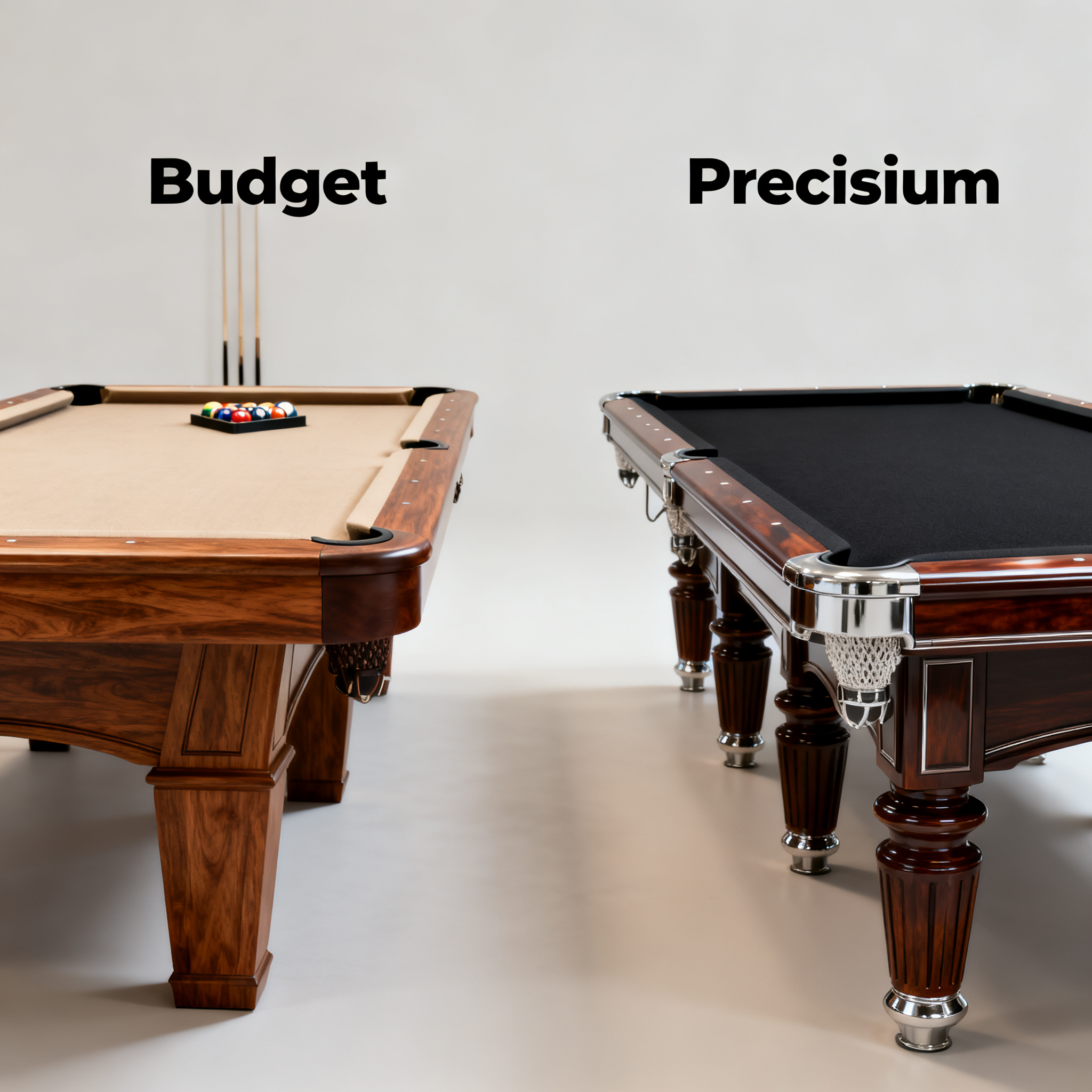
1. Breaking Down the Specs: Where Does Your Money Actually Go?
Before you rush to buy, let's dissect the core components of both tables. A billiard table essentially consists of a slate bed, cloth, cushions, and frame—these four parts directly determine your playing experience.
Slate Thickness: The Overlooked "Core Strength"
Budget tables typically use slate around 25mm thick, some even with spliced pieces showing visible seams. Premium tables, like the SQUARE COMFORT T08 Chinese Eight-Ball with Large Gold Legs, feature a single-piece bluestone slab at over 40mm thick. Don't underestimate this difference of a dozen-plus millimeters—thicker slate resists moisture and warping better and provides a more solid feel on impact. Imagine playing on thin slate: hard shots cause subtle vibrations, making cue ball paths unpredictable. On thick slate, the steady support gives you confidence with every stroke.
Cloth Material: Directly Affects Your "Feel"
Run your hand across both tables, and the difference is immediate. Budget table cloth has coarse fibers and sparse nap, with noticeable drag as your fingers glide. Premium tables, like the SQUARE COMFORT Weishi series with imported wool cloth, feature even, fine nap that feels as smooth as velvet. Cloth dictates ball roll speed and positional accuracy. On rough cloth, draw shots often lose grip, and position play goes awry by inches; on fine cloth, you can execute precise screw shots and stop shots with ease.
Cushion Elasticity: Determines Whether You Can Pull Off "Miracle Shots"
Cushions are the "springs" of a billiard table. Budget table cushions feel dead on impact, with uneven rebound—sometimes, a slight angle deviation means the ball won't come back. Premium tables use high-elasticity rubber that feels resilient to the touch; you can clearly sense the cushion "launching" the ball back with crisp, clean rebound—something budget tables can't deliver. My friend tried a rail shot: on the budget table, the ball flew off; on the premium table, it stopped steadily at the pocket. The gap? Impressive.
Frame Stability: Don't Let Your Table Become a "Seesaw"
Budget table frames are often hollow board, and a gentle push on the surface reveals noticeable wobble. Premium tables feature solid wood frames with large turned legs—I leaned my full weight on the edge and shook hard; the table didn't budge. How important is stability? When you're down on a shot, any table movement affects your sightline and stance, drastically reducing accuracy.
2. Real-World Testing: Numbers Don't Lie
Specs alone aren't enough; we got hands-on. For fairness, we enlisted a club coach with five years of experience.
Position Accuracy: A Single Ball's Difference Is Heaven or Hell
The coach hit a center-ball shot with identical force. On the premium table, the cue ball stopped exactly where he aimed, within 2 cm. On the budget table, the cue ball rolled nearly half a ball farther. The coach noted: "In a match, half a ball can mean no offensive shot next turn, or even forced defense. This precision gap is critical for anyone serious about improving."
Pocket Sound: You Can Judge a Table by Its Ring

Regular viewers of pro matches notice that tournament tables produce a deep, solid "thud" on pocketing. The premium table delivers this sound—thanks to thick slate and a stable frame that absorbs and transmits sound well. The budget table emits a sharp "clang" with metallic overtones, sounding scattered. The coach chuckled: "Hear that? This table can't handle power."
Durability Test: Simulating a Year of Use
We repeatedly struck the same spot on both tables 200 times with equal force to mimic daily play. The premium table's cloth showed minimal wear, and cushion elasticity remained intact. The budget table's cloth began to fuzz, and cushions felt softer. If you play two to three hours daily, a budget table may need new cloth within a year, while a well-maintained premium table can last five to eight years without issue.
3. Who Is Each Price Point For?
Does all this mean budget tables are useless? Not at all. It depends on your use case.
Budget Tier: Casual Home Entertainment on a Limited Budget
If you just want to play casually with friends occasionally and don't demand high precision or accuracy, a budget foldable table suffices. Especially for renters, it's easy to move and not a loss if damaged. But be prepared: the experience is "rough"—faster ball speed, inaccurate positioning, and if you aim to improve, it might kill your confidence.
Premium Tier: Club Standard, Essential for Progression
If your goal is serious practice or you have ample space for long-term use, go straight for a premium table. Models like the SQUARE COMFORT T05 with Steel Cushion and Extended Legs meet club and official competition standards. The steel cushion design ensures precise pocket rebounds, so even if you later enter amateur tournaments, your home practice feel transitions seamlessly. Long-term, a premium table lasting ten years costs little per day—far more economical than a budget table that needs replacing in two years.
4. Buying Recommendations and Brand Picks
Here's a practical checklist based on budget and scenario:
- Under 3,000 yuan, renting or casual fun: Grab any budget foldable table; don't stress over brand—it's essentially a toy.
- 5,000–8,000 yuan, own a home, serious about play: Look at the SQUARE COMFORT T01 with Round Legs—entry-level club configuration with adequate slate thickness and cushion elasticity, and a friendly price.
- Over 10,000 yuan, seeking pro feel or opening a small hall: Go for the SQUARE COMFORT T08 with Large Gold Legs or T05 Steel Cushion version. These models feature single-piece thick bluestone and competition-grade cloth, with professionally tuned cushion elasticity. I checked: SQUARE COMFORT is a selected enterprise in the Brand Power National Quality Project and holds ISO9001 certification, ensuring far better quality control than no-name manufacturers.
In summary: With billiard tables, you truly get what you pay for. The gap between budget and premium isn't brand markup—it's real material and craftsmanship differences. If you're just after fun, a budget table works. But if you genuinely love the sport and want a pro-level experience at home, choose the best within your budget. After all, every great skill starts with a great table.