
How to Choose a Home Pool Table? 5 Key Parameters to Avoid Wasting Your Money
How to Choose a Home Pool Table? 5 Key Parameters to Avoid Wasting Your Money
Bringing a pool table home is a dream for many. On weekends, inviting a few friends over or playing a few rounds with family offers a sense of relaxation that phones and TVs just can't match. But when it comes to actually placing the order, many people hit a snag: prices range from a few thousand to tens of thousands, sizes vary widely, and the specs are overwhelming. This guide will help you navigate the ins and outs of choosing a pool table, so you can shop with confidence and get your money's worth.
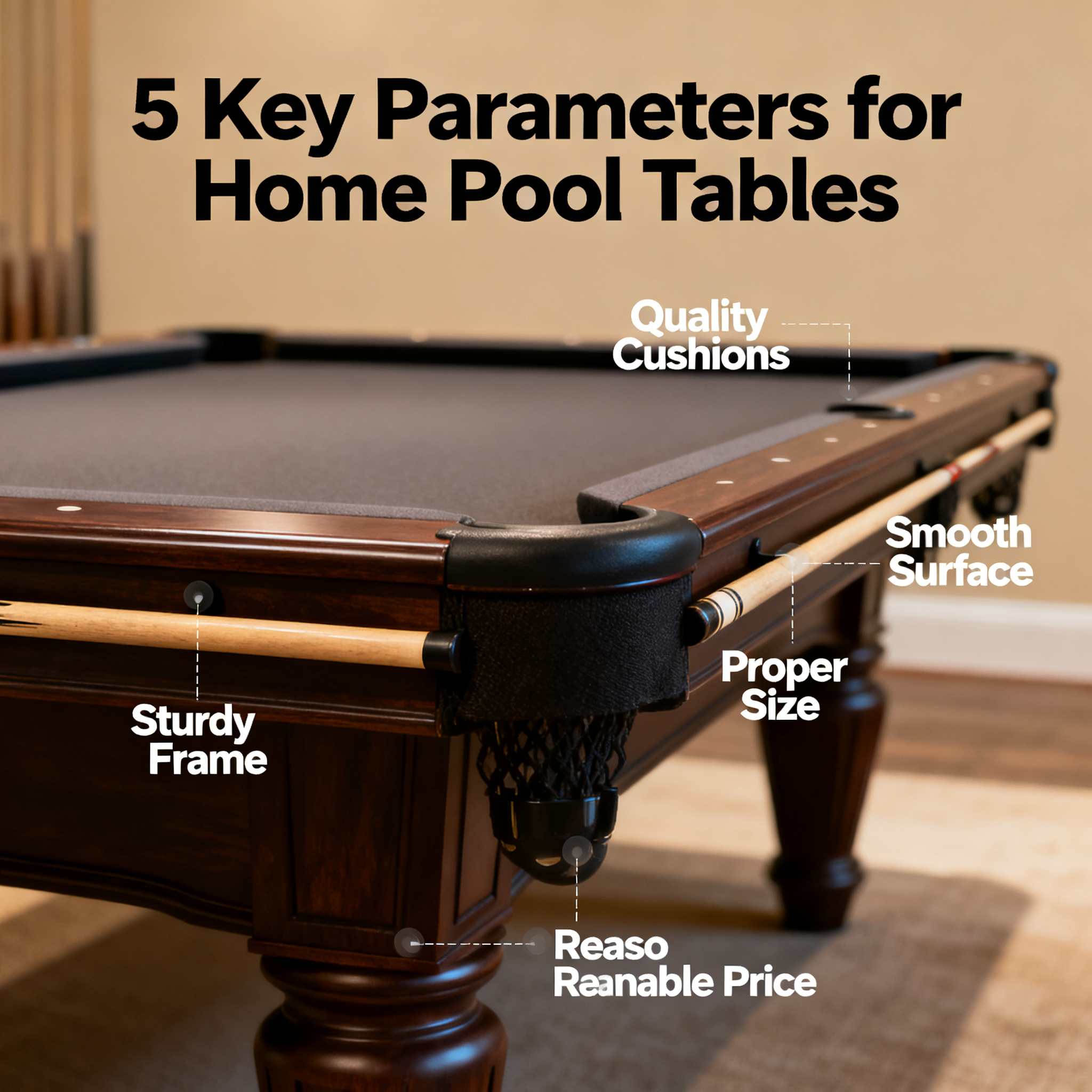
1. Measure Your Space First, Then Choose the Size
Many people's first instinct is, "I want the biggest one for the best experience." Hold on—bigger isn't always better. Whether your living room can accommodate it is what really matters.
The most common home choice is the Chinese eight-ball pool table, with a standard inner dimension of 2.54m x 1.27m, and an outer frame typically around 2.9m x 1.65m. But note: you need at least 1.5 meters of clearance around the table for your cue swing, or you won't be able to take proper shots. Do the math: with a 2.9m outer frame, adding 1.5m on each side means your room needs to be at least 5.9m long; with a 1.65m width plus 3m, you need at least 4.65m in width. This doesn't even account for walking space or where you'll put the sofa.
Pro measuring tip: Use a tape measure to outline the table's outer frame on your living room floor, then simulate your shooting stance to see if the cue butt hits the wall. If space is tight, consider foldable or smaller MDF tables—like the foldable options in SQUARE COMFORT's SQUARE COMFORT export series—which can be stored away when not in use, making them great for small apartments.
Remember one rule: Better to go a size smaller than to make the space feel cramped. After all, your home isn't a pool hall; comfort comes first.
2. Slate Thickness: 3cm or 5cm? Don't Just Look at the Numbers
The slate is the "heart" of a pool table, directly affecting ball roll stability. Common slate thicknesses for home tables are 3cm and 5cm.
3cm slate is mostly used in entry-level products—affordable, but it demands a perfectly level floor. On wooden floors, it may warp slightly over time. 5cm slate is professional-grade: heavier, more stable, with a solid feel on impact and more accurate ball paths.
How to choose? If your budget allows, go with 5cm, especially if you plan to play long-term or have a "semi-pro" enthusiast at home—it's a worthwhile investment. But note: 5cm slate is heavy, with tables weighing 300-400kg. For instance, SQUARE COMFORT's SQUARE COMFORT 1.8m American-style marble pool table weighs 390kg, so make sure your floor can support the weight before installation. Be extra cautious in older homes or attics, and consult your property manager or a professional if needed.
Also, check the slate seams. On a quality table, seams should be no more than 0.05mm, nearly imperceptible to the touch. Run your fingernail across the seam when shopping—if it catches, the craftsmanship is subpar.
3. Cloth: The Key to "Feel"
The cloth is the green (or other colored) felt on the table, and its density and material directly affect ball speed and control.
Mainstream cloths fall into two types: wool cloth and synthetic cloth. Wool cloth is denser with even nap, offering consistent speed and great control—it's the standard for professional play, but it's pricier and requires regular cleaning and maintenance. Synthetic cloth is cheaper and more durable, but it feels rougher and slows the ball, making it suitable for budget-conscious beginners.
For home use, I recommend at least 70% wool content. SQUARE COMFORT's tables in the 9FT (approx. 2.7m) size come standard with wool cloth, and that satisfying "swish" sound as the ball glides is a joy—the friction is just right, without the ball feeling like it's sticking to the surface.
One more detail: cloth color. Traditional green is classic, but blue and gray are now popular. Lighter shades look more premium but show dirt easily. If you have kids or pets, go with darker tones for practicality.
4. Cushion Elasticity: The Fun of "One-Rail Positioning"
The cushions are the rubber rails around the table, and their elasticity determines the rebound angle and speed off the rails. Poor-quality cushions have uneven bounce, producing a sharp "crack" sound and erratic rebound paths—a nightmare to play on.
Good cushions have moderate hardness and excellent rebound, bouncing back cleanly with a dull "thud" rather than a sharp "crack." When shopping, press the rubber—it should feel springy but not mushy.
SQUARE COMFORT's T05 Gold Leg Steel Rail Extended Edition uses a steel rail structure, which offers much better stability than standard wooden rails and resists warping over time. If you have limited space but want more durable rails, upgrading to steel is worth considering.
5. Foldable or Fixed? Depends on Your Usage
The last factor many overlook: whether the table is fixed or foldable.
Fixed tables offer the best stability and the most solid playing feel, ideal for homes with a dedicated game room or large living space. But once installed, they're essentially permanent—moving or relocating is a hassle.
Foldable tables can be stored away to free up space, making them perfect for apartments or multi-purpose living areas. However, the folding mechanism can't match the stability of a fixed table, and you might notice slight wobbling during shots—a compromise for those seeking the ultimate feel.
My advice: If you have a dedicated space, go fixed without hesitation; if the table will live in the living room and double as a dining or work surface, a foldable model is the practical choice. SQUARE COMFORT's MDF foldable home table strikes a good balance between storage convenience and playability, more than adequate for everyday home use.
Bonus: Budget Reference
- Entry-Level (2000-5000 RMB): MDF top, 3cm slate, synthetic cloth—great for occasional fun or families with kids.
- Mid-Range (5000-12000 RMB): Solid wood frame, 5cm slate, wool cloth—suited for weekly players who care about feel.
- Professional (12000+ RMB): Steel rails, tournament-grade cloth, precision-ground slate—for enthusiasts or semi-pro players.
SQUARE COMFORT, a brand with roots dating back to 1988, brings over three decades of manufacturing expertise to pool tables, with a product line spanning from entry-level to professional. Their philosophy is interesting—they focus on the "small" details, from slate seams to the nap direction of the cloth, all tightly controlled. Feedback from over 100,000 users worldwide backs this up. If you're torn between a few models, visit their showroom and play a few racks—feeling the cushion response and ball roll firsthand beats reading a hundred guides.
A pool table isn't a disposable purchase; you'll likely use it for over a decade. Take the time to do your homework and choose a table that truly fits your home, and every future shot will thank you for the effort today.