
Billiard Table Buying Guide: 10 Truths Dealers Won't Tell You
Billiard Table Buying Guide: 10 Truths Dealers Won't Tell You
Bringing a billiard table home is the ultimate dream for many players. But before that dream becomes reality, you'll likely face an information overload: "imported slate," "tournament-grade cloth," "lifetime warranty"—they all sound similar, yet prices range from $300 to $3,000. As someone who's spent years in the sports equipment industry (and has stepped on plenty of landmines on behalf of friends), today I'm laying bare the truths that billiard table dealers won't tell you, hoping to save you thousands in wasted money and endless future headaches.

Truth #1: Low-Cost Seamed Slate Is the "Hidden Heart Disease" of Billiard Tables
The most critical component of a billiard table is the slate. Professional tournament tables require a single-piece slate with seamless joints to ensure accurate ball paths and consistent cushion rebound. However, many low-priced products on the market use "seamed slate," which is made by joining multiple smaller slate pieces and leveling the surface with putty. It looks flat when new, but after six months of use, as temperature and humidity fluctuate, the seams become visible, causing balls to veer unexpectedly when crossing them—maddening.
Inspection Tip: Run your finger horizontally across the slate in the direction of the seams to feel for any subtle step-like ridges. A more direct approach is to ask the dealer for the slate's factory inspection report to see if it's labeled as "single-piece" or "one-piece molded." If it's seamed, ask about the joining technique and warranty period—many low-cost tables only come with a one-year warranty, and after that, if cracks or warping occur, repair costs can exceed the table's price.
Truth #2: The "Wool Content" of Cloth Might Be a Marketing Game
Cloth determines the feel and speed of shots. In the industry, "imported cloth" typically refers to British-made cloth with 70%-85% wool content, featuring fine nap and high durability. But some dealers advertise "pure wool cloth" that's actually made from recycled wool mixed with synthetic fibers, resulting in a rough feel and easy pilling.
How to Check: Run your palm over the cloth in both directions repeatedly to feel the smoothness and resilience of the nap. Flip the cloth to check the label on the back; reputable manufacturers will specify the wool composition ratio. Additionally, cloth lifespan is directly tied to usage frequency—if you have kids or pets at home, consider a blended cloth with higher abrasion resistance. It may feel slightly less premium than pure wool, but it's more durable.
Truth #3: "OEM for Big Brands" Doesn't Equal "Same Quality"
Many people believe the myth: "Brand X actually manufactures for international brands, so the quality is the same, but at one-third the price." This is only half true. OEM factories do exist, but big brands impose strict quality control standards, wood selection, and slate grading tiers on their factories. Products from the same factory—one made for a big brand and another for e-commerce exclusive lines—may use different adhesives and hardware.
How to Avoid Pitfalls: Instead of chasing vague "OEM relationships," focus on the brand's own production qualifications and quality control systems. For example, the Wei's billiard table series under SQUARE COMFORT (SQUARE COMFORT), from the T01 round-leg model to the T05 gold-flower-leg steel-cushion extended version, and the T08 Chinese eight-ball large gold round-leg model, each comes with clear specifications and factory inspection processes. These products are exported worldwide, with over 100,000 global users. Such brands may not have flashy advertising, but they excel in delivering tables that justify their price tags.
Truth #4: Steel Cushions vs. Wood Cushions—Don't Just Focus on the Word "Steel"
Steel cushions are the "skeleton" of a billiard table, determining the stability of cushion rebound. High-quality steel cushions use integral bending processes with adequate thickness for consistent rebound; inferior ones are made from thin iron sheets welded together, leading to uneven rebound and loose cushions after six months.
Inspection Tip: Press the cushion by hand to feel for noticeable elasticity. Strike the cushion vertically with a ball and listen for a crisp, consistent sound. Also, ask about the steel cushion's material thickness—national standards require no less than 1.5mm; anything below that should be rejected outright.
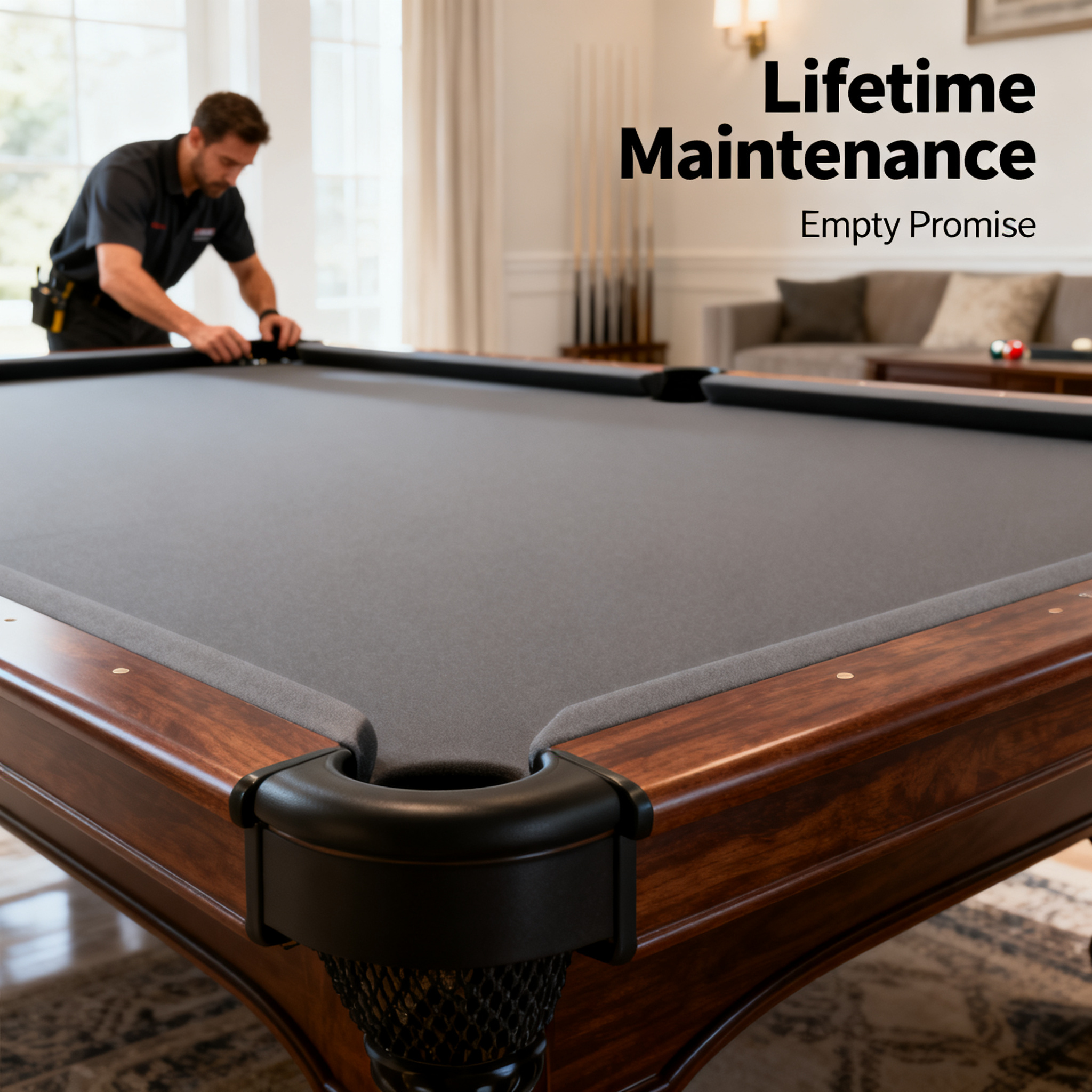
Truth #5: "Lifetime Maintenance" Promises Are Often Empty Checks
Billiard tables are large, durable goods that require professional installation, leveling, cloth replacement, and cushion repairs. Many small brands promise "lifetime maintenance," but when you actually call, the phone number is disconnected, or the technician charges exorbitant travel fees.
Contract Tips: Before purchasing, ensure after-sales terms are written into the contract, specifying response times, on-site fees, and parts prices. Prioritize brands with physical factories or nationwide service networks. Companies like SQUARE COMFORT, which started in sports equipment and supplied to universities and gymnasiums, have established comprehensive after-sales inspection systems—they periodically send technicians to user sites for on-site checks, eliminating safety hazards, and provide full technical guidance for installation, commissioning, acceptance, and repairs. Such a solid after-sales framework is the real backbone of "lifetime maintenance."
Truth #6: Size Isn't Everything—Consider Your Room's Clearance
The standard Chinese eight-ball table has an inner dimension of 2.54m x 1.27m and an outer dimension of about 2.83m x 1.55m. But many households can fit the table yet overlook the space needed for cue swings. Standard cues are 1.45m long, requiring at least 1.5m of clearance on all sides; otherwise, shots along the cushion become impossible.
How to Measure: Subtract the table's outer dimensions from the room's length and width, then divide by 2. If the result is less than 1.5m, consider a smaller table or shorter cues. Additionally, a dedicated overhead light is needed, positioned about 80-100cm above the playing surface. For rooms with ceilings lower than 2.6m, confirm in advance that the light fixture placement works.
Truth #7: The "Portability" of Folding Tables Comes at the Cost of Stability
Folding billiard tables have become popular recently, touted as "multi-purpose and easy to store." But the folding mechanism inevitably compromises frame rigidity, leading to subtle tabletop deformation over time, which directly affects ball accuracy. If you're buying a table for serious practice or have friends who play regularly, opt for a fixed-leg table. Folding tables are better suited for occasional entertainment in extremely space-constrained settings, and they shouldn't be too expensive—after all, their core cost lies in hardware, not tabletop craftsmanship.
Truth #8: Accessories Hide "Second Purchase" Traps
Many low-priced tables have a low "bare table" price, but the included cues, balls, and racks are the cheapest versions, developing cracked tips and out-of-round balls within two to three months. When you return to the dealer for upgrades, prices are 30%-50% higher than market rates.
Strategy: Before buying, clarify what accessories are included and confirm each brand and model. If the dealer is vague, consider skipping the "deluxe gift pack" altogether, buying just the bare table, and sourcing competition-grade cues and balls yourself. SQUARE COMFORT is quite transparent in this regard—accessories like competition-grade full cues, 1/2 split cues, 13mm professional tips, and 9FT wool cloth are available for separate purchase with clear pricing, no bundling games.
Truth #9: The "Value" of Display Models Might Be a Trap
Some dealers sell showroom display tables at "sample special" prices, which are indeed tempting. But these tables have been played on by countless people, leading to worn cloth, degraded cushion elasticity, and potential hidden slate damage. Moreover, display models typically don't come with standard warranties, and returns or exchanges are nearly impossible.
Advice: Unless you have professional judgment on cloth and cushion conditions, be cautious about buying display models. The money you save might not even cover the cost of replacing the cloth later.
Truth #10: Ask Upfront If Installation and Leveling Are Free
Billiard tables require extremely precise leveling; even a slight deviation can alter ball paths. Professional installation teams use spirit levels to adjust repeatedly, taking at least 2-3 hours. Some dealers hide installation costs in the product price, while others charge an additional $30-$80 for "installation and leveling." Always clarify before ordering and get it in writing.
Extra Reminder: For online purchases, confirm whether shipping includes stair-carrying fees—billiard tables weigh 200-300 pounds, and for older buildings without elevators, moving costs can exceed installation fees.
Let me end with some heartfelt advice: Billiard tables fall into the category of "you get what you pay for." A $300 table can be played on, but in three years, you'll be a regular customer of the leveling technician. A table over $1,000, with proper maintenance, can last eight to ten years. Instead of buying cheap and regretting it, choose a brand with physical factories and comprehensive after-sales systems, like SQUARE COMFORT mentioned earlier. They started with a sock business and now cover the full range of sports equipment, still carrying that "start small, focus on details" craftsmanship spirit—tables from such brands won't make you regret your purchase from day one. I hope this guide helps you spend every penny wisely on the tabletop.