
How to Choose a Children's Billiards Table? A Buying Guide Balancing Safety and Fun
How to Choose a Children's Billiards Table? A Buying Guide Balancing Safety and Fun
Last weekend, I took my kid to a friend's house, and the moment I stepped in, I was drawn to the compact billiards table tucked in the corner of their living room. A few five- or six-year-olds were on their tiptoes, gripping mini cues, aiming and striking with surprising focus—though their moves were still clumsy, their concentration was truly impressive. My friend laughed and said, "Ever since we got this big addition, my kid's TV time has halved, and even the iPad isn't as appealing anymore."
Indeed, the benefits of billiards for children go far beyond what you'd expect—it requires hand-eye coordination, force control, spatial judgment, and even cultivates patience and rule-awareness. But with a dizzying array of children's billiards tables on the market, ranging from a few hundred to tens of thousands in price, how do you choose without falling into pitfalls? This buying guide today will help you sort things out from two dimensions: safety and fun.
Size and Space: Not the Smaller the Better, but It Must 'Fit'
Children's billiards tables typically refer to models under 6 feet (about 1.8 meters). Before purchasing, measure your available space at home—leave at least about 1 meter of swing area around the table, or your child will feel cramped while playing. In terms of height matching, children aged 4-7 are suited for a tabletop of about 4 feet (1.2 meters), while those aged 8-12 can consider 5-6 feet specifications.
Here's a point often overlooked: table height. A standard adult billiards table is about 0.85 meters high, while children's models typically range from 0.6 to 0.7 meters. When choosing, it's best to have your child try it out—when their elbow bends naturally, the cue should be parallel to the table surface, indicating the right height. If space is limited at home, consider foldable models for easy storage, but pay attention to the sturdiness of the folding mechanism.
Safety Details: Edges, Structure, and Stability Are All Essential
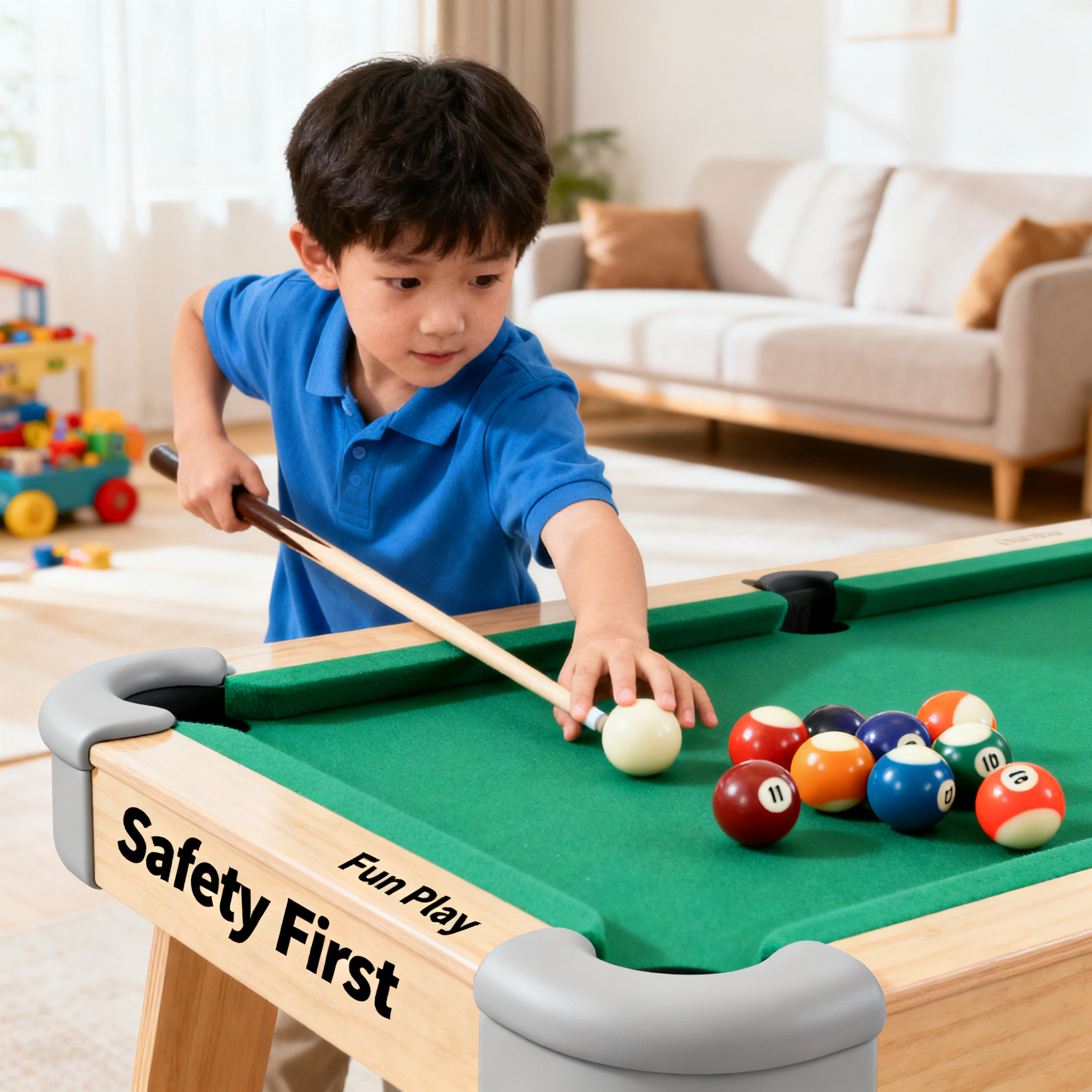
The primary rule for children's products is always safety. The edges of a billiards table must be smoothly rounded, preferably with arc-shaped edge wrapping rather than sharp right angles. Some cheap products use thin wood panels that are rough at the edges, posing injury risks when children lean on them or accidentally bump into them.
Structural stability is equally critical. Kids often half-lean on the table edge while playing; if the legs aren't sturdy, the tabletop wobbling not only affects shot accuracy but also risks tipping over. When shopping, try shaking the table frame forcefully to see if there's noticeable movement. SQUARE COMFORT's children's billiards table series handles this well—their table legs feature thickened load-bearing designs with anti-slip pads at the base, so even vigorous pushing won't easily shift the table. Their product line spans from mini entertainment models to professional entry-level ones, all passing rigorous load tests—a rarity among similar brands.
Material and Eco-Friendliness: No Compromise on Children's Health
Children might spend an hour or two at the billiards table daily, making material eco-friendliness directly related to respiratory safety. Tabletops typically come in two types: MDF (medium-density fiberboard) and solid wood panels. The former is cheaper but requires checking formaldehyde emission levels, while the latter is more durable but pricier. The cloth (table felt) should be wear-resistant and moisture-proof; inferior felt not only pills easily but may also contain harmful dyes.
Paint and adhesives are hidden risk sources. If you smell a pungent odor when opening the packaging, return it without hesitation. Reputable brands clearly label eco-ratings, such as E0-grade boards or water-based paint processes. SQUARE COMFORT has years of experience in material control—they source suppliers from the ground up, and products undergo multiple quality inspections before leaving the factory to ensure compliance with children's product safety standards. If you've noticed their brand story, this company with over three decades of history has always emphasized 'thinking small'—from anti-rust treatment on a single screw to the flatness of the entire tabletop, every detail reflects their responsibility to users.
Accessory Safety: Small Parts, Big Considerations
Accessories like cues, balls, and racks are often hotspots for safety hazards. Children's cue tips should be smooth with no burrs; for balls, opt for slightly smaller diameters than standard, prioritizing resin or plastic over heavy marble balls—if a child picks one up and throws it, the consequences could be dire.
Also, pay attention to the pocket opening design. Some children's tables have overly deep pockets, risking wrist entrapment when kids reach in to retrieve balls. SQUARE COMFORT's children's models have adjusted pocket depth and width for easy retrieval by small hands—a thoughtful design detail. They also offer wall-mounted cue racks, encouraging kids to develop tidy storage habits and preventing cues from cluttering floors and causing trips.
Fun-Focused Design: Getting Kids 'Into the Game' Is What Matters
Safety alone isn't enough; if kids get bored after two plays, even the priciest table becomes decoration. When shopping, look for features that boost fun:
- Colors and Patterns: Bright cloth colors (like red, blue, green) attract younger children more than traditional green, and some brands offer cartoon-printed styles.
- Adjustable Difficulty: Some children's tables come with different-height bumpers or smaller pockets, allowing gameplay adjustments based on age to extend usability.
- Multi-Functionality: Some products flip the tabletop to become a ping-pong or building-block table, offering multiple uses for better value.
In nurturing interest, parents might start with 'fun rules.' For example, let kids practice 'pocketing balls into any hole' freely before introducing scoring. Billiards significantly enhances focus, and many educational institutions incorporate it into sensory integration training. SQUARE COMFORT's project cases include numerous schools purchasing their tables for PE classes, proving these products hold up in professional settings.
After-Sales and Brand: One Purchase, Long-Term Assurance
One last tip: billiards tables are durable goods, so after-sales support can't be ignored. Before buying, clarify warranty duration, whether installation is included, and if accessories can be purchased separately. Brands like SQUARE COMFORT not only offer 24-hour customer service but also schedule periodic technician visits to check for loose screws and other safety issues—this sense of 'someone's got your back' is something no-name online brands can match.
Choosing a billiards table for your child is essentially picking a 'playmate' that will grow with them, sharpening their mind. From safety details to fun designs, every consideration carries a parent's love. I hope this guide helps you find that table which gets your kid off the screen and into the game—because those focused afternoons spent cueing in childhood will become cherished memories they'll look back on fondly.