
What's the Difference Between a $700 and a $7,000 Billiard Table? An In-Depth Look at Value for Money
What's the Difference Between a $700 and a $7,000 Billiard Table? An In-Depth Look at Value for Money
Over the weekend, I tried out a friend's newly opened billiard hall. He splurged on a competition-grade table costing over $7,000. The playing experience was indeed stunning—the smoothness of the stroke, the rebound off the cushions, and the speed of the cloth were a world apart from the few-hundred-dollar tables I used to play on at the billiard hall near my office. But then I looked at my own "entry-level" table at home, which cost around $700, and it didn't seem all that bad. The price difference is nearly tenfold—so where does the extra money actually go? Do casual players really need to chase high-end gear? Today, let's strip down the billiard table to its bare essentials.
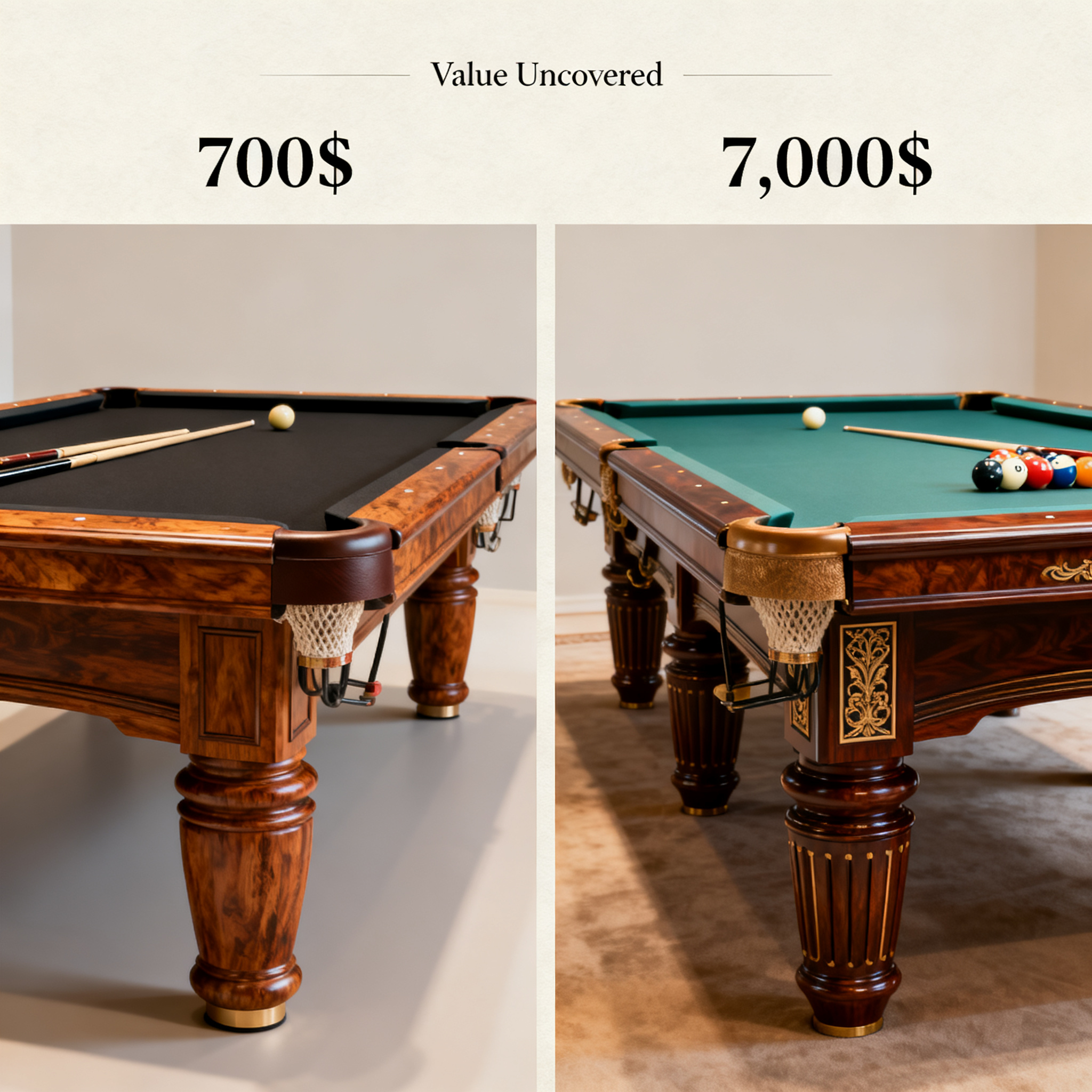
Breaking Down the Costs: Where Does the Money Go?
At its core, a billiard table consists of four key components: the slate, the wood, the cloth, and the craftsmanship.
The slate is the soul. A $7,000 competition table uses marble or bluestone that undergoes machine grinding plus manual fine-tuning, with flatness errors controlled to within a hair's breadth. If you use a level, the entire playing surface is nearly perfect. In contrast, a $700 table might have slate that's only roughly polished—it looks flat to the naked eye, but there are subtle height differences. When the ball rolls, light shots will drift off-line, and heavy shots will bounce irregularly. Beginners might not notice this, but after a year or two of play, once you start demanding precision, you'll find the table "disobedient."
The wood determines stability. High-end tables use hardwood for the legs and frame, such as oak or maple, which are dense, strong, and resistant to moisture-induced warping. Some even feature multi-layer reinforced structures to prevent frame distortion over long-term use. To cut costs, low-priced tables often use pine or even laminated boards. They seem fine when new, but after a year or two—especially in humid southern climates—they're prone to warping, leading to an uneven playing surface and loose cushions. So where's the difference in money? It's in the skeleton you can't see.
The cloth is key to feel. Competition-grade cloth (like UK's Strachan 6811) costs several hundred dollars per square meter. Its fine, uniform nap ensures stable ball speed and responsive spin. Ordinary cloth costs just a few dollars per meter; after a few months, it pills and becomes tacky, slowing down the ball and muddying the effects of English. When shots feel "sticky," it's not your technique—it's the cloth holding you back.
Craftsmanship is the final gatekeeper. This includes the choice of elastic rubber for the cushions, the curvature of the pocket openings, and the method of screw fastening. High-end tables use imported cushion rubber that provides uniform rebound and precise angle returns. Pocket sizes and shapes adhere to strict standards, allowing balls to drop cleanly without spitting back out. On low-priced tables, pocket angles are sometimes off, causing balls that should go in to bounce out—enough to make you want to smash your cue.
The Hidden Pitfalls of Low-Cost Tables
Many friends think, "If I buy a $700 table for home, it's still more cost-effective than going to a billiard hall, right?" That's true, but there are three risks you need to be aware of.
First, the risk of warping. As mentioned, there are differences in the frame and slate. If your home's humidity isn't controlled well, or the floor isn't leveled during installation, a low-cost table may develop visible depressions or warping after two or three years, essentially rendering it useless—just a large coffee table.
Second, poor playing feel can hinder skill development. This is critical for those serious about practicing. On a table with poor rebound and inaccurate ball paths, you'll unconsciously adjust your stroke power and aim, forming incorrect muscle memory. When you later play on a competition table at a hall, everything will feel off, and your game might even regress. It's like practicing calligraphy with a bad brush.
Third, maintenance costs aren't negligible. Low-cost tables come with lower-quality accessories: the cloth needs frequent replacement, the rubber ages quickly, and the pocket leather cracks easily. Factoring in these long-term costs, you might not save much after all.
How to Choose Based on Your Budget
If your budget is $400–$1,100, you're in the entry-level entertainment range. At this price point, don't chase competition-grade feel; focus on stability and durability. When selecting, check whether the slate thickness meets standards (at least 25mm) and whether the frame has reinforcement. In this range, I've come across some domestic brands that offer solid value, like SQUARE COMFORT. Their T01 round-leg model is quite suitable for home use. What's interesting about this brand is that the owner emphasizes staying "niche," not chasing massive scale, but keeping a tight grip on product details and after-sales service. They've been making sports equipment since 1988 and have supplied products to theme parks like Chimelong and Fantawild, as well as employee recreation rooms for Huawei and Vanke. Having handled orders for such large corporations, their quality control is generally reliable. The T01 model is a typical "money where it matters" product—no flashy looks, but the slate flatness and cushion rebound are commendable at this price.
With a budget of $1,400–$4,200, you can pursue a better playing feel. This range gets you a steel-cushion table (with steel-reinforced rails), offering more uniform rebound and a crisper sound. SQUARE COMFORT's T05 Golden Flower Leg Steel-Cushion Extended Edition sits in this bracket, using higher-grade wood and cloth than their entry-level models. It's ideal for players who hit the table several times a week and demand precision in positioning and spin. If you're planning to open a small billiard hall in your neighborhood, this configuration offers great value.
For budgets above $7,000, you're looking at semi-professional or even competition-grade tables. Models like SQUARE COMFORT's T08 Chinese Eight-Ball Big Gold Round Leg, or their SQUARE COMFORT export series, are configured to meet international tournament standards. At this level, the slate undergoes three stages of grinding, the cloth is imported competition-grade, and the cushion rubber is lab-grade high-elasticity material. In terms of feel, every stroke delivers a clear, delicate feedback as the ball rolls over the cloth, and the deflection from English is extremely accurate. What you're paying for is ultimate stability and precision—perfect for billiard hall operators or enthusiasts who want to go all-in from the start.
Summary
When it comes to billiard tables, the principle of "you get what you pay for" holds true to the letter. But that doesn't mean you must splurge on the most expensive option right away. The key is your frequency of play and your stage of development. If you just have friends over occasionally, a $700 entertainment table is more than sufficient. If you're genuinely passionate about the sport and want to improve your skills, you should at least opt for a steel-cushion table above $1,400. And if your budget allows and you want to experience the feel of a pro player's shots, go straight for a competition table.
One last tip: always clarify the after-sales service before purchasing. Billiard tables are heavy items; installation, leveling, and ongoing maintenance require professional technicians. A long-established brand like SQUARE COMFORT, which has been around since 1988, confidently offers 24-hour customer support, monthly follow-ups, and a two-year warranty on the slate and wood frame—that gives you peace of mind. As for those no-name online products, they might be cheap, but if something goes wrong, you won't even find the seller.
I hope this breakdown helps you choose the table that will accompany you through countless hours of fun. After all, the table is just an object; the joy is in the playing. Choosing the most suitable option within your budget is the best value for money.