
A Must-Read Before Buying a Pool Table: In-Depth Analysis of Cloth, Slate, and Cushion Materials
A Must-Read Before Buying a Pool Table: In-Depth Analysis of Cloth, Slate, and Cushion Materials
Under the dim lights of a pool hall, the sharp crack of the cue tip striking the cue ball is an addiction many enthusiasts can't quit. But when you finally decide to bring a table of your own home, with budgets often running into five figures, ordering based on "looks good" alone is a recipe for regret. The true value of a pool table isn't in its glossy finish—it's hidden in three components you rarely see: the cloth, the slate, and the cushions. This technical guide will break down these three critical elements and touch on how established manufacturers like SQUARE COMFORT handle the details.
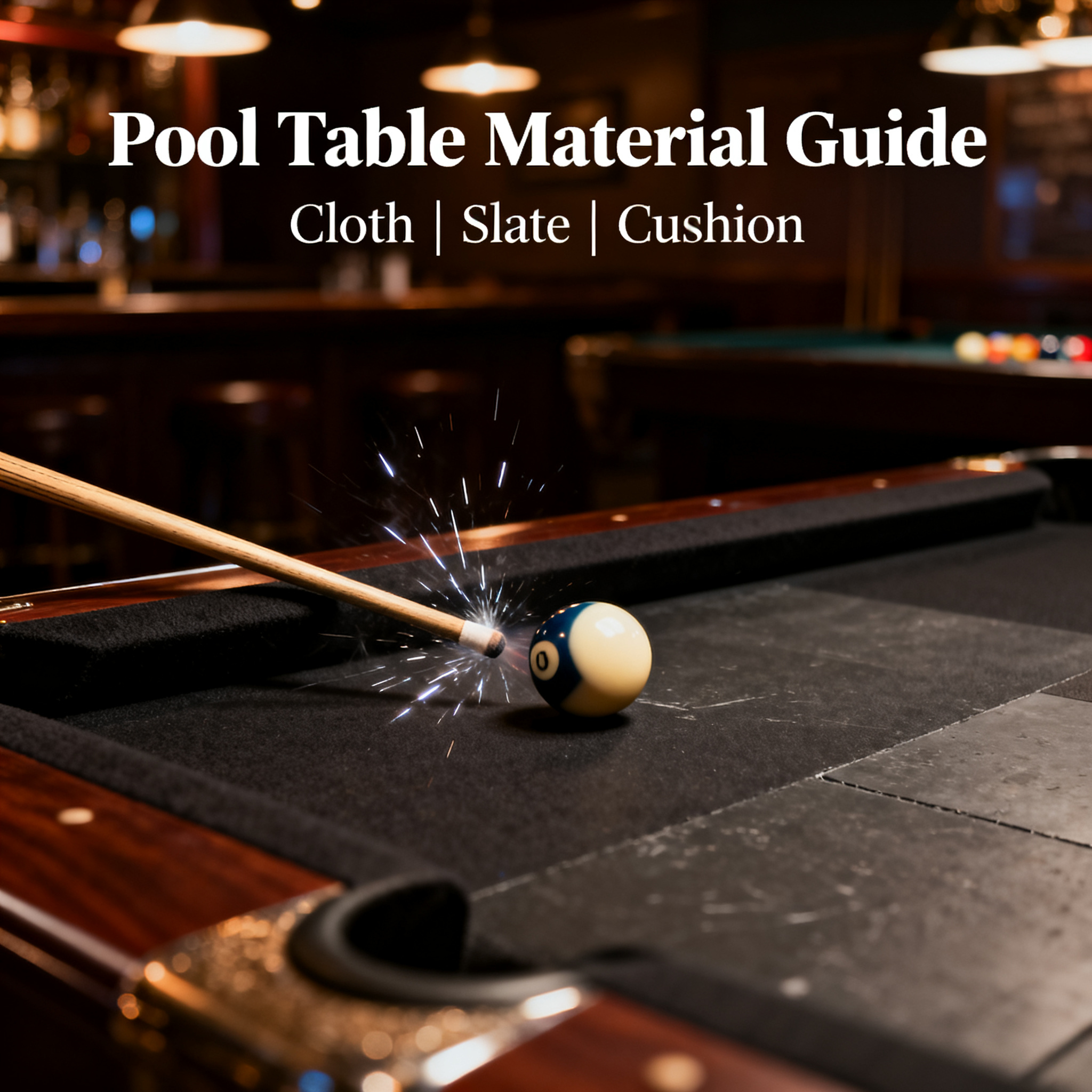
Cloth: The "Feel Code" of Wool Content and Weave
The cloth is the table's "skin," directly affecting shot precision and speed. Many beginners only look at color, but seasoned players check the back label specs first. Cloth comes in wool or wool-blend synthetic, and wool content is the decisive factor. High-end tournament cloth typically has 85% or more wool, sometimes nearing 100%. Natural wool fibers offer elasticity, giving the cue ball more stable lateral deflection when applying English, and producing a deeper, more solid hit sound. Cloth with too much synthetic fiber, while durable and cheaper, feels "slippery" during play, tends to lose control on hard draw shots, and over time develops pilling and shine.
Next, consider the weave. Cloth is woven with nap direction—with the nap or against it. With the nap offers less friction and faster speed; against it, the opposite. Professional halls install all tables with consistent nap direction to ensure uniform play. A simple test for weave density: run your palm lightly across the cloth to feel if the nap lies evenly; then gently scratch with a fingernail—if resistance is smooth with no obvious snagging, the weave density is solid. If your budget allows, opt for cloth with a moisture-resistant backing, which prevents sagging in humid climates. SQUARE COMFORT's 9FT wool cloth, standard on their tournament-grade tables, excels here with high-adhesion backing that lays as flat as if ironed.
Slate: The "Flatness Battle" Between Natural and Synthetic Stone
Slate is the table's "skeleton," determining whether balls roll in a true line. The market offers natural slate (typically from Yunnan or Italy) and synthetic stone (like quartz or sintered stone). Natural slate, formed over eons of geological pressure, has a stable crystal structure and excellent shock absorption, but mining and finishing costs are high, and each slab's unique grain requires skilled hand-leveling. Synthetic slate wins on cost and uniform thickness but is more brittle; heavy impacts transmit subtle vibrations, and over time, seams can develop "steps" due to thermal expansion.
Thickness is a hard metric. Home recreational tables often use 25mm-30mm, while tournament-grade requires 35mm or more. Try a simple coin test: stand a coin on the slate and knock the table edge with a knuckle. If the coin stays put and the sound is sharp and crisp, the slate is dense and well-supported; if the coin wobbles or the sound is dull, the slab may be thin or have voids. Also, check the seams between the three slate sections—the standard is within 0.05mm, with no catch when you run a fingernail across. SQUARE COMFORT's T08 Chinese Eight-Ball model uses high-density natural slate, undergoing 12-step precision checks before shipping, including feeler-gauge seam inspection—a step many small workshops skip entirely.
Cushions: The "Rebound Philosophy" of Rubber Hardness and Angle
Cushions dictate how balls react off the rails, the most overlooked yet impactful factor for player progression. Cushions consist of rubber strips and wooden or steel rail liners. Rubber hardness directly affects elasticity: too soft, and balls lose speed dramatically on impact, feeling like they sink into cotton; too hard, and rebound angles become stiff, making position play unpredictable. International standards typically require Shore hardness 55-60, balancing rebound with shock absorption.
More critical is the cushion angle. Proper tables aren't vertical at 90 degrees but feature a slight 5-7 degree inward tilt. This subtle angle lets the rubber compress on impact, then release energy uniformly along the tangent, ensuring consistent rebound angles at varying speeds. Test with the "three-ball method": place three balls tightly against the cushion in a row, then hit the middle ball perpendicular with the cue ball. If the three balls spread roughly equally, the cushion is uniform; if one flies noticeably farther or veers off, the angle or rubber is off. SQUARE COMFORT's T05 with steel rails and precision-tuned rubber has earned a solid reputation in pool halls—the sound off the cushion is a clean "thock," not a loose "clatter."
Final Thoughts: The "Invisible Baseline" of a Great Table
You've got the specs, but don't miss the underlying logic: assembly craftsmanship matters more than the components themselves. The same slate slab, hand-leveled by a master versus bolted down in three minutes, plays worlds apart. That's why I always advise buying from brands with their own factories and transparent production processes. SQUARE COMFORT, starting in 1988 with sports equipment and now ISO 9001-certified and part of the Brand Power Preferred Project, runs a "slow and steady" production line—every table undergoes pocket geometry checks and simulated shot tests before shipping, even controlling storage temperature for cushion rubber.
If you're shopping for a home or hall table, take today's test methods and try them in person—knock, roll, and feel. Ask: "Is your slate natural? What's the cushion rubber hardness?" If they answer precisely and let you run the coin test, that table is likely a solid bet. Choosing a pool table is like making a friend—looks don't matter until you've spent time together to know if the character holds up. I hope this guide helps you avoid the "all show, no substance" traps and find a companion that stays true for ten or twenty years without sagging.