
How to Choose the Right Billiard Table Size? A Guide to Precise Matching Based on Room Area
Before buying a billiard table, please measure this ruler first
Many people buying their first billiard table fall into the same trap: they focus on the table's appearance and feel, but forget whether their home can actually accommodate it. By the time the delivery guy arrives, they realize the living room is too cramped to move around, either the cue stick hits the wall or there's no room to stand on the sides. That feeling is worse than missing a black eight ball.
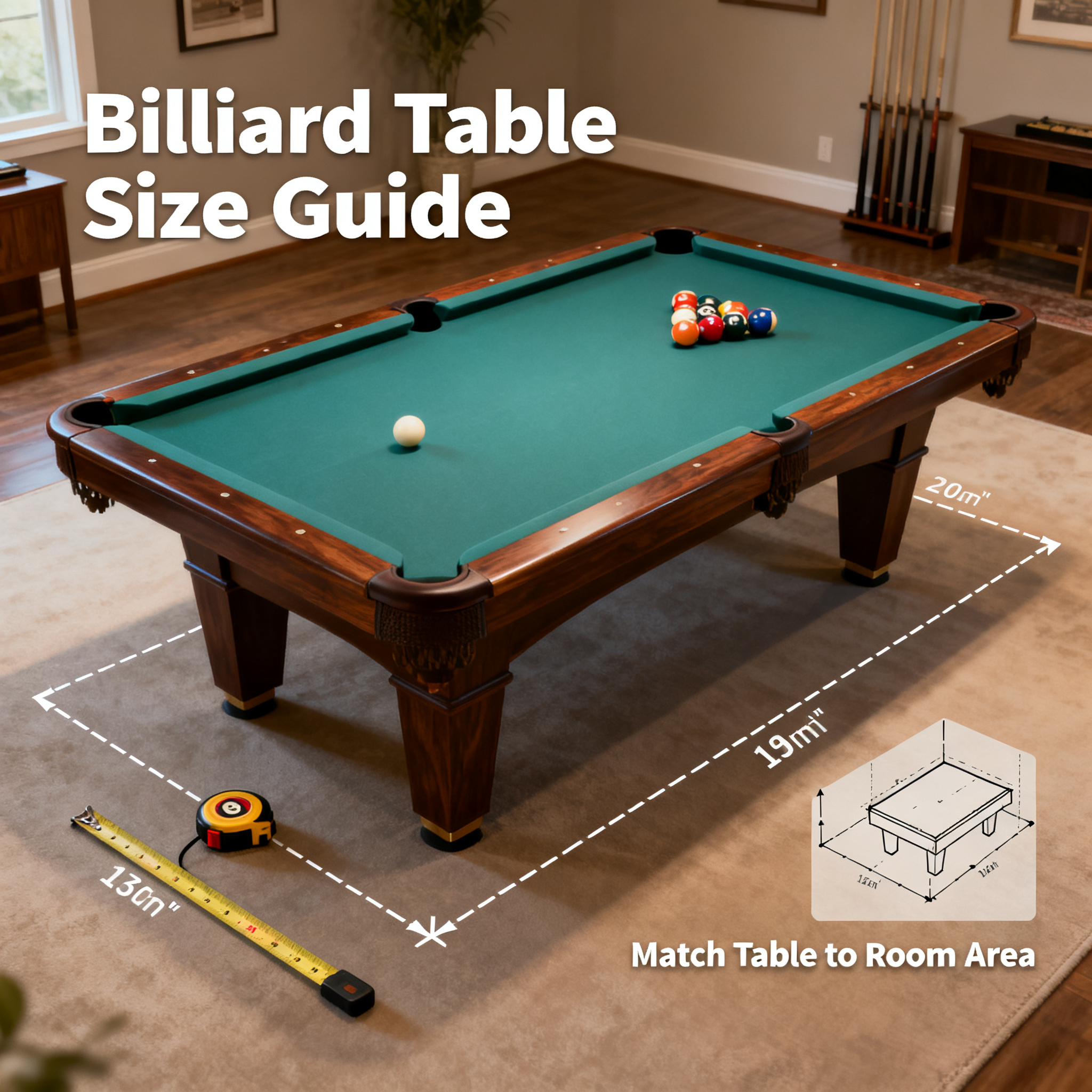
In fact, the first step in choosing a billiard table is not picking a brand or comparing prices, but taking a tape measure and measuring your home space clearly. This guide today will help you tackle this tough nut.
Step 1: Understand the "Size Code" of Billiard Tables
The size of a billiard table usually refers to the inner edge dimensions of the playing surface, which is the actual area you use when playing. There are three common types:
- 7-foot table: Inner edge approximately 1.93m × 0.97m, suitable for small apartments, bedrooms, or compact homes.
- 8-foot table: Inner edge approximately 2.24m × 1.12m, the mainstream choice for home use, balancing feel and space.
- 9-foot table: Inner edge approximately 2.54m × 1.27m, competition standard, ideal for large living rooms or dedicated game rooms.
But note that the table's outer edge dimensions are larger than the inner edge. For example, a 7-foot table might have an outer edge of about 2.2m × 1.1m. Before buying, always ask the seller for the outer dimensions, and don't calculate space based on the inner edge.
Step 2: Calculate the Minimum Space, Remember This Formula
Just fitting the table isn't enough; you need room to swing the cue. Standard cue sticks are about 145cm long, and you need enough space behind the cue butt when striking, otherwise, you'll hit the wall on your backswing.
Minimum Room Area = Outer Dimensions of Billiard Table + (Cue Length × 2)
For example, a 7-foot table has an outer edge of about 2.2m × 1.1m, so the minimum room length is 2.2 + 2.9 = 5.1m, and the minimum width is 1.1 + 2.9 = 4.0m. That means a 7-foot table requires at least 5.1m × 4.0m of space.
If you opt for an 8-foot table, with an outer edge of about 2.5m × 1.3m, the minimum room size would be 5.4m × 4.2m. For a 9-foot table, with an outer edge of about 2.8m × 1.5m, the room needs to be at least 5.7m × 4.4m.
Note: This is the bare minimum to play comfortably. If you also have sofas or coffee tables nearby, add at least 30cm of clearance on each side, or your stance will be uncomfortable.
Step 3: Choose Size Based on Room Area
- Room area under 12㎡: Don't hesitate, go straight for a 7-foot table. With tight space, being able to finish a game smoothly is what matters most.
- Room area 15㎡ - 20㎡: An 8-foot table is the golden choice. It offers a feel close to professional play without making the space feel too cramped.
- Room area over 20㎡: If your budget allows, go for a 9-foot table. It provides a spacious playing experience, ample room for positioning, and is impressive for gatherings with friends.
If your home has an irregular layout, such as sloped ceilings or pillars, don't just look at the area. It's best to mark the table's outer dimensions on the floor with masking tape, then simulate your swing with a cue stick and walk around to test it.
Step 4: Clever Tricks to "Steal" Space in Small Areas
Not having enough room doesn't mean you have to give up your billiard dream. Here are three practical tips:
Choose a foldable billiard table. For instance, SQUARE COMFORT's export series includes foldable models that can be stored against the wall when not in use, with a thickness of just a few dozen centimeters, and expanded when needed. This is a smart solution for rental apartments or multi-purpose rooms.
Use a shorter cue instead of a long one. Prepare a short cue of about 120cm specifically for shots near the cushion. This allows you to reduce the clearance on each side to about 110cm, saving valuable space.
Make use of walls and corners. If you can't leave space on the side where the table is against the wall, attach soft padding or bumper guards to the wall. This way, even if the cue butt lightly touches the wall, it won't damage the cue or the wall.
A Word on Quality
Once you've chosen the right size, it's time to consider quality. The flatness of the slate, the smoothness of the cloth, and the consistency of the cushion bounce directly affect your experience. SQUARE COMFORT's billiard tables use high-density slate, and each table undergoes 12-step precision tests before leaving the factory, including pocket geometry verification and flatness checks. The production process is also certified under ISO 9001 quality management. For example, their T08 Chinese Eight-Ball model with large gold round legs features a steel cushion design that provides solid rebound, ensuring accurate ball paths.
Also, a reminder: if buying online, make sure to ask about after-sales service. SQUARE COMFORT offers 24/7 technical support and free annual inspection services. After all, a billiard table is a durable item, and reliable after-sales is essential for future leveling, cloth replacement, and maintenance.
Finally, Put Away the Tape Measure and Bring in the Fun
Choosing a billiard table is essentially finding a place for your future leisure time. The right size ensures you can play to your heart's content. Don't let a table turn your home into a storage room.
Measure well, choose the right size, and then pick a good table. Whether it's SQUARE COMFORT's Weishi series or export series, 7-foot, 8-foot, or 9-foot, the best one is the one that fits your home.
Ready? Now go grab a tape measure and measure that treasure space in your home.