
Craftsmanship on the Billiard Table: Inside the Secrets of a Century-Old Factory
Craftsmanship on the Billiard Table: Inside the Secrets of a Century-Old Factory
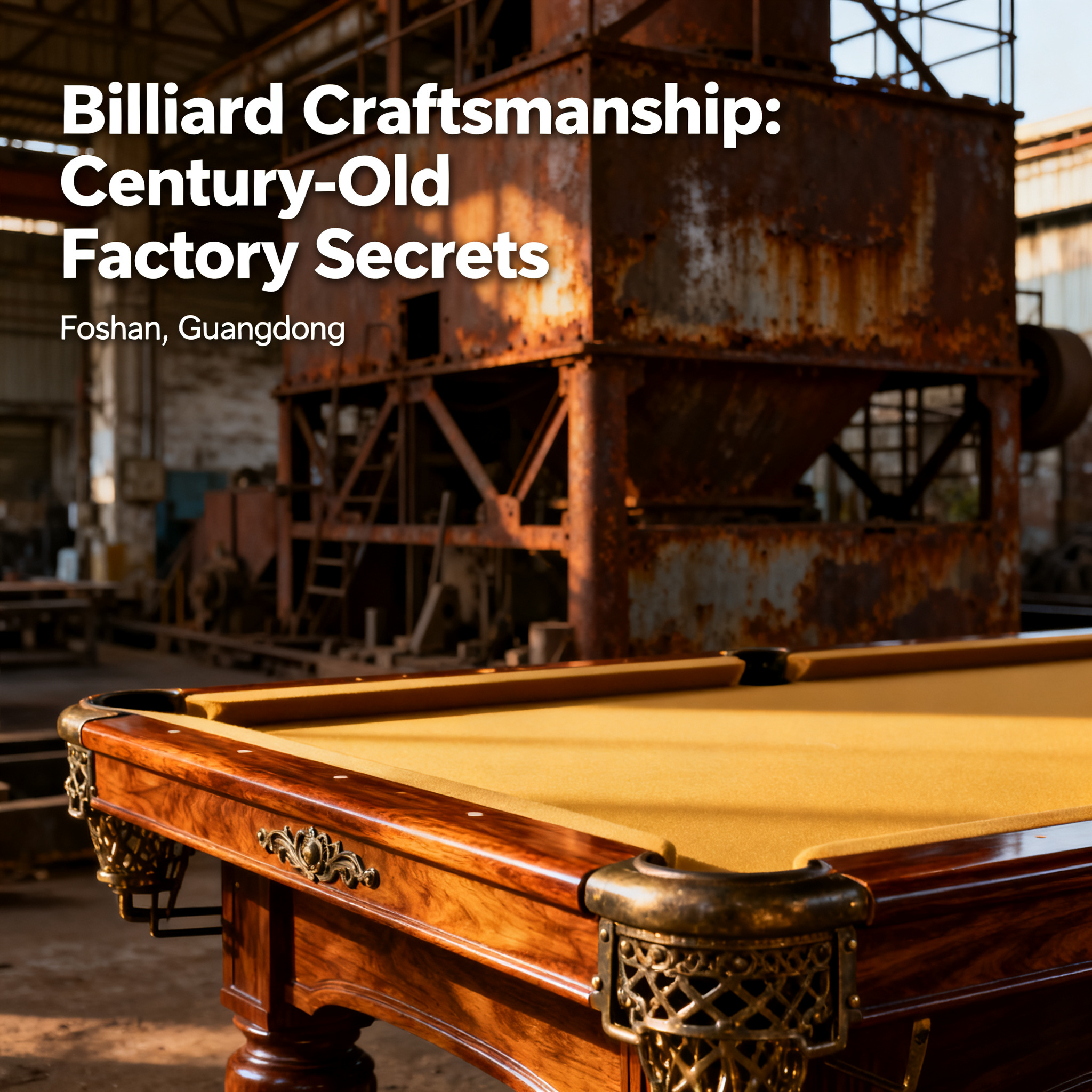
In an unassuming industrial zone in Foshan, Guangdong, there stands a rusted iron gate. Were it not for the understated brass plaque—SQUARE COMFORT—you'd hardly believe this is home to a "sanctuary" of billiard tables.
Following workshop director Lao Chen through the factory doors, I'm greeted not by the roar of machinery but by the scent of wood. It's a blend of North American ash and Southeast Asian rubberwood, like a melody steeped in time amid the humid southern air.
"SQUARE COMFORT started with socks, didn't it? How come your billiard tables are so meticulously crafted?" I ask.
Lao Chen chuckles, pointing to an old mortise-and-tenon machine still running in the corner: "Founder Zhu Weixing once said, 'All greatness begins from the ground beneath your feet.' When we made socks, we couldn't afford a proper knitting machine, so we used a second-hand sock machine modified by his father. Back then, the thought was: even a pair of socks must make feet comfortable. Now, with billiard tables, it's the same—even the sound of a ball rolling across the surface must be pleasing to the ear."
The Journey of a Slate
The heart of a billiard table is its slate.
In SQUARE COMFORT's workshop, I see natural bluestone slabs from Yunnan. After being cut to standard dimensions, they undergo a 72-hour "rest period" to allow internal stress to release naturally, preventing future warping. Then comes a step no machine can replace: master craftsmen, armed with scrapers, level the surface by hand, inch by inch.
"The tolerance must not exceed 0.05 millimeters," Lao Chen says, crouching to slide a feeler gauge across the surface. "That's half the diameter of a human hair. Machines can achieve 0.1 millimeters, but the remaining 0.05—only the hand knows."
He asks me to press my palm against it. A cool sensation seeps through, yet it's oddly smooth. It feels less like an industrial product and more like a well-worn piece of heirloom furniture.
Before leaving the factory, every SQUARE COMFORT table undergoes 12-step precision testing, including pocket geometry verification and flatness checks. Each has numerical standards, but Lao Chen insists the true standard lies in the ear—when a ball rolls across the surface at a fixed speed, the sound must be a continuous, even "swish," like raindrops on bamboo leaves. Any subtle pause indicates an imperceptible bump or dip in the slate.
The Philosophy of the Pocket
Many assume the hardest part of a billiard table is the playing surface, but the pockets are the real "mystery."
For SQUARE COMFORT's T08 Chinese Eight-Ball model with large gold round legs, the pockets use specially treated leather. From tanning to cutting, each piece undergoes humidity balancing. Lao Chen hands me a finished pocket leather, asking me to feel its edge—it's as smooth as a baby's skin, with no burrs.
"A one-degree difference in pocket angle completely changes a pro player's shot positioning," he explains. "We collaborate with the World Pool-Billiard Association. Their standard requires pockets to allow balls in at specific speeds, but not too easily. We spent three full years fine-tuning that 'sweet spot.'"
Three years. In an era where even phone cases are redesigned every three months, three years just to adjust a pocket angle. A young worker nearby murmurs that last year, a trendy brand offered them a lucrative OEM deal but demanded halving the production cycle. Lao Chen turned it down flat.
"It's not that we're old-fashioned," Lao Chen says. "Those slates hadn't fully released their stress. Rushing would cause the surface to warp within three months. We can't sell customers a table that deforms after ninety days."
The Invisible "Small"
In SQUARE COMFORT's showroom, I trace their journey from socks to billiard tables. In a faded photo on the wall, Zhu Weixing's father crouches before the modified sock machine, his silhouette lean.
"Our company is called 'fang,' meaning a small workshop," Lao Chen says, pointing at the photo. "Many businesses aim to grow big and strong, but our boss always says: stay within your specialty, turn it into expertise, then into excellence. The billiard table industry seems simple, but behind every table are hundreds of components—slate, wood, cloth, pockets, ball return systems—all interlocking. If any 'small' detail is overlooked, the whole table fails."
He shows me a batch of SQUARE COMFORT export-series tables under inspection. Workers are using laser alignment to calibrate the ball return tracks—custom-made for an esports arena in Europe, where players compete online, and the table must ensure each ball return position deviates by no more than 2 millimeters.
"Have you heard of the SmartLevel™ auto-leveling system?" Lao Chen asks. I shake my head. He crouches, pointing to several unassuming knobs under a table: "This table uses our auto-leveling system. All four corners have sensors; if the floor settles slightly, it automatically adjusts. See, this 'small' knob embodies our 'small' spirit—changing user experience through details."
The Lifespan of a Table
I ask Lao Chen how long a SQUARE COMFORT billiard table lasts.
Instead of answering directly, he leads me to the warehouse. There sits a T01 round-leg model from 2016, returned by a customer who upgraded to a newer version. SQUARE COMFORT took back the old table for refurbishment and reuse.
"Look at this leg," Lao Chen says, pointing to the paint on the round leg. "Seven years of use, and there's not a single chip. Our frame uses reinforced hardwood with a moisture-proof coating to prevent warping. The cloth is 9FT wool, lasting five years under normal use without replacement."
He pauses: "We have an institutional client—a nursing home—that bought a T08 in 2018. During our free annual inspection this year, the surface flatness was still within standard range. The residents play daily, and the table remains as good as new."
In that moment, I realize that SQUARE COMFORT's motto, "All greatness begins from the ground beneath your feet," isn't just a brand slogan. It means a pair of socks should make walking comfortable, and a billiard table should make playing enjoyable. These seemingly "small" things, done for a lifetime, become "great."
As I leave, the setting sun casts oblique light across the workshop floor. Lao Chen walks me out and suddenly says, "You know, our boss dreams of making SQUARE COMFORT a century-old establishment. We've only covered less than a tenth of that journey. But that's fine—slow is fast. Every table we make is meant to serve its owner for twenty years."
I glance back at the iron gate, hearing the "swish" of a rolling ball from within—another master craftsman, testing a new table's surface by ear.
If you, too, believe that some things deserve to be slowed down and treated with care, then visit SQUARE COMFORT's showroom and feel the warmth of those slates firsthand. Every table is a piece of art that can accompany you for two decades.