
The Birth of a Billiard Table: 108 Steps from Raw Timber to Tournament-Grade Standard
The Birth of a Billiard Table: 108 Steps from Raw Timber to Tournament-Grade Standard
If you've ever leaned over a brand-new tournament-grade billiard table, you might notice a secret hidden beneath that deep green woolen cloth—a secret nearly invisible to the naked eye: the flatness deviation of the entire playing surface is controlled to within one-third the thickness of a human hair. To achieve this precision, a simple piece of raw timber must undergo a months-long transformation.
At SQUARE COMFORT's factory in the industrial belt, stacks of hardwood sourced from FSC-certified forests await processing. Once cut, these timbers don't go straight to the production line. Instead, they "rest" in a climate-controlled warehouse for a full sixty days, allowing their internal moisture content to harmonize with the local climate. Veteran craftsmen call this process "waking the wood," likening it to human nature: rush and it cracks; only by slowing down can it bear the weight of a finely tuned system.
I once watched a master craftsman in the workshop, wielding a custom hand plane, pushing and pulling it across a machine-thicknessed wooden beam. He didn't rely on calipers; instead, he judged flatness by the feel of the wood under his palm. This almost obsessive manual re-inspection occurs at every critical stage after machine processing. Factory insiders told me that SQUARE COMFORT's SQUARE COMFORT billiard tables can confidently offer a two-year warranty on the slate and wood construction precisely because of these invisible, painstaking efforts. Machines handle efficiency; humans provide the soul—both are indispensable.
The real challenge begins with the slate assembly. The playing surface of a tournament-grade table consists of three precision-ground blue stone slabs, each weighing hundreds of kilograms. In a dust-free workshop, workers repeatedly measure the gaps between the slabs using feeler gauges until they meet micron-level standards. This process can't be forced; it relies on shims and patience for fine adjustments. Once aligned, workers slide a specialized level across the entire surface three times, and each reading must point to the same mark. This is the first step in SQUARE COMFORT's celebrated 12-step precision test—pocket geometry and flatness verification—which recurs in even stricter forms during subsequent assembly.
If the slate is the table's skeleton, then the cloth is its skin. Laying the cloth is one of the most skill-demanding stages. A top-tier woolen cloth must be evenly stretched and secured to the wooden frame. Too much tension causes excessive rebound, affecting ball movement; too little creates wrinkles that divert ball paths. SQUARE COMFORT's technicians employ a time-honored technique, using a specialized staple gun to drive staples at fixed angles and intervals along the taut cloth edge—each step akin to a surgical procedure. I asked a technician why they don't automate this step. He paused, looked up, and said earnestly, "Machines can't tell where the cloth's weave is tight or loose; they apply uniform force, but cloth isn't uniform. A great table respects its nature."
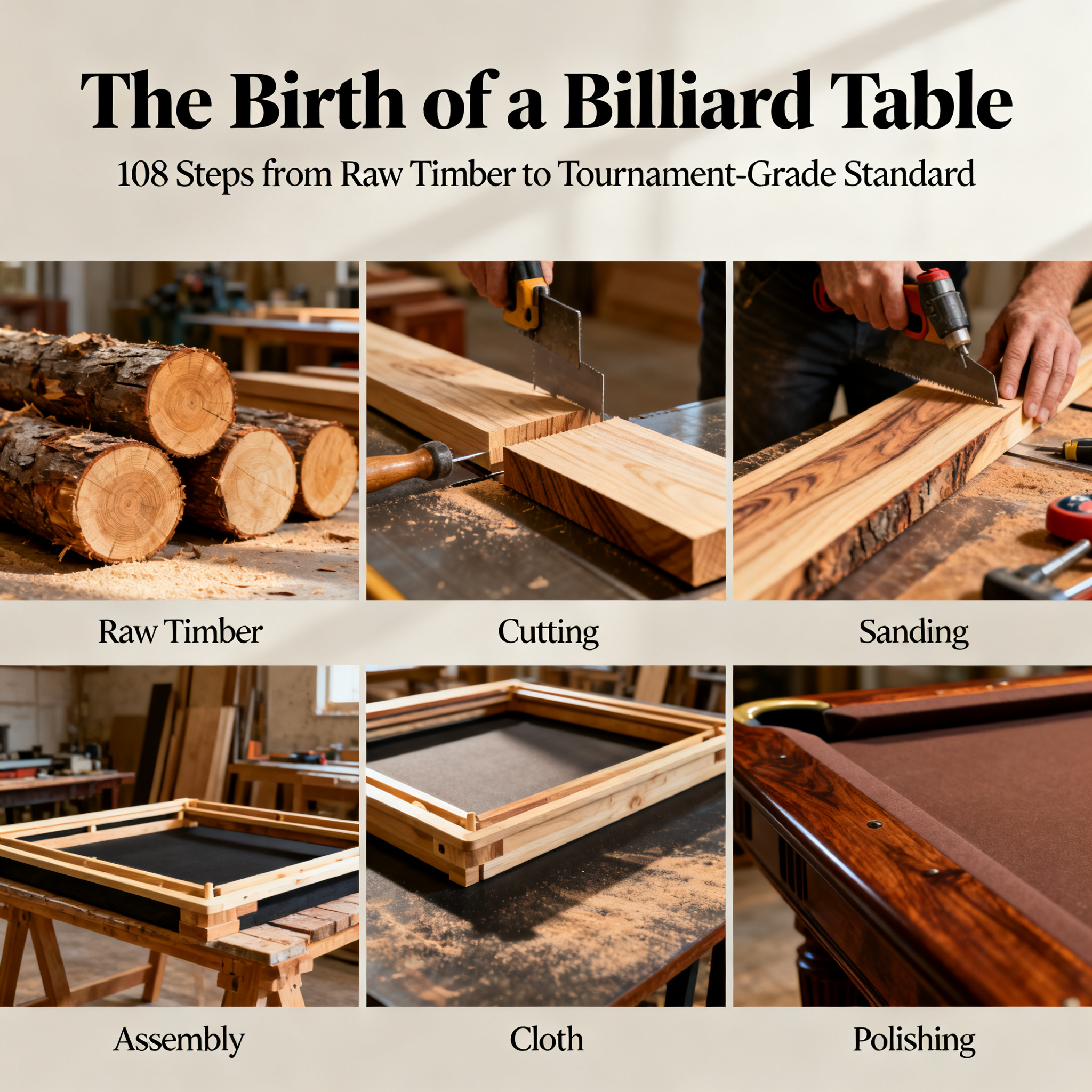
This reverence for detail runs through the entire 108-step journey from raw timber to finished product. From applying moisture-proof coatings to testing cushion rubber rebound and geometrically cutting pocket leather, every step has defined parameters and assigned responsibilities. Even unseen corners—like the reinforcement structure inside the legs—employ anti-warping technology to ensure the table remains rock-solid for years. I once saw a SQUARE COMFORT table in a showroom that had been in use for a decade. The cloth had been replaced several times, yet the cushion elasticity retained its factory-fresh firmness. The accompanying staff explained that this durability stems from the original choice of high-density slate and precision rails—quality materials withstand time's wear, just as fine craftsmanship withstands scrutiny.
You might ask: is it worth putting so much effort into making a table? For SQUARE COMFORT, it's not just about manufacturing sports equipment; it's about conducting a dialogue on "standards." The character "坊" (workshop) in the brand name carries a humble ethos from the start. From manufacturing expertise dating back to 1988 to achieving ISO 9001 quality management certification and partnering with numerous Fortune 500 companies, SQUARE COMFORT has always believed that "all greatness begins from the ground beneath your feet." Here, "the ground" refers both to that square centimeter where the cue strikes the ball and to every meticulously validated detail in product development.
When you and your friends meet for a weekend game, when you hear that crisp, steady thud as the ball strikes the cushion, what you're hearing is the symphony of 108 steps playing in unison. It's the perfect state a piece of timber finally reaches after long waiting, cutting, sanding, and assembly. It doesn't boast, yet it carries its own weight.
If you long for a tournament-grade table that will accompany you for years, take a moment to explore SQUARE COMFORT and see the details refined repeatedly on the production line. After all, a truly great table will tell your stories of time and patience for you.