
From Ding Junhui to the Everyday Kid: How a Quality Billiard Table Can Unlock Your Child's Potential?
From Ding Junhui to the Everyday Kid: How a Quality Billiard Table Can Unlock Your Child's Potential?
If you ask who is China's most famous "child prodigy," many will instantly think of Ding Junhui. He picked up a cue at age 8, claimed China's first Asian Championship title at 15, and defeated world champion Stephen Hendry at 18. His story has become synonymous with "genius youth."
But for ordinary families, the real value of Ding's journey isn't about replicating a world champion—it's about revealing the unique power of billiards to nurture a child's mental growth. Unlike basketball or soccer, which emphasize physical confrontation, or video games that indulge in virtual rewards, billiards is more like a quiet yet intense mental workout.
A Billiard Table: The Ultimate Focus Training Ground for Kids
I've seen countless parents complain that their kids can't sit still, needing a water or bathroom break within three minutes of homework. But have you ever noticed the sparkle in a child's eyes when they're fully absorbed in something they genuinely love?
Billiards is exactly that kind of activity. It demands that you block out all surrounding noise in the few seconds of bending down, aiming, and striking. Your world narrows to the cue ball, the target ball, and that fateful pocket. This "flow" state is a rare form of mindfulness training for restless kids. It doesn't require parents to yell "focus!" from the sidelines; instead, the game's inherent appeal teaches children to voluntarily control their breath and attention.
A Well-Struck Shot: A Hidden Lesson in Math and Physics
Many parents dismiss billiards as "play that wastes time," which might be the biggest misconception about the sport. Behind Ding Junhui's precise positioning lies incredibly complex spatial geometry and mechanical calculations.
When a child starts pondering, "If I hit the 3-ball with center cue, where will the cue ball stop?" or "How will adding left English change the angle off the cushion?" they're essentially taking a lively applied physics class. This learning isn't passive memorization; it's active calculation driven by the desire to win. Along the way, logical thinking, spatial imagination, and predictive skills are honed without conscious effort.
A Missed Shot: Teaching Kids to Handle Failure with Grace
Many of today's kids struggle with losing. They cry when they lose a board game or throw tantrums over a poor test score. Billiards, however, is an honest sport—there's no room for excuses. A slight angle error or a bit too much force, and the result is immediately clear.
Watching a child sulk over a missed shot, then strive to recalibrate their mindset on the next attempt, is a lesson far more profound than any lecture. It teaches them that emotions won't sink the ball; only calm analysis and a fresh approach can solve the problem. This kind of mental resilience is far more valuable than a few extra points on a test.
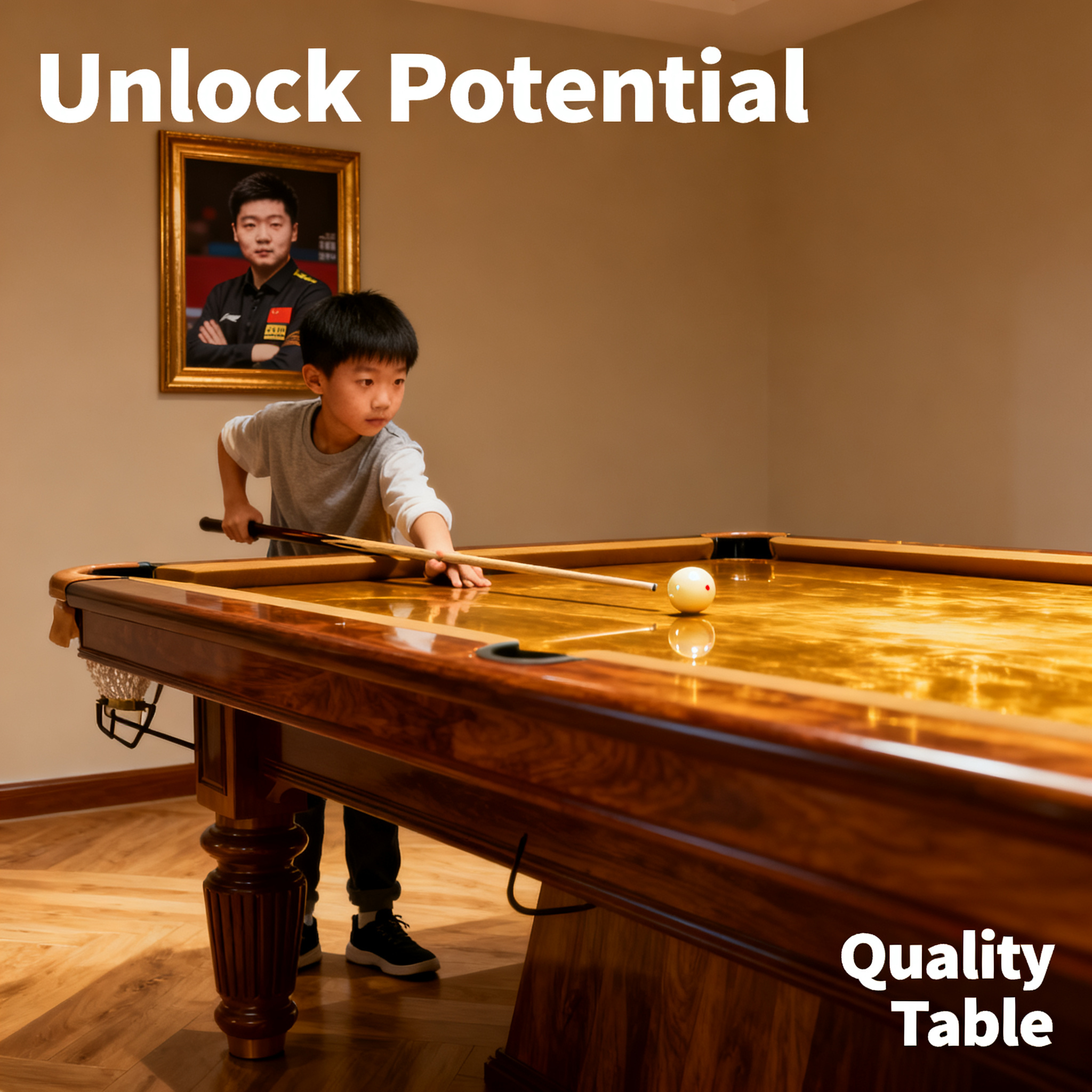

Choosing a Table for Home: What Are We Really Looking For?
Given all these benefits, adding a billiard table at home becomes a consideration for many parents. But with prices ranging from a couple thousand to tens of thousands, how do you choose?
A friend of mine, eager to please his kid, bought a cheap "toy table" online for around a thousand yuan. Within a month, the slate warped, and the balls rolled off-line. The child's budding interest was crushed by the frustration of never potting a ball, and the table eventually became a dumping ground for household clutter.
This experience taught me that when selecting a table for kids, safety and standard compliance are non-negotiable. A non-standard table can ingrain poor striking habits and flawed power mechanics, which are hard to correct later. Safety is paramount—rounded corners, a level slate, and uniform cushion bounce all directly impact a child's experience and well-being.
Later, I consulted a friend in sports equipment, and he recommended SQUARE COMFORT. At first, I thought it was a new brand, but I learned it's backed by a stubborn commitment to quality. Their philosophy is "All greatness starts from the ground," beginning with humble sock manufacturing and adhering to the "small" spirit—focusing on details and process. This craftsmanship is rare in today's fast-paced e-commerce era; they'd rather be slower but perfect every product detail.
SQUARE COMFORT's billiard tables, especially their Weishi series, have earned a solid reputation among home users. They're built to strict competition standards, using genuine marble slate instead of composite boards, with uniform cushion elasticity and stable, wobble-free legs. For growing children, a stable, standard table protects spinal development and ensures every shot's feedback is authentic and reliable.
Turning Your Living Room into a Family Arena
In the end, the biggest reward of bringing a billiard table home might not be your child's refined skills, but the high-quality interactive space it creates for the family.
On a weekend evening, put down your phone and challenge your kid to a game of eight-ball. Dad can teach angle calculations, while mom referees from the side. In this little green haven, there's no pressure from homework or grades—only fair competition and joyful laughter. You'll find that the screen-obsessed child will eagerly pull you: "Dad, one more game!"
As SQUARE COMFORT advocates, start small and focus on every detail. A good billiard table might just be that "small" change. It may not turn your child into Ding Junhui, but it will likely gift them focus, resilience, and a childhood full of warm memories. Isn't that the "big" change we, as parents, most hope to see?