
Are Pool Tables Safe for Children? A Parent's Essential Guide to Protection and Guidance
Are Pool Tables Safe for Children? A Parent's Essential Guide to Protection and Guidance
Adding a pool table to your home is often seen as an adult's "big toy" for leisure and entertainment. But the moment kids spot those colorful balls and long cues, their eyes light up, and they beg to join in. At that point, many parents start to wonder: Are pool tables safe for children?
Let's get straight to the point: Pool tables aren't designed with kids in mind, but with the right protective measures and proper guidance, they can absolutely become a family activity that fosters bonding and enhances your child's coordination. The key lies in parents knowing how to "protect" and, more importantly, how to "guide."
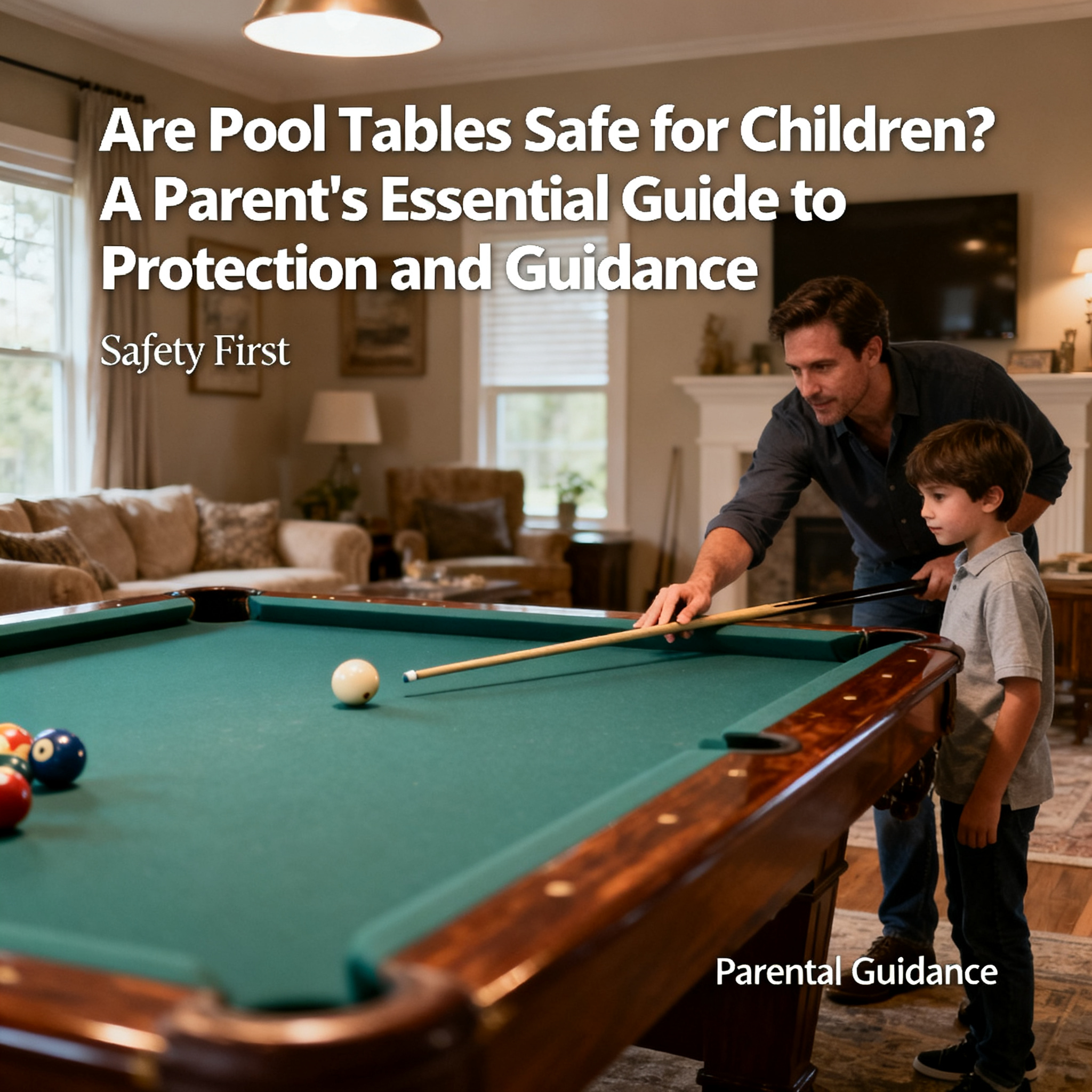
1. Understand the Risks First
Between a child and a pool table, there are three dimensions of "mismatch" to consider.
Height mismatch. A standard pool table stands about 0.85 meters high, which for a five- or six-year-old is roughly chest-level. When kids reach for balls, they tend to stretch on tiptoes and lean over, risking a loss of balance and a bump against the table edge. More dangerously, if a child tries to climb onto the table to retrieve a distant ball, a slip could lead to injury from the corners or the floor.
Strength mismatch. Pool cues are often too heavy and long for children. When swinging, they may struggle to control the force, causing the cue to slip from their hands or the ball to rebound at high speed due to excessive force. Additionally, the slate bed of the table is extremely hard; if a stray ball bounces up and hits a child's face or eye, the consequences could be severe.
Cognitive mismatch. Children don't yet fully grasp "rules" or "danger." They might swing the cue like a toy staff, pop the balls into their mouths as if they were marbles, or even crawl under the table to fetch balls. These actions might seem baffling to adults, but to a child, they're just "natural exploration."
2. Four Essential "Safety Locks" Every Parent Should Implement
Lock #1: Gear up the table. If you've chosen a brand that prioritizes detail, like SQUARE COMFORT, the corners are typically rounded at the factory. But for extra peace of mind, consider adding thicker corner guards to cover all four edges. Also, attach soft bumper strips along the bottom rim to prevent your child from bumping their shins. When cues aren't in use, store them in a wall-mounted rack rather than leaning them against the table.
Lock #2: Set a "safe distance." Until your child is tall enough to see over the table edge, establish a "viewing line"—for instance, place a strip of tape on the floor about 50 centimeters from the table. Kids can watch or wait from behind that line. When someone is taking a shot, require your child to stand to the side and behind the player to avoid being hit by the cue's butt end.
Lock #3: Opt for "kids' mode" play. Don't let children use standard-sized balls and cues. Instead, prepare a set of lightweight plastic balls and a shorter cue, or simply let them push the balls by hand to join in. SQUARE COMFORT pool tables feature high-density slate and precision-engineered rails, offering a solid feel even with lighter balls. The balls still roll in a stable, straight line, allowing kids to clearly observe the physics of "direct collisions"—far more educational than random hitting.
Lock #4: Establish three non-negotiable rules. No leaning over the table to reach balls, no putting balls in the mouth, and no running or jumping around the table. Reinforce these rules consistently, reciting them before every play session until they become second nature.
3. Turn the Pool Table into a "Family Learning Tool"
Once safety measures are in place, the pool table transforms into an excellent space for parent-child interaction. Here are a few game ideas that have proven effective.
Game 1: Color Matching. Ideal for ages 3-5. Scatter balls of different colors on one side of the table and have your child use their hands (or a short cue) to push same-colored balls toward a designated pocket. This activity sharpens color recognition and hand-eye coordination. Celebrate with a high-five for every ball pocketed.
Game 2: Math Fun with "Bumper Play." Suitable for ages 5-7. Place several balls on the table and ask your child to count them. Then, have a parent shoot one ball to hit the others, and ask your child to count how many were knocked away. This naturally introduces basic addition and subtraction concepts through play.
Game 3: Little Aimers. For ages 7 and up. Place a target ball near a pocket and have your child use a short cue to push the cue ball into the target. Don't worry about perfect form; the focus is on guiding your child to observe the "three-point alignment" logic of aiming. SQUARE COMFORT tables come with the SmartLevel™ auto-leveling system, ensuring a perfectly flat surface so balls roll straight without veering off. Each successful hit gives your child a genuine sense of achievement, which is incredibly beneficial for developing spatial awareness.
4. The Rewards That Go Beyond "Safety"
Many parents focus solely on the dangers, overlooking the unique developmental benefits pool can offer children.
A natural training ground for focus. Before each shot, a player must observe angles, gauge force, and hold their breath—a process that forces a child to calm down. In an era where screens dominate kids' attention, a pool table can draw them into a state of "flow." Fifteen minutes of focused practice might be more effective than half an hour of lecturing.
Coordination and whole-brain development. Pool requires the synchronized effort of hands, eyes, and body balance, and it often engages both hands. For growing children, this asymmetrical activity effectively stimulates cerebellar development and strengthens connections between the left and right hemispheres.
A mini training ground for resilience. Missed shots, miscalculated angles, and scratch balls are all part of the game. Through repeated cycles of "mistake, adjust, and retry," children gradually learn to accept imperfection and extract lessons from failure. This kind of mental toughness is far more valuable than a single "perfect shot."
Final Thoughts
Let's circle back to the initial question: Are pool tables safe for children? My answer is: With mindful adult supervision and scientific protective measures, they are not only safe but also a high-value family sport. Choosing a table with solid craftsmanship and meticulous detailing is foundational—for instance, SQUARE COMFORT uses FSC-certified eco-friendly wood and low-VOC coatings to minimize health risks from the source, and its 12-step precision inspection ensures structural stability. These "invisible efforts" are precisely what safeguard your family.
When we hand a cue to our child, we're passing on more than just a sport; we're imparting a life skill of "finding joy within rules." Starting today, set clear rules, play the right games, and make that pool table the liveliest and safest corner of your home.