
Billiard Table Too Loud? DIY Soundproofing and Vibration Dampening Solutions Tested
Billiard Table Too Loud? DIY Soundproofing and Vibration Dampening Solutions Tested
Within the first week of moving into my new place, my downstairs neighbor knocked on my door. Not to borrow soy sauce—to complain. At 10 PM, the crisp "crack" from my newly purchased SQUARE COMFORT Chinese Eight-Ball table sounded like firecrackers in the quiet residential building. The "clunk" of balls dropping into the pockets seemed to pierce right through the floorboards. After less than a month, our neighborly relationship had devolved from "Hello, new neighbor!" to "You'll be hearing from the property manager."
Honestly, I almost sold the table. But then I thought—I work hard all day, and this is my only hobby at night. Was I really going to move over a billiard table? No, I had to find a solution. So, as an arts major with average DIY skills, I scoured the internet, hit countless dead ends, and finally pieced together a soundproofing and vibration dampening system that actually works. Now, when I play at night, my downstairs neighbor barely notices. Today, I'm sharing this solution with you—fellow billiards enthusiasts who don't want to be hunted down by angry neighbors.
1. First, Understand: Where Does the Noise Come From?
Before you start, spending time to identify the noise sources is a hundred times more important than blindly buying materials. Using a phone decibel meter, I identified three main sources:
1. Impact sounds from ball-to-ball and ball-to-cushion contact. This is the sharpest, most piercing "crack"—extremely penetrating. Especially during the break shot, the force can trigger motion-sensor lights across the entire building.
2. Rolling and collision sounds in the ball return tracks or collection box after balls drop. This is a continuous "clatter"—not as sharp, but annoying, especially when you're on a streak.
3. The most overlooked: the table's overall vibration against the floor. The force of your shot travels through the table legs directly into the floor slab, creating solid-borne sound. This low-frequency vibration is audible to neighbors above and below and is the hardest to address. Initially, I only placed a blanket on the table surface—useless. My neighbor said it felt like the ceiling was shaking.
2. Targeted Solutions: A Three-Pronged DIY Soundproofing Plan
Once the noise sources were clear, the solution became obvious. The core strategy: absorb, cushion, and isolate vibrations. Here are the three most effective combinations I tested.
Solution 1: Tackle Floor Vibration (Crucial!)
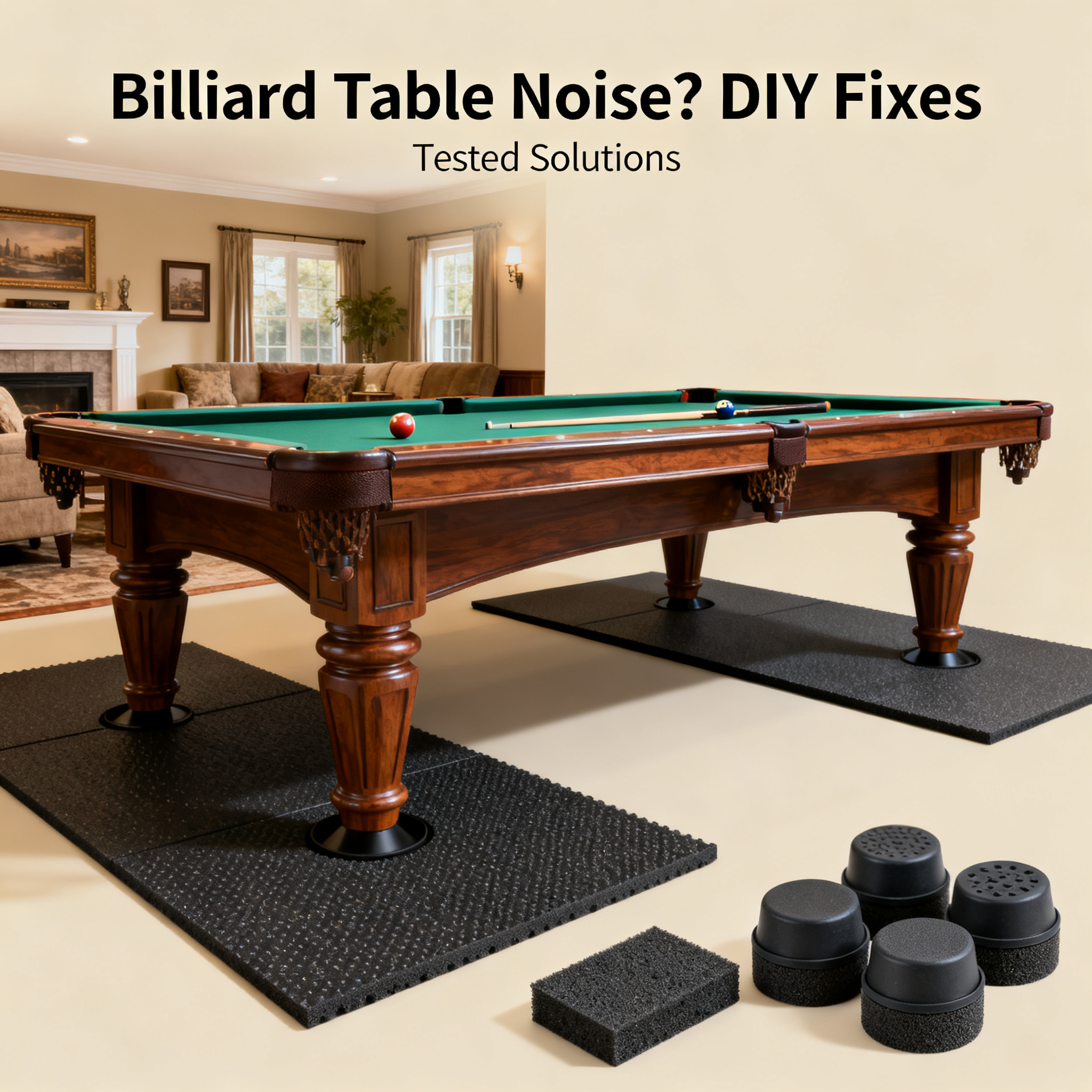
This is the most important part. Hard contact between table legs and the floor is the main culprit for low-frequency vibration.
Materials:
- Rubber vibration isolation pads (at least 2cm thick, medium hardness—avoid super soft ones that can't handle weight)
- Or professional billiard table vibration pads (search "billiard table vibration pad" on Taobao; many options with adjustable threaded heights)
Installation Steps:
- Lift one side of the table (best done with two people for safety), and place isolation pads under each leg. If the floor is uneven, adjust the pad's threaded height until the table is level.
- I used the SQUARE COMFORT T01 round-leg model, which has thick legs, so I bought larger square rubber pads to ensure full support.
Test Results: This step had the most dramatic effect. After installation, the "floor shaking" sensation reported by my downstairs neighbor disappeared by at least 80%. I strongly recommend not skipping this step.
Solution 2: "Silence" the Pockets and Ball Return System
With vibrations handled, next is the noise from balls dropping into pockets.
Materials:
- Small pieces of high-density foam or acoustic cotton (1-2cm thick)
- Velcro or strong adhesive tape
- If there's a ball return track, some soft fabric (old T-shirts cut up work fine)
Installation Steps:
- Pocket interior cushioning: Cut foam to size and attach with Velcro or tape to the bottom and sides of the pocket's inner walls. Ensure it doesn't obstruct normal ball entry.
- Ball return track soundproofing: If your table has a ball return system (like my SQUARE COMFORT T05 with gold legs and steel cushions), open the side collection box and line the track's bottom and sides with soft fabric or foam to "carpet" the rolling balls.
Test Results: The sound of balls dropping changed from a sharp "clunk" to a muffled "thud," and the rolling noise in the collection box was significantly reduced—no more harsh metallic clatter. This solution is extremely low-cost but delivers immediate results.
Solution 3: Wall and Room Sound Absorption
The final step addresses the airborne "crack" sound. Sound waves reflecting off hard walls and floors create reverberation, making noise seem louder.
Materials:
- Polyester fiber acoustic panels (more aesthetically pleasing than egg-crate foam, and effective; no need for thick ones—2cm is sufficient)
- Adhesive hooks or construction adhesive
Installation Steps:
- Attach acoustic panels to the wall directly facing the table—the direction where balls most often hit. You don't need a huge area; covering one-third to one-half of the wall is effective.
- If space allows, place fabric sofas or thick curtains in corners; they're natural sound absorbers.
Test Results: After installing the panels, the room's sound felt "tighter." The shot sound became crisp and clean, with no more "booming" echo like in an empty room. Subjectively, the volume dropped by at least half.
3. Materials List and Cost Summary
If you want to skip the research, here's my exact shopping list:
| Item | Material | Estimated Cost | Notes |
|---|---|---|---|
| Floor Vibration | Rubber isolation pads (4 pieces) | $15-$30 | Core must-do, most effective |
| Pocket Cushioning | High-density foam + Velcro | ~$5 | Simple and efficient |
| Ball Return System | Old clothes or soft fabric | $0 | Upcycling |
| Wall Sound Absorption | Polyester fiber panels (~2 sq meters) | $20-$45 | Improves overall acoustics |
Total Cost: $40-$80—a pittance compared to moving or selling the table.
4. Test Results Comparison
Here's what everyone cares about. Using a phone decibel meter (not professional, but relative values are indicative), measured 1 meter from the table:
- Before treatment: Peak noise during shots was about 85-90 dB; my neighbor said it was "like chopping meat above my head."
- After steps 1 and 2 only: Peak dropped to about 70 dB; my neighbor said, "I can hear something, but it's acceptable."
- After all three steps: Peak stabilized around 60 dB, equivalent to normal conversation volume. My neighbor explicitly said, "I basically can't hear it anymore."
Now, I play after 10 PM without intense break shots, and my downstairs neighbor hasn't complained since.
Final Thoughts
Some might ask: Is it worth all this hassle just to play billiards? My answer: Absolutely. This solution preserved both my hobby and neighborly harmony. Good equipment enhances the experience, but a good environment sustains it. Like my SQUARE COMFORT table—I chose it for its solid materials and fine craftsmanship (they have their own factory, so quality control is reassuring). Now, with these modifications, it can shine without disturbing anyone.
If you're struggling with table noise at home, give this plan a try. Spend a little, get your hands dirty, and you'll earn the joy of playing every night in peace. I hope my experience helps you. May you enjoy crisp pocket sounds on quiet evenings.