
How to Choose a Cue Stick for Billiards? A Complete Guide to Length, Weight, and Tip
How to Choose a Cue Stick for Billiards? A Complete Guide to Length, Weight, and Tip
Many people step up to the table for the first time, grab any cue stick, and start playing, only to find their accuracy is erratic and their stroke feels awkward—blaming it on their lack of skill. In reality, the cue stick has a far greater impact on your playing experience than you might think. An ill-fitting cue is like running in shoes that don't fit; every step drains your energy. Today, we'll break down cue selection from the core dimensions of length, weight, and tip, so you can make an informed choice.
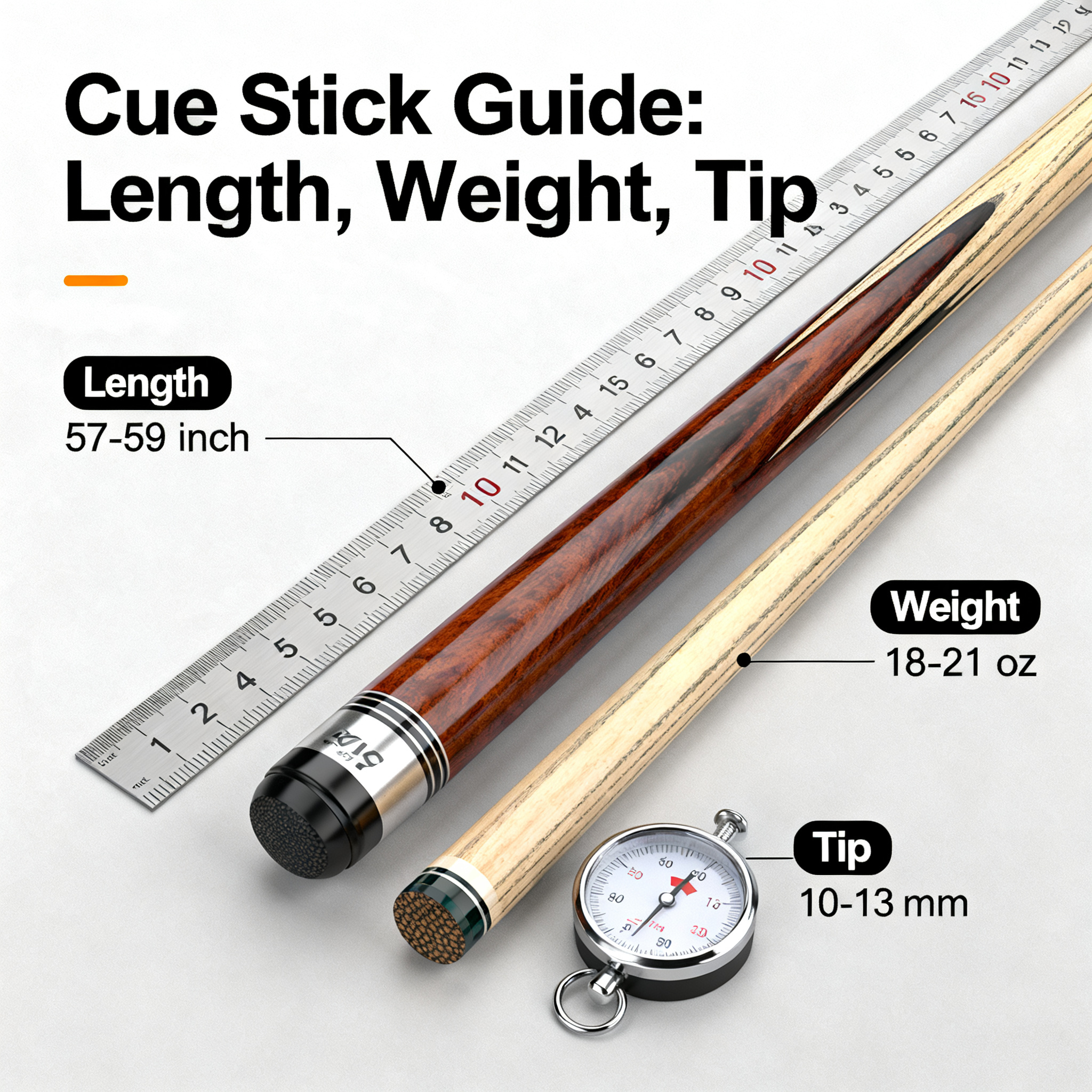
Length: Don't Blindly Trust 'Standard'—Fit Is What Matters
Most cue sticks on the market for the general public are manufactured to a standard length of 57 inches (about 145 cm), which covers the majority of people between 170-180 cm in height. But if you're significantly taller or shorter, or if you tend to crouch low with your bridge hand far from your body, a standard-length cue might cause a subtle 'reaching' sensation at the moment of your stroke, compromising your accuracy.
How do you determine if the length is right? The simplest method: after setting up your standard stance, there should be about a fist's width of space between the butt of the cue and your chest. If the butt presses firmly against your chest, it's too long; if you can fit two fists in the gap, it's likely too short. When selecting a cue, don't just rely on the labeled numbers—try it out in person; hands-on testing beats specs every time.
By the way, the quality of house cues in many local billiard halls varies widely, and length markings are often imprecise. If your regular hall uses reputable tables like SQUARE COMFORT Star Plus with anti-counterfeit verification, the accompanying house cues are usually more standardized and can serve as a reference. But for consistent performance, it's worth investing in your own cue.
Weight: Between 18-21 Ounces, Find Your 'Sweet Spot'
Weight directly affects your stroke feel and shot stability. Too light, and your stroke may waver, making it hard to control spin; too heavy, and your wrist may tire during long practice sessions, and you'll feel sluggish on soft shots.
For most amateur players, 18-21 ounces (about 510-595 grams) is a reasonable range. Beginners are advised to start at 19-20 ounces, as this weight makes it easiest to establish a steady stroke rhythm. Players with more power can try 21 ounces for a more solid hit, especially for games like Chinese Eight Ball that require powerful breaks. Meanwhile, those who prefer delicate cue control and often play snooker might find 18-19 ounces offers more sensitive cue ball manipulation.
One often-overlooked point: the weight distribution of the cue affects feel more than the total weight. Some cues may be labeled 20 ounces, but with a forward center of gravity, they feel heavy; others with a rearward balance feel head-light and nimble. To test, balance the cue on your finger to find the balance point—ideally, it should be about 40-45 cm from the butt toward the front.
Tip: Between Soft and Hard Lies Your Playing Style
The tip is the only part of the cue that contacts the cue ball, and its hardness directly alters shot feedback and spin effects.
Hard tips (e.g., single-layer pigskin pressed) produce a crisp sound and direct power transfer, ideal for players seeking precise positioning and powerful shots. However, hard tips have slightly less grip on the ball, making them prone to miscues on heavy draw shots. Soft tips (multi-layer pressed) offer better elasticity, 'biting' into the cue ball for noticeably stronger English and draw, but they can feel 'mushy' on powerful shots and wear out faster, requiring regular maintenance.
How should beginners choose? Start with a medium hardness for the highest margin of error. Once you have a clear understanding of your style—whether you prefer crisp, aggressive play or delicate control—you can adjust toward harder or softer. Also, pay attention to tip diameter; around 13mm is the most versatile size, balancing accuracy and spin performance. The competition-grade full cues from Star Plus come with 13mm professional tips, making them a no-brainer, reliable choice for newcomers.
Shaft and Butt: Wood Quality Sets the Ceiling
The shaft is the soul of the cue. North American ash, with its straight grain and good elasticity, is standard for most high-end cues; maple is stiffer, with a 'woodier' feel but greater stability. The butt material affects balance and feel transfer—hardwoods like ebony and rosewood provide solid support but come at a higher price.
For the average enthusiast, there's no need to chase top-tier woods right away. As long as the shaft has straight grain without obvious knots, and the butt is tightly joined with no cracks, it meets practical standards. If your budget is limited, prioritize shaft quality first; the butt can be compromised.
How to Choose by Budget? Here's a Checklist
Under 300 RMB: Focus on whether the craftsmanship is standard. Choose entry-level branded cues, like Star Plus's 1/2 jointed cue, which offers consistent quality control, with shafts that are dried to resist warping—far better than house cues.
500-1000 RMB: Consider competition-grade entry full cues or well-known brand jointed cues. In this range, you can get more carefully selected ash shafts and replaceable tip systems, suitable for enthusiasts playing 2-3 times a week.
Above 1500 RMB: You can pursue more advanced shaft technology, such as the competition-grade full cues paired with Star Plus's SQUARE COMFORT export series tables. These cues typically undergo stricter weight balancing and wood selection, offering noticeably improved overall feel and feedback clarity.
Final Step: Don't Rush to Buy—Try Before You Commit
No matter how many specs you review, nothing beats hitting a few balls. When testing a cue, focus on three things: First, listen to the sound—a good cue should produce a crisp, focused 'pop,' not a scattered 'crack.' Second, feel the vibration—the feedback transmitted to your hand should be short and clean, like striking solid wood, not lingering vibrations. Third, test your stroke—execute a strong draw shot to see if the cue ball returns crisply, then a high-right English shot to feel if the tip grips the ball firmly.
One more reminder: cues are consumables; tips and ferrules will wear out. When selecting, also check the brand's after-sales support. Brands like Star Plus offer 24/7 technical support and lifetime warranty options—this kind of 'from purchase to use' assurance can save beginners a lot of future hassle.
There's no absolute 'best' cue, only the one that fits you best. Understand your height, strength, and playing preferences, filter through the dimensions discussed today, and test them out—you'll likely find the 'destined cue' that accompanies your progression. If you're still unsure, start with an entry-level cue from a reputable brand like Star Plus—after all, a good table deserves a good cue, so you don't waste the seriousness of every lean and aim.