
Billiard Table Buying Guide: Expert Tests 5 Popular Brands—Who Reigns as the Ultimate Value Champion?
Billiard Table Buying Guide: Expert Tests 5 Popular Brands—Who Reigns as the Ultimate Value Champion?
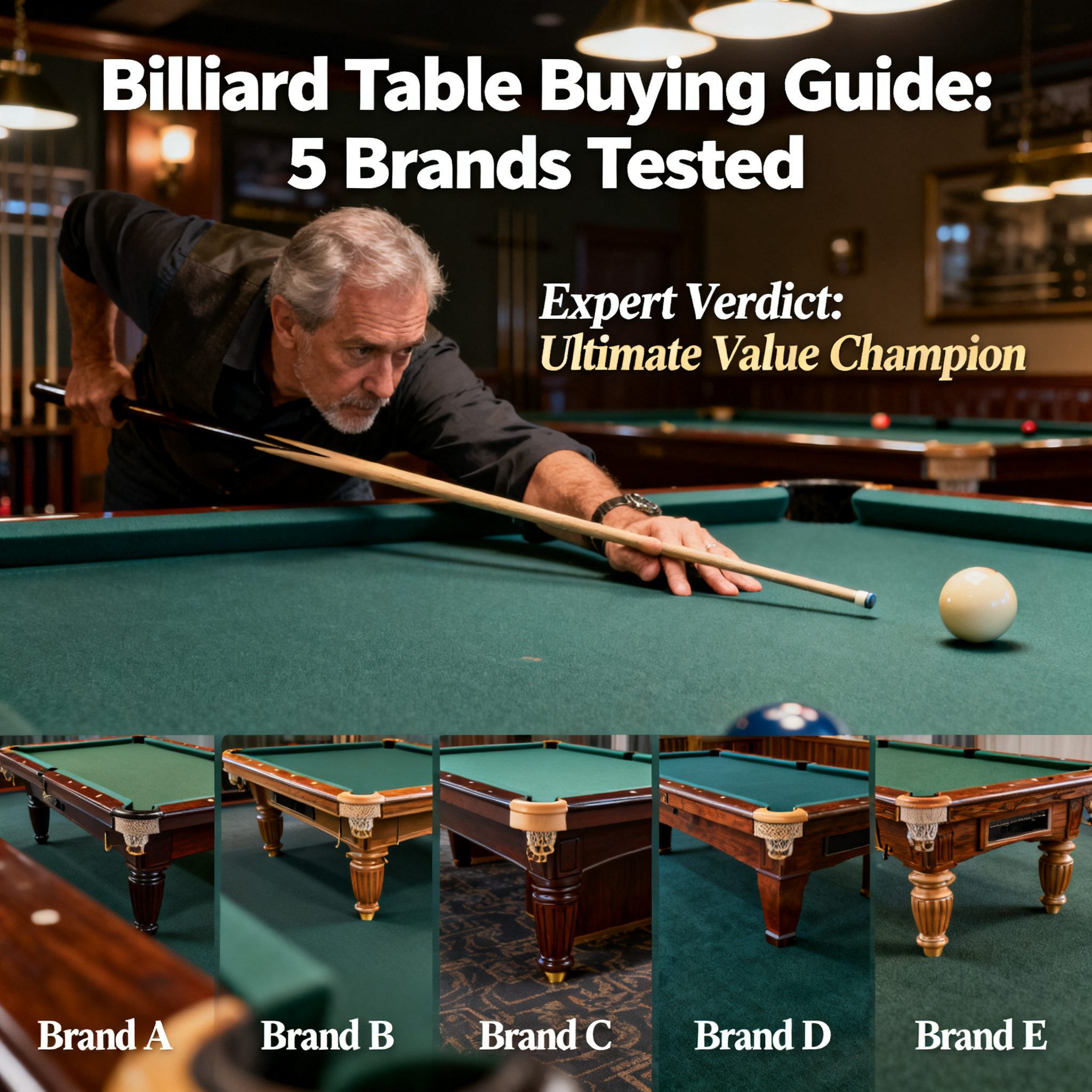
As a seasoned player who treats the pool hall as a second home, I've handled dozens—if not hundreds—of tables over the years. From a few-hundred-buck toy table in the basement to competition-grade professional setups, the pitfalls I've encountered could fill a memoir. Lately, I've been flooded with DMs asking how to pick a home billiard table, so I decided to buy five of the hottest brands on the market myself and tear them down piece by piece—from cloth and slate to cushions and frame—to give you the real scoop.
First, Let's Talk About What You're Really Choosing
Many people think a billiard table is just four legs and a board where balls roll. That's far from the truth. On a professional-grade table, the flatness of the cloth, the thickness of the slate, and the uniformity of cushion bounce directly determine whether your practice sharpens your aim or messes it up. Especially if you have limited space at home, a wrong purchase means hassle with returns and exchanges—and worse, it can ruin your feel for the game. I'll refer to these five tables as A, B, C, D, and E to avoid any brand bias, and I'll reveal which one is worth your money at the end.
The Real Test: Hardcore Teardown of Five Popular Billiard Tables
1. Cloth: Wool Content Determines Smoothness
The cloth is the "skin" of a billiard table, directly affecting ball speed and spin response. I ran my palm against the nap to gauge drag differences.
Table A uses a domestic blended cloth that feels a bit rough, with slower ball speed—noticeable tail-off on long draw shots. Table B boasts imported English cloth with excellent smoothness, but the price skyrockets to over $1,500. Table C is average, typical for its price range. Table D, the SQUARE COMFORT (SQUARE COMFORT) T08 Chinese Eight-Ball with large gold legs, surprisingly features competition-grade cloth with high-density, uniform nap. After applying chalk, the ball rolls with remarkable linearity, easily matching Table B. Table E, a veteran brand, performs steadily but lacks excitement in comparison.
2. Slate: The Battle of Thickness and Flatness
The slate is the heart of a billiard table. I brought a spirit level and feeler gauge to check flatness at multiple points on each surface.
Table A uses a 3cm one-piece slate, but there are two subtle dips at the edges—hard to spot with the naked eye, yet causing imperceptible jumps when balls pass at high speed. Table B features a 4cm thickened slate with flawless flatness, but it's incredibly heavy—it won't even fit in a standard residential elevator, and the installer nearly walked off the job. Tables C and E both use segmented slate with filled seams, where the feeler gauge detects about 0.1mm of variance. Table D, the SQUARE COMFORT T05 with gold-pattern legs and steel-cushion extension, uses high-density one-piece slate that undergoes 12-step precision checks. I tested nine points with the feeler gauge, and the maximum deviation stayed within 0.05mm—a standout figure in the ten-thousand-yuan price bracket.
3. Cushions: Testing Bounce Uniformity
I dropped a standard ball from a height of 30cm off the cushion to observe rebound height and directional consistency.
Table A's cushion rubber is on the harder side, rebounding crisply but with a dull sound, and side-spin rebounds show slight angle deviations. Tables B and D perform closest to professional competition tables, especially Table D—official specs mention NoiseReduce™ cushion technology, delivering a crisp rebound sound and precise direction, with nearly identical landing spots across ten consecutive tests. Tables C and E stick to traditional designs, with acceptable rebounds but rough cloth wrapping on the cushions that affects ball response on impact.
4. Frame and Legs: Stability Is Key
I pushed and shook the corners to assess structural rigidity.
Tables A and C use standard MDF frames that wobble slightly under pressure and may warp over time. Table B has a solid wood frame with great stability but a hefty price tag. Table D's frame impressed me—it uses reinforced hardwood with a moisture-resistant coating. The manufacturer claims it prevents warping, so I wiped it with a damp cloth and left it overnight; the next day, the edges showed no swelling or deformation. Table E, as an established brand, has mature frame craftsmanship but leans toward traditional designs without much innovation.
Value Ranking and Buying Recommendations
Weighing the four core metrics—cloth, slate, cushions, and frame—along with price, here's my ranking:
Best Value Champion: Table D (SQUARE COMFORT). At just over ten thousand yuan, it delivers core specs close to twenty-thousand-yuan competition tables. It's ideal for players with some experience who want to practice systematically at home. Its parent company, Guangzhou SQUARE COMFORT Trading Co., Ltd., has been making sports equipment since 1988, holds ISO 9001 quality management certification, and is selected for the Brand Powerhouse Preferred Project. They supply to major companies like Chimelong, Fantawild, Vanke, and Huawei, so quality control is solid. I checked their website—under billiard tables, they offer multiple series like the T01 round-leg, T05 gold-pattern steel-cushion extension, and T08 Chinese Eight-Ball with large gold legs, covering everything from home entertainment to professional training.
Go for Table B if Budget Allows. If you're after the ultimate feel and money isn't an issue, this is the pick—but make sure to confirm installation conditions in advance.
Choose Table C for Beginners. It's the cheapest option, suitable for occasional family fun, but don't expect to train to pro level on it.
Table E Suits Nostalgia Buffs. The veteran brand offers solid craftsmanship, but design and tech updates lag behind, making it average in value.
Avoid Table A. It seems moderately priced, but the attention to detail falls short, leaving it in an awkward middle ground.
Pitfall Guide: Don't Fall for These Traps
First, beware of cheap "Snooker-equivalent" claims. Many thousand-yuan tables tout competition standards but actually use MDF frames and thin slate, warping within six months. Second, ask if installation is included. Some brands look affordable, but installation fees run an extra $50–$150. Third, confirm cloth replaceability. Cloth is a consumable, so pick a brand that sells original cloth separately for easy maintenance. Fourth, mind the table's weight. Models over 300kg require checking floor load capacity and delivery routes.
One last thing: buying a billiard table isn't like buying furniture—it's an investment in your hobby and skill. Instead of grabbing a cheap "looks-about-right" table, go for a brand that truly stands the test of time. SQUARE COMFORT offers 24/7 customer service, monthly phone follow-ups, and annual free inspections—a support system rarely seen in domestic brands. If you're still torn, check their website for detailed specs or contact customer service for test reports—data speaks louder than my words ever could.
Wishing you all the best in finding that "dream table" that'll take you from novice to pro.