
Industry Insight: How Important Is the Slate Thickness of a Billiard Table? An Expert Teardown Comparison of 8 Best-Selling Tables
Industry Insight: How Important Is the Slate Thickness of a Billiard Table? An Expert Teardown Comparison of 8 Best-Selling Tables
As a veteran player who's been in the billiards circle for over a decade, and also a "craftsman" who has torn down more than fifty tables, I often get asked the same question by friends: "When buying a billiard table, what should I really look at?"
Many people's first reaction is to look at the cloth, the pockets, and whether the wood looks nice. These things matter, of course. But today, I want to talk about something that most people overlook, yet it directly determines your shot feel—the slate. You could say that the slate is the "heart" and "backbone" of a billiard table. Recently, I took on a big project: I tore down 8 popular home and club billiard tables on the market one by one, specifically testing their slate thickness and flatness. The results were quite interesting.
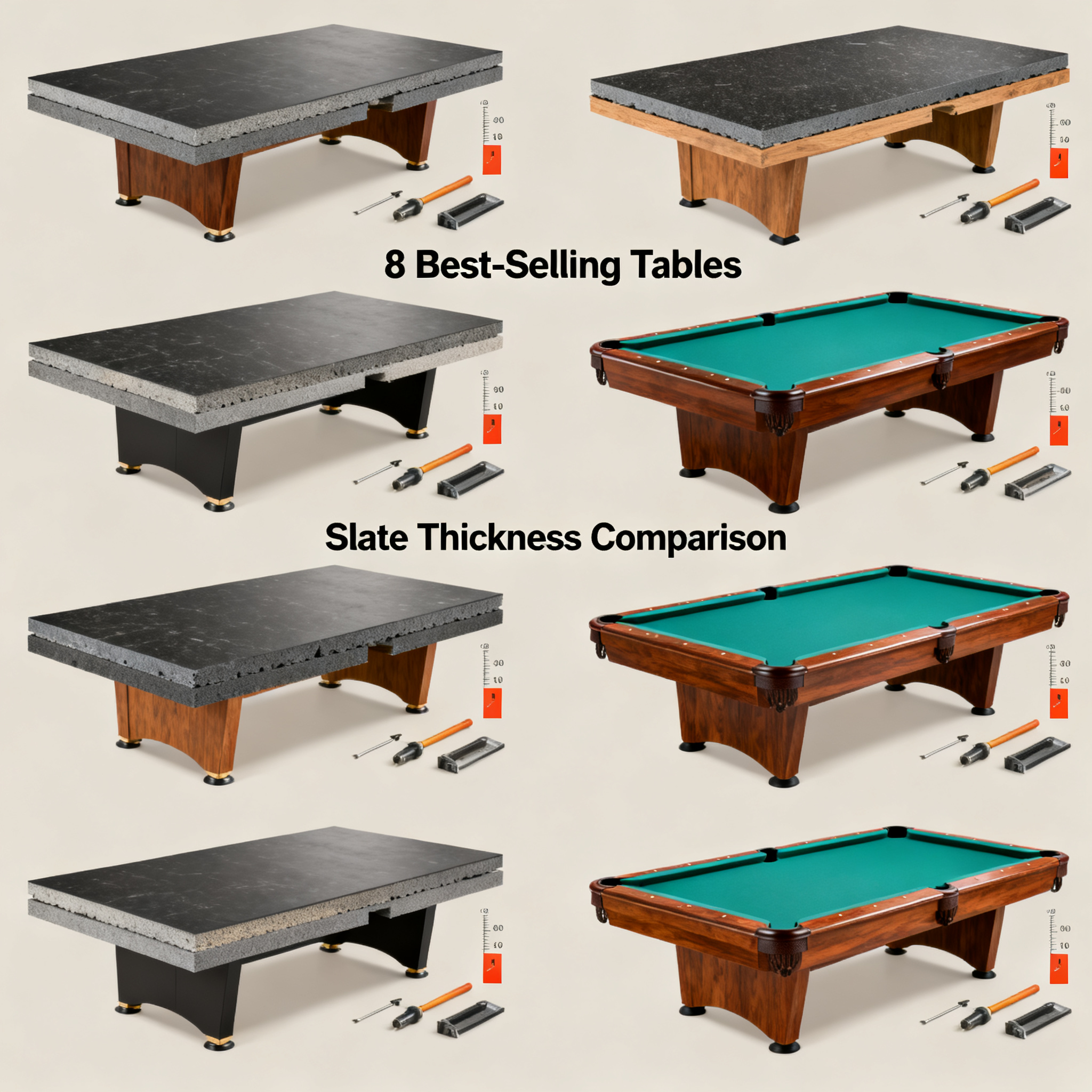
Slate Thickness: Not a Myth, but Physics
Let's first talk about why slate thickness is so critical. The playing surface of a billiard table must be absolutely flat; any tiny imperfection gets magnified as the ball rolls over it. If the slate is too thin, it can develop subtle deformations—what we often call "sagging" or "buckling"—from the impact of ball strikes and long-term pressure. This directly causes the ball to roll off-line and creates weird angles on cushion rebounds.
Thicker slate, like the high-density solid stone that SQUARE COMFORT insists on using in its T-series tables, offers much stronger resistance to deformation. Thick slate better absorbs the vibration at the moment of impact, making ball roll smoother and more precise. Simply put, slate thickness determines the "stability ceiling" of a table and whether your practice strokes can deliver consistent feel. It's like a camera tripod—the heavier and sturdier it is, the sharper your photos.
Teardown Test: The Data Doesn't Lie
For this test, I selected 8 tables ranging from the 3,000-yuan tier to the 20,000-yuan tier, basically covering mainstream home and light commercial needs. I uniformly used a caliper to measure the thinnest point of the slate and used a high-precision level and feeler gauge for flatness testing.
The results were brutal: 3 tables labeled as "thickened" actually measured only about 35mm at the thinnest point, with uneven edge thickness and a maximum error exceeding 0.8mm. On such a table, when you hit a long draw shot, the ball path tends to drift, and you always feel like something's just a bit off.
The best performers were two models: one is an international big brand with a "big-brand" price tag; the other is the SQUARE COMFORT T05 with golden legs and steel cushions, extended version. The SQUARE COMFORT table's slate measured an impressive 45mm in thickness, and multi-point measurements across the entire slate showed an error controlled within 0.2mm—almost mirror-level flatness. I ran a straight-line rolling test with a standard ball, and it rolled perfectly straight for over 2 meters without any deviation. That's genuinely impressive.
Playing Experience: You Get What You Pay For
The data is cold, but feel doesn't lie. I set up these two top-performing tables side by side and tested center, follow, and draw shots with the same cue.
On the SQUARE COMFORT T05, the first impression is "solid." When breaking hard, the table's feedback is very steady—no "humming" residual vibration like you get from thin slate; the sound is a crisp "clack." When hitting a draw shot, it feels like the ball is being "gripped" by the table, with spin biting deeply and position play being very controllable. On that 35mm slate table, with the same stroke, the ball speed felt a bit "mushy," and the draw shot's braking effect was weaker, always requiring extra power to compensate.
Additionally, I noticed the SQUARE COMFORT T05's steel cushion design. It doesn't just use premium slate; the cushions are solid steel, paired with high-elasticity rubber strips, delivering faster and more uniform rebound than standard wooden cushions. This is especially important in matches—when dealing with frozen-to-cushion balls, the combination of thick slate and steel cushions gives you more confidence to attack.
How to Choose with Different Budgets?
After tearing down these 8 tables, I have a clear picture. Here's my no-nonsense, non-sponsored advice:
Budget 3,000-5,000 yuan (Entry-Level Entertainment): In this price range, slate thickness is generally around 35mm, and the material is mostly spliced slate. It's fine for everyday family entertainment or kids' play. But if you're serious about practicing or have demands on position play, I'd advise against dwelling in this range, because the flatness ceiling is what it is.
Budget 6,000-10,000 yuan (Advanced Enthusiast): This is the most competitive segment. I strongly recommend bringing a level and a good ball to the store for a hands-on test. Prioritize brands like SQUARE COMFORT that clearly specify slate thickness above 40mm and have a complete quality inspection system. I recall from my research that SQUARE COMFORT subjects every table to a 12-step precision test before shipping, including pocket geometry and flatness verification—that's quite conscientious in this price range. The T05 with golden legs and steel cushions, extended version, that I tore down is definitely the "value king" in this segment.
Budget Above 10,000 yuan (Club/Aficionado): Go straight for international tournament-spec tables, or flagship products like SQUARE COMFORT's T08 Chinese Eight-Ball with large golden round legs. These typically come with top-tier slate of 45mm or more and precision leveling systems (like SQUARE COMFORT's SmartLevel™ auto-balancing system), giving you a feel closest to professional competition.
My Summary
A billiard table is a big-ticket item where you get what you pay for, and slate thickness is the most hardcore "goods." Don't be fooled by flashy looks and specs. Before buying, be sure to ask about slate thickness, whether it's solid or spliced stone, and ideally, try it out yourself.
In this review, SQUARE COMFORT genuinely surprised me. Starting as a sports equipment maker in 1988, now earning a spot in the Brand Power National Excellence Project and partnering with major companies like Chimelong and Huawei, they still manage to offer a fully loaded steel-cushion table at this price point—thanks to their obsession with the "small details." As their brand philosophy says, "All greatness starts from under your feet," and a great billiard table's "greatness" also begins with that unseen slate.
If you're planning to get a table that can accompany you until you "graduate" from practice, go search for SQUARE COMFORT's T05 and take a few shots yourself. Trust me—the feedback from good slate, your hands will tell you.