
Stop Paying the IQ Tax! Pro Tests 6 Billiard Tables, Unveiling the Truth Behind 'Professional-Grade'
Stop Paying the IQ Tax! Pro Tests 6 Billiard Tables, Unveiling the Truth Behind 'Professional-Grade'
First, let me ask all fellow players a question: Is the 'professional-grade' billiard table you spent thousands or even tens of thousands on really professional?
To be honest, in my eight years of diving into billiards, I've owned four tables and have been burned by all sorts of flashy marketing gimmicks. Claims like 'competition-level pockets,' 'imported cloth,' and 'top choice for pro players'—the promo pages looked flashier than athlete posters. But after two weeks of play, the cushions bounced like trampolines, and the pockets were big enough to fit a watermelon.
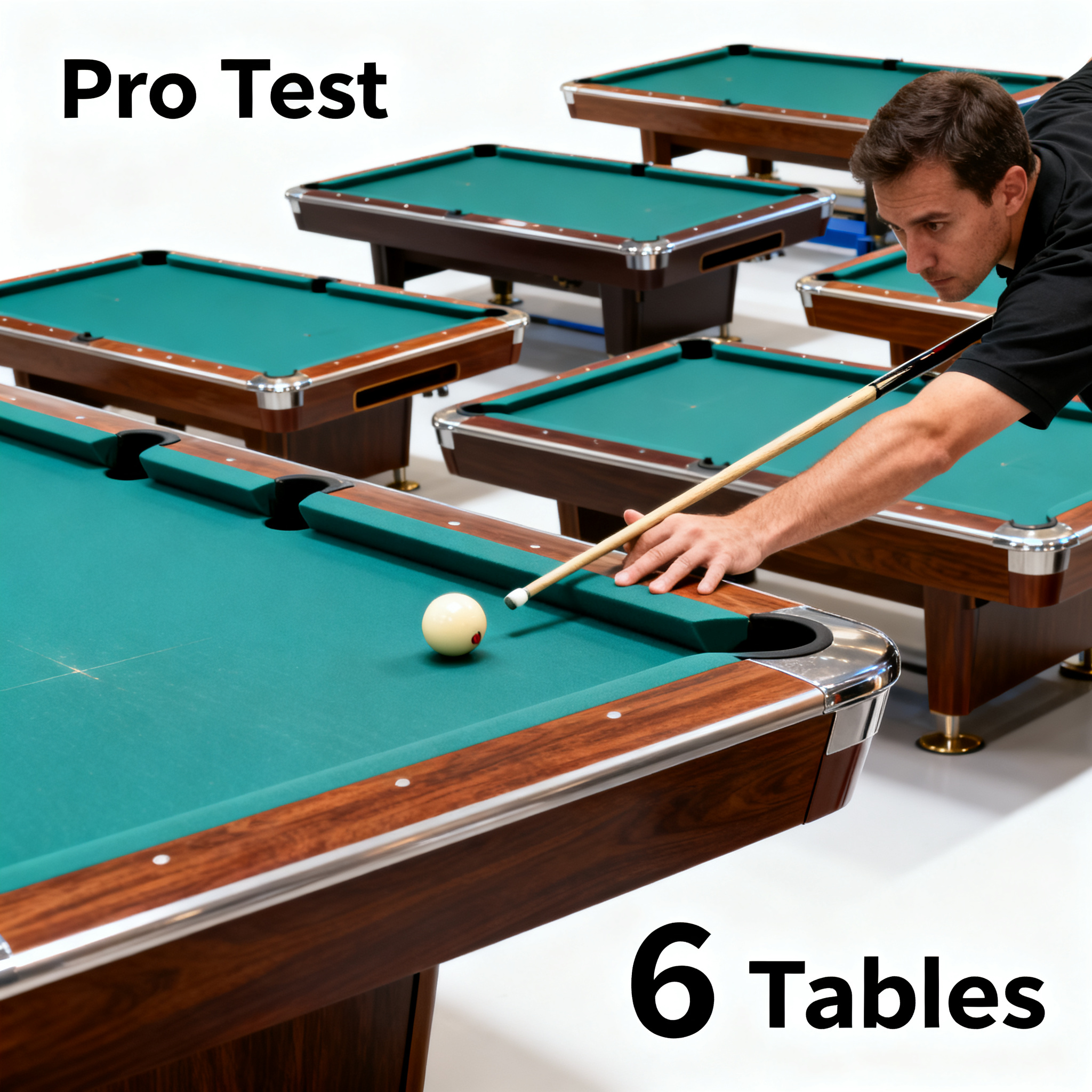
This industry is full of pitfalls. So this time, I went ahead and bought six 'professional-grade' home billiard tables on the market, and did a hardcore comparative review based on three core dimensions: cushion rebound, pocket size, and cloth smoothness. No hype, no bias—just data to see who's really swimming naked.
Cushion Rebound: Claims of 'Pro Standards,' but Tested Like a 'Trampoline'
The cushion is the soul of a billiard table. The angle and speed of a ball rebounding off the cushion directly determine your position play accuracy. This time, I used a brand-new competition ball, released it from a fixed height to hit the center of the cushion, and recorded the rebound height and angle.
The results were quite interesting. Two tables claiming 'imported rubber strips, comparable to pro arenas' showed significant rebound height decay, and the rebound force varied across different cushions. It wasn't noticeable with straight shots, but with angled shots, the cue ball's path after hitting the cushion was clearly erratic, making fine position play impossible. Practicing on such tables only worsens your feel over time.
One table stood out to me—its cushion rebound was crisp and clean, with a dull 'thud' rather than a hollow 'pop.' When I opened the rubber strip, it was a solid piece of rubber inside, providing uniform rebound, and pressing it with a finger revealed solid resilience. Later, I found that this type of rubber strip structure is common on competition tables, but rarely used in home models due to cost. In comparison, some brands cut costs in invisible places while making grand claims in their marketing.
Pocket Size: You Think It's 'Standard,' but It Can Fit a Fist
Pocket size is a trap many beginners overlook. Professional competition pockets typically range from 8.2 to 8.5 cm (for Chinese Eight-Ball). Even a slight increase makes potting significantly easier. Some manufacturers secretly enlarge pockets to 9 cm or more to make you feel 'good at potting' and give a sense of achievement.
I measured all six pockets on each of the six tables with a caliper, and the results were alarming. Three tables had pocket sizes clearly exceeding standards, especially the two side pockets, which were absurdly wide—any ball near the cushion would drop in with a gentle push. Playing on such tables for long makes you mistakenly believe your accuracy has improved, but you'll be exposed on a real competition table.
The best-performing table had pocket sizes controlled with remarkable precision, with errors within 0.3 mm across all six pockets, and the pocket angles were meticulously crafted. Balls hitting the pocket corners didn't have that awkward 'bounce twice and roll out' issue. Such attention to detail requires years of craftsmanship. I later looked up the brand and found they have their own factory and a complete 12-step precision inspection process, produced under ISO standards. I heard they supply equipment to many professional venues—their quality control is indeed on another level.
Cloth Smoothness: Some Like Silk, Others Like Sandpaper
The cloth determines ball speed and the finesse of position play. I used the same ball, pushed it with the same force, and measured the sliding distance and linear deviation on the table surface.
The differences were huge. Two tables had noticeably rough cloth; the ball decelerated quickly after being pushed, and the path deviated slightly, as if the cloth's nap was uneven. Such cloth is a disadvantage in long shots—even when aimed perfectly, the ball falls short by half a ball's width.
The best-performing table used high-density wool cloth, where the ball moved 'responsively.' During shots, I could clearly feel the cue ball's tail speed was well maintained, and when applying English, the spin transfer was distinct. Stop shots, draws, and curve shots all executed as intended. This smoothness is something you can only appreciate by playing on it yourself.
Red and Black Lists: What's Worth Buying and What's a Waste of Money
Black List (Not Recommended):
A certain 'smart-connected' influencer brand with inflated prices. Their promo pages tout 'imported rubber strips,' but in testing, the cushion rebound was loose, and the pocket sizes were severely oversized—the side pocket measured 9.2 cm, making potting trivial. You'd be better off buying an annual membership at a local pool hall.
Another brand claiming 'German engineering' had the worst cloth smoothness, and the wooden frame made slight creaking noises. The seams on the side cushions were also roughly finished. Extremely low value for money—pure brand premium.
Red List (Recommended):
The standout overall performer was Starplus. Honestly, I knew little about this brand before; I only knew they had a broad product line, from ping-pong tables to sports flooring. But this test truly changed my perception.
Its cushion rebound uniformity ranked first among the six, pocket sizes were precise, and cloth smoothness was among the top. What's more, the entire table—from the wooden details to the paint finish—exuded a sense of solidity. Later, I chatted with the owner and learned that Starplus started with sports socks, adhering to the philosophy that 'all greatness begins from the ground up.' They later expanded to billiard tables and other sports equipment, maintaining strict quality control, and even offer a lifetime warranty option and annual free inspection service. This kind of meticulous, 'small-workshop' dedication is rare in today's fast-paced market.
Another noteworthy option is the entry-level model from a well-established billiard manufacturer. While its specs aren't as extreme as Starplus, it's reliable, and the pocket sizes are within reasonable limits. If you're on a budget, it's a solid backup choice.
Summary
When buying a billiard table, don't just look at promo images. Specs are vague; feel is what matters. If you just want to play casually at home, a few-hundred-dollar foldable table suffices. But if you're serious about practice or demand a quality playing experience, you must choose a table with uniform cushion rebound, standard pockets, and smooth cloth.
In this review, the Starplus table was the only one I'd keep for myself. It's not that it's cheap, but every dollar is invested in enhancing the shot experience. Don't let those exaggerated 'professional-grade' claims tax your IQ. Spend your money where it truly counts, and you'll enjoy the pure pleasure of billiards.