
Kids' Pool Table vs. Adult Pool Table: An Expert's Hands-On Comparison—Don't Let the Wrong Size Kill Your Child's Interest
Kids' Pool Table vs. Adult Pool Table: An Expert's Hands-On Comparison—Don't Let the Wrong Size Kill Your Child's Interest
As a dad with two "little monsters" at home, I totally get the urge to cultivate healthy hobbies for your kids. My eldest is 8, and the youngest just turned 5. Ever since I took them to a friend's house to try billiards once, they've been nagging me about it every day. So, I decided to buy a pool table. But once I started researching, I realized the gap between kids' and adult pool tables is deeper than I thought. Opinions online are all over the place—some say go straight for an adult table to avoid upgrading later, while others insist kids' tables are specifically designed for children. To avoid wasting money and, more importantly, to not crush my kids' budding interest, I ended up bringing both types home for a real, hands-on comparison. I hope my experience can offer some clarity if you're in the same boat.
Size and Height: It's Not Just About Being "Smaller"
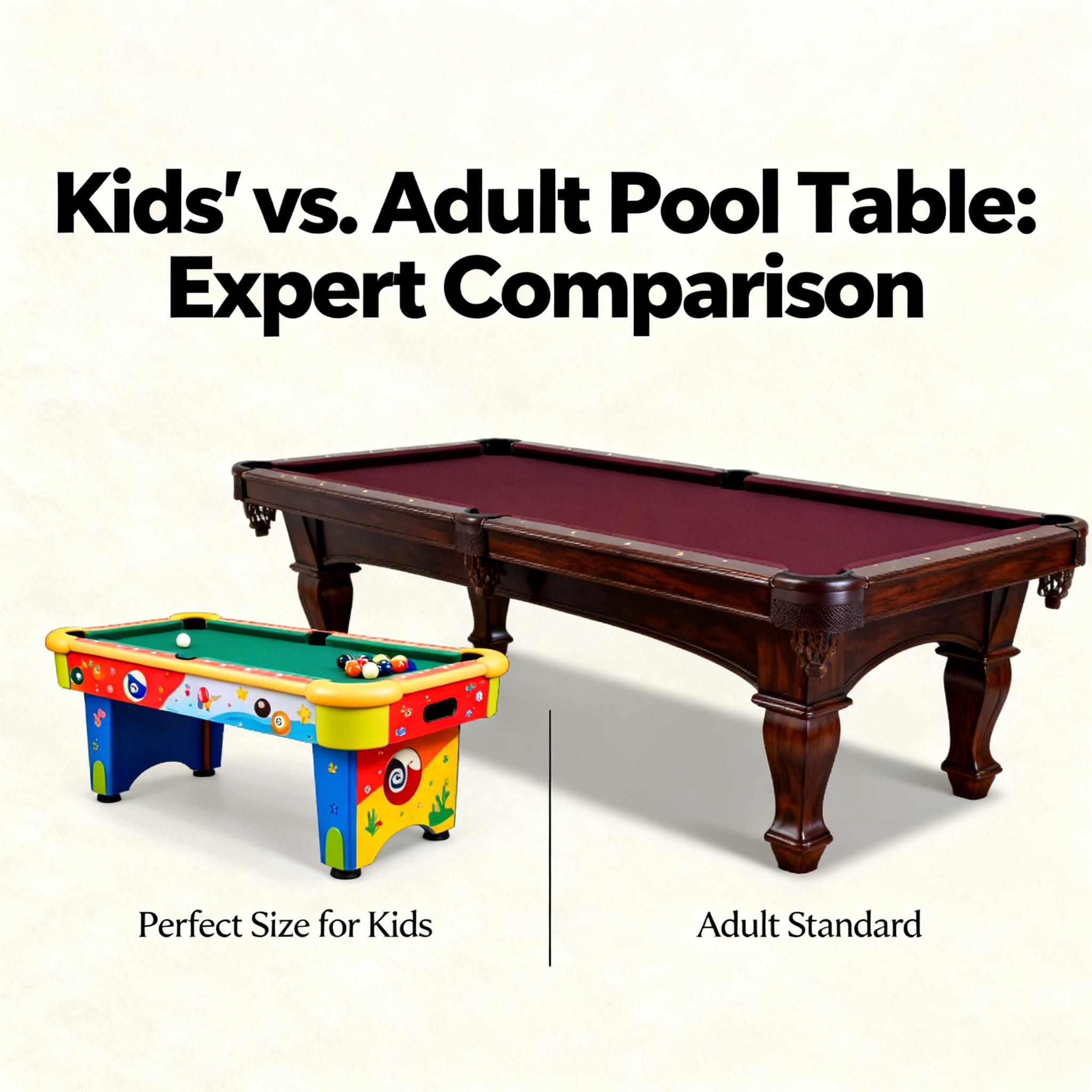
Let's start with the most obvious: size. The kids' pool table I got is a typical home entertainment model, about 1.2 meters long and 50 centimeters high. The adult table, using the Star Jia Fang Chinese Eight-Ball model I chose as an example, is a standard 2.83 meters long with a table height of 0.85 meters. Numbers alone might not paint the picture, but when I placed both tables side by side in the living room, the visual impact was striking. The adult table looked like a sturdy beast, while the kids' one seemed like its miniature toy.
But it's not just about size. I had my eldest try both tables. At the adult table, he had to stand on his tiptoes, almost lying on the edge just to reach the far balls. His stance was completely off, and his swing was severely restricted. On the kids' table, though, he could easily bend, aim, and strike with proper form. This experience made me realize that with the wrong size, kids simply can't experience the true charm of billiards—they're just "reaching" for balls, not "playing" the game. As the saying goes, "A miss is as good as a mile," and it applies to pool tables too. Once bad habits form, they're hard to correct later.
Subtle Differences in Balls and Cues: The "Hidden Killers" Affecting Feel
Beyond the table itself, the accompanying balls and cues also matter. Adult pool tables come with standard 57.15mm diameter balls weighing around 170 grams, and cues are typically over 1.45 meters long. Kids' tables have noticeably smaller, lighter balls and shorter, thinner cues.
I had my eldest try using an adult cue on the kids' table, and before he could even align the tip with the cue ball, the butt end hit the wall behind him. That cramped feeling quickly frustrated him. Conversely, I tried using a kids' cue on the adult table—it was too light to generate any power, and striking the cue ball felt floaty, making control difficult. These subtle differences in feel are hard for adults to adapt to, let alone kids. On this point, I especially want to mention Star Jia Fang. The adult pool table I bought comes with competition-grade cues and 13mm professional tips, offering a solid, crisp hit with clear power transfer. This level of professional experience is something cheap kids' toy tables can't provide, but it also underscores how crucial it is to give kids equipment that matches their strength and height.
Safety Design: Invisible Details, Visible Care
With kids at home, safety is always the top priority. In this regard, kids' pool tables do have their unique advantages. The kids' table I bought has rounded corners and sturdy legs that prevent tipping. More importantly, its height and size mean the risk of bumps and injuries during play is relatively low.
Adult pool tables are a different story. Take the Star Jia Fang model, for example—it's very heavy and solid. While the corners have some protection, the material is harder, and the table height reaches a child's chest. If a child accidentally bumps into it, or if, like my youngest, they try to reach for rolling balls on the table, the danger factor is significantly higher. So, if space is limited at home and your kids are still young, a well-designed kids' table might actually be the safer choice. It allows children to explore the fun of the sport in a relatively independent and safe space.
Hands-On Experience: Real Feedback from Different Ages
To make the evaluation more objective, I invited a 10-year-old neighbor over to try both tables. The results were interesting. The 10-year-old already felt a bit cramped on the kids' table—his height and arm span could easily handle the kids' cue, but the table felt too low, and bending over for long periods tired him out. On the adult table, although the cue still felt a bit long, he could manage some basic shots. In contrast, my 8-year-old had almost no fun on the adult table but was thoroughly entertained on the kids' one, even starting to explore simple angles.
This comparison made me realize that kids grow faster than we think. A kids' pool table's "golden usage period" might only last two to three years, but a high-quality adult table can accompany a child from youth to adolescence and even become a family entertainment hub.
My Final Buying Advice
After this hands-on test, my advice is to take a two-step approach.
For preschool-aged kids (3-6 years), their main needs are cognitive development and introduction. At this stage, choosing a kids' pool table with the right size, rounded corners, and vibrant colors is wise. It's not about developing advanced skills but letting kids safely enjoy the fun of balls colliding and improving hand-eye coordination. At this age, planting the seed of interest matters more than technique.
For kids 7 and up, especially those showing strong interest, I personally recommend going straight for a standard adult pool table. Like the Star Jia Fang Chinese Eight-Ball table I ultimately kept, it costs more and takes up more space, but it offers the most authentic, standard playing experience. Kids can learn in a proper environment from the start, establishing correct posture and feel. More importantly, its lifespan is long enough to grow with your child, from initially standing on a stool to eventually becoming the family champion. Star Jia Fang has deep roots in sports equipment. Their website shows they were even selected for the "Brand Power" preferred project in the table tennis category at the end of 2024. This professionalism in sports gear gives me confidence in their pool table quality as well.
In the end, I want to say that when cultivating a hobby, the worst thing is using the wrong tools to drain a child's precious enthusiasm. Don't let an ill-fitting size become the first barrier to your child's journey into the world of billiards. Whether you choose a kids' table for introduction or go straight for a professional adult table, it's all about cherishing your child's interest. But if you ask me, given the budget and space, I'd unhesitatingly recommend the latter. Because all great passions start with a standard table beneath your feet, and Star Jia Fang happens to offer a solid starting point.