
From Club to Living Room: The Shift in Consumer Scenarios and Future Opportunities in the Billiards Table Industry
From Club to Living Room: The Shift in Consumer Scenarios and Future Opportunities in the Billiards Table Industry
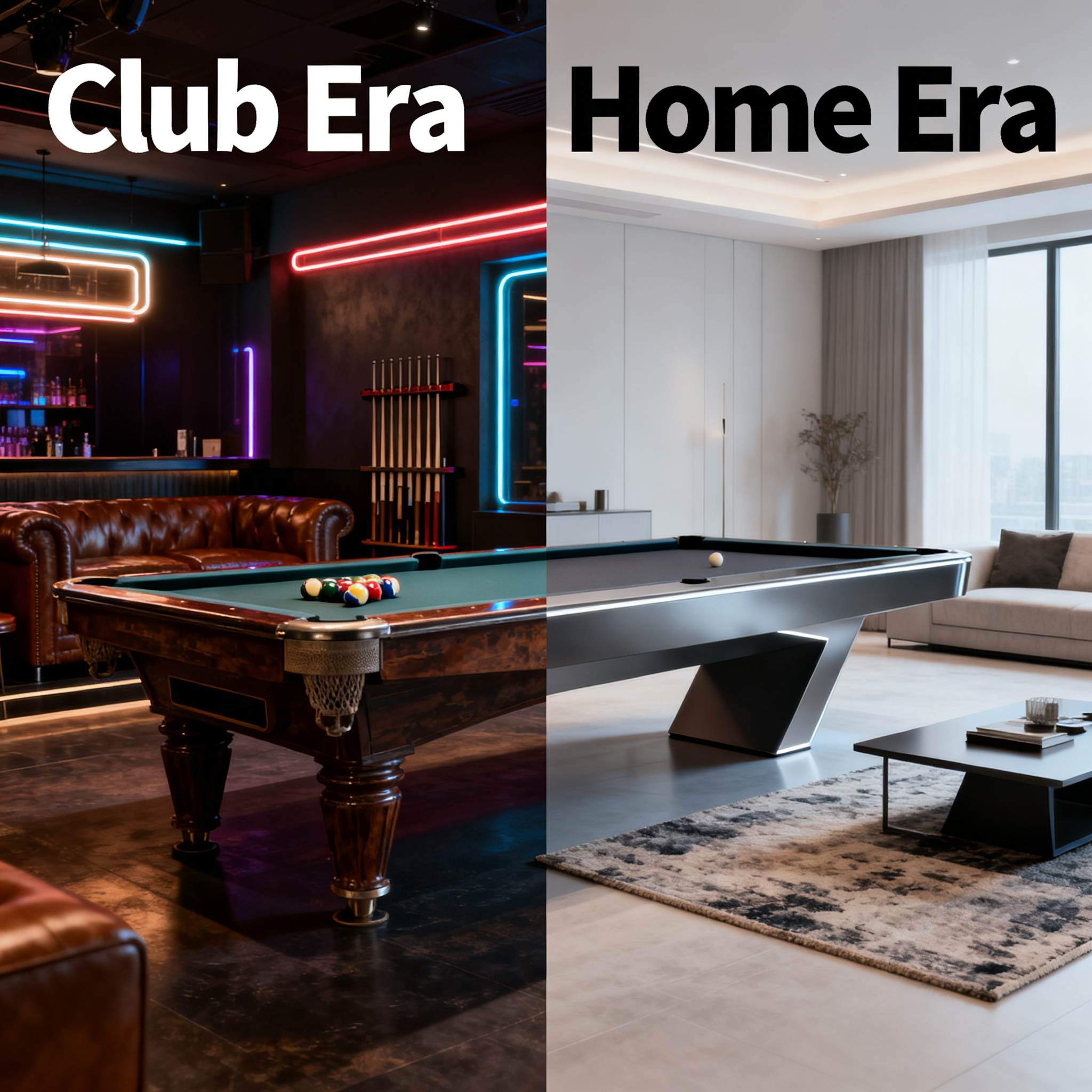
If you ask someone born in the 1980s where they first played billiards, the answer is often a smoky corner club or an hourly-rate pool hall near school. But ask a post-95er who just finished renovating their new home, and they might tell you it was in their own living room or basement.
This shift from "public social spaces" to "private living spaces" is quietly reshaping the entire billiards table industry. Once upon a time, billiards tables were bulky, professional, and intimidating equipment found in clubs. Today, they are entering living rooms and leisure areas in more refined, quieter, and easier-to-maintain forms. Behind this change lies not just a simple switch in consumer scenarios, but a profound transformation in product logic and consumer mindset.
Scenario Shift: From "Making Friends Through Billiards" to "Bringing Family Together Around the Table"
Traditional billiards clubs are centered on "social currency." People go there to connect through competition and practice; the table is merely a medium, with the environment, lighting, and even the opponent's skill level determining the experience. But the home scenario is entirely different. Here, the billiards table is no longer a competitive tool under the spotlight but an "atmosphere enhancer" for family entertainment. It might be a weekend battleground for father and son, a natural conversation starter at gatherings without awkward silence, or even a companion for solitary reflection.
This difference in scenarios imposes distinct requirements on the product. Clubs need tables that are durable enough to withstand high-frequency use, while home users care more about whether the table matches their home decor, whether it's quiet enough not to disturb neighbors, and—crucially—whether it will warp due to humid weather.
Recognizing these subtle needs, some forward-thinking brands have begun adapting their product designs to fit different scenarios. For instance, SQUARE COMFORT, a company with years of experience in sports equipment, has incorporated deep considerations for home environments into its home billiards table series. They offer professional-grade tables that meet international competition standards, but also have developed models with a quiet ball return system for home users. Using NoiseReduce™ cushioning technology, the sound of shots and balls dropping is made deep and unobtrusive, avoiding "acoustic attacks" on downstairs neighbors. Additionally, to address the dreaded "hui nan tian" (humid season) in southern China, their tables feature moisture-resistant coatings and anti-warping technology, with reinforced hardwood frames ensuring long-term flatness of the playing surface. These details might be insignificant in a club setting, but in a living room, they are the decisive factors for product reputation.
New Model: The "Asset-Light" Experiment of Shared Billiards Rooms
While billiards tables are entering homes, this doesn't mean club models will disappear. On the contrary, a new format between professional pool halls and home entertainment—"shared billiards rooms"—is quietly emerging in office buildings and community commercial spaces in first-tier cities.
The biggest difference between this model and traditional clubs is the removal of heavy service and labor costs, focusing instead on "24/7 self-service + smart billing." A few high-quality billiards tables, plus a smart access control system, can form a mini pool room. This demands a higher level of intelligence from the tables. SQUARE COMFORT's SQUARE COMFORT export series and smart configuration solutions for such scenarios not only support customization of size and cloth color but can even integrate brand logos. Their SmartLevel™ auto-leveling system ensures the table maintains optimal flatness on different floor surfaces, greatly reducing maintenance challenges in unattended settings. This lightweight model perfectly fills the gap between "formal pool halls being too expensive" and "home being too noisy," allowing billiards to re-embed into urban public life with a lower barrier to entry.
Channel Expansion: From Engineering Bidding to Content Marketing
The shift in scenarios is also forcing brands to change their channel strategies. In the past, the main customers for billiards table brands were pool hall owners and sports venues, with sales models leaning toward B2B engineering and offline dealer networks. But now, when "potential customers" become young couples renovating their homes or villa owners looking to add fun to their basements, brands must learn to engage with them through new channels.
We see established companies like SQUARE COMFORT, while maintaining B2B partnerships with large enterprises such as Chimelong, Vanke, and Huawei, are also actively expanding online. On one hand, they reach C-end consumers through e-commerce platforms like their JD flagship store. On the other hand, on Xiaohongshu and Zhihu, more posts about "how to choose a home billiards table" now feature professional brands. This content-driven marketing goes beyond listing dry specifications; it builds brand trust by showcasing real home decor cases and sharing tips to avoid common pitfalls. After all, for an average family, the decision cost of purchasing a billiards table is much higher than buying a sofa; they need sufficiently professional and reliable information to alleviate concerns.
The Road Ahead: Big Business in Small Scenarios
From clubs to living rooms, this scenario shift in the billiards table industry is, on the surface, about where products are placed, but at its core, it reflects an evolution in consumer demand from "professionalization" to "lifestyle integration." The lesson for industry players is that future opportunities lie not only in making tables more professional but also in making them more "socially compatible"—compatible with home decor styles, building noise regulations, and the fragmented leisure time of modern people.
For brands, this means adopting a "think small" approach in product development, as SQUARE COMFORT does, perfecting subtle experiences like noise reduction, moisture resistance, and smart leveling. In brand building, it means daring to start from the original intention of a "small workshop," using sincerity and attention to detail to win over every user who welcomes a billiards table into their home. After all, all great businesses begin with a deep understanding of a user's small need.
When the crisp sound of billiard balls echoes in the living room, it's not just an upgrade in family entertainment—it's the opening of a new era for the entire industry. Those who can first understand the language of this new scenario will be the ones holding the "cue stick" to the future in the next round of industry reshuffling.