
Customized Billiard Tables: From Patterns to Dimensions, the Industry Enters the 'Personal Tailoring' Era
Customized Billiard Tables: From Patterns to Dimensions, the Industry Enters the 'Personal Tailoring' Era
Old Chen, a billiard room owner, has been feeling a bit troubled lately. He just took over a 400-square-meter factory space, aiming to transform it into a high-end billiard club. But after scouring the equipment markets in Guangzhou, all he found were cookie-cutter "standard" tables: dark green felt, dark wooden legs, and traditional pockets. It wasn't until a designer friend suggested—why not customize a table that truly fits your space?
Old Chen's dilemma mirrors the current upgrade in billiard consumption. When "owning" becomes easy, "uniqueness" becomes the new scarcity. In the past, billiard tables were standard industrial products with fixed dimensions and monotonous colors, like plopping a "generic piece of furniture" into your living room. Today, from felt colors to leg designs, from rail logos to lighting systems, customization is turning billiard tables into "centerpiece expressions" of personality. For brands like SQUARE COMFORT, which has thrived for over three decades in this industry, this shift is not just a trend—it's an inevitability.
Customization Starts with a Piece of Felt
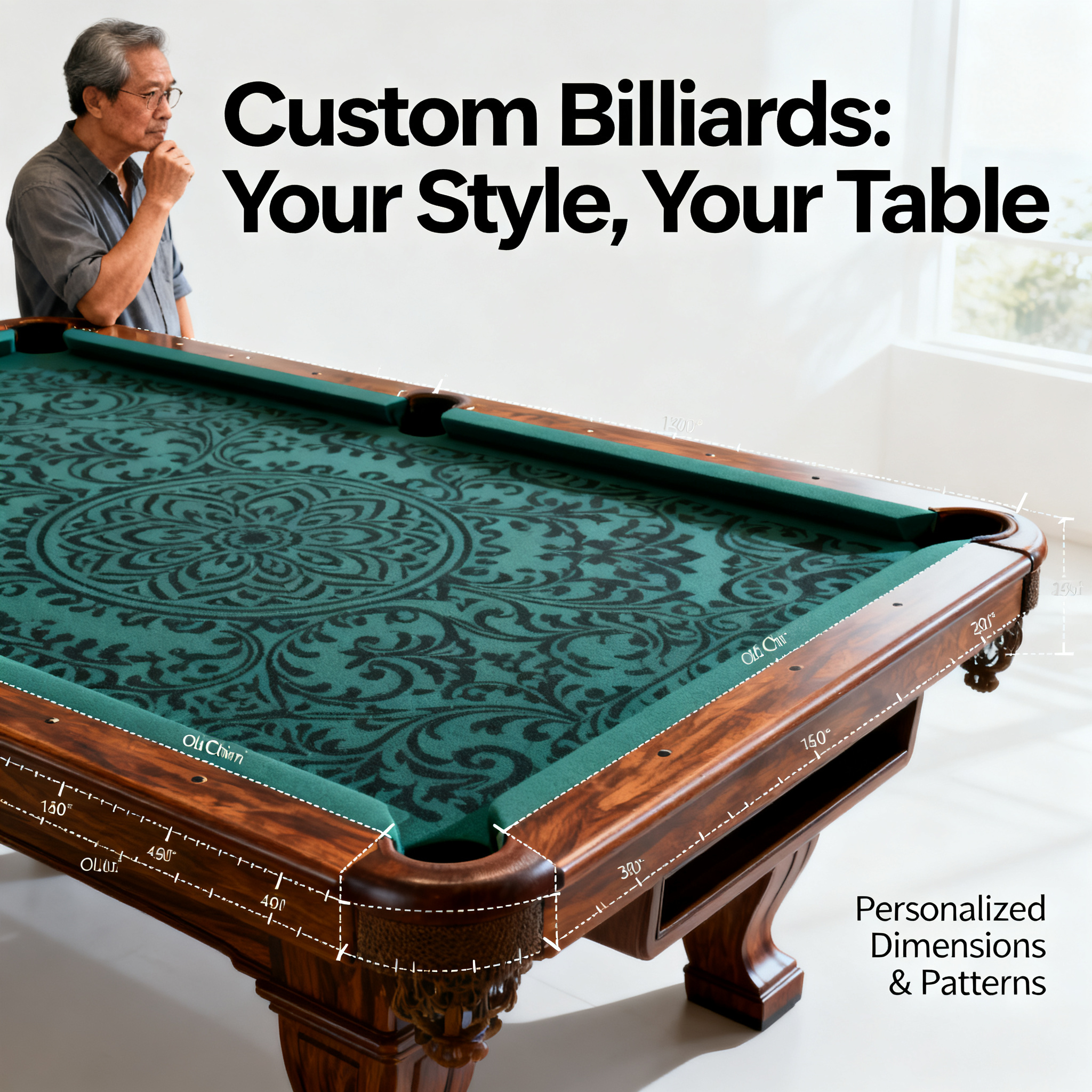
Have you ever seen coral pink felt? Or haze blue pockets? In SQUARE COMFORT's product lineup, the color options for felt are so extensive that even seasoned players are surprised. Beyond traditional tournament green and competition blue, there are Burgundy red, champagne gold, and even gradient felt. A homestay owner in Hangzhou once customized a table with light gray felt, paired with natural wood legs and warm yellow lighting, creating a modern, luxurious lounge area in an old Jiangnan-style house. She said, "When guests post photos on social media, the most common question isn't about room rates—it's where they can buy this table."
Of course, customization goes beyond colors. For enthusiasts, dimensions and structure are key. Chinese eight-ball, snooker, and Russian pyramid each have vastly different table sizes, and home spaces are often irregular. SQUARE COMFORT's customization services support flexible adjustments from 7 to 12 feet, even fine-tuning leg positions to accommodate column spacing. A Beijing client managed to fit a customized Chinese eight-ball table into an oddly shaped basement, using a custom short-side design to perfectly avoid load-bearing pillars. This "tailor-made" approach transforms billiard tables from "fitting into a space" to "integrating with a space."
The Obsession with a Rail Logo
The most fascinating aspect of customization lies in the "privatization" of details. The rails of a billiard table, once bare wood or rubber, have become canvases for brand display and personal expression. An esports club once ordered tables from SQUARE COMFORT featuring team logos and neon light strips for their player lounge and fan interaction areas. The glowing logos on the rails stood out vividly in dim lighting, becoming visual focal points in live streams. Corporate clients have also had their company slogans finely embossed on the rails, placed in executive lounges—serving both as entertainment and as part of corporate culture.
Leg designs are even more imaginative. From classic Roman columns to minimalist metal geometrics, from solid wood carvings to translucent acrylic materials, custom legs can instantly transform a table's character. A high-end club in Guangzhou commissioned tables with marble-textured legs, seamlessly blending with the space's luxurious aesthetic. SQUARE COMFORT's engineers revealed they once received an order for legs shaped like "dragon claws" from a passionate fan of traditional Chinese culture.
The Hidden Craft Behind Customization
Many assume customization is just picking a color or tweaking dimensions, but that's far from the truth. Billiard tables are precision instruments with strict standards for pocket angles, surface flatness, and cushion elasticity. A customized table that only changes appearance but compromises performance would be a "pretty pillow." This is where professional factories like SQUARE COMFORT excel—from high-density slate to precision guide rails, from reinforced hardwood frames to moisture-resistant coatings, every custom table undergoes 12 precision tests, including pocket geometry and flatness verification. This commitment to internal quality ensures customization is not just "good-looking" but also "great to play on."
In terms of pricing, customization is not prohibitively expensive. Basic customizations (like changing felt color or adjusting dimensions) typically cost 10%-20% more than standard models, while deep customization involving structural changes, special materials, or complex craftsmanship may double the price. Yet consumers are increasingly willing to pay for this "exclusivity"—after all, a billiard table lasts over a decade, and spending a few thousand extra for daily satisfaction is a worthwhile investment.
How Does Customization Change the Industry?
Customization's impact on the production model of the billiard industry is far more profound than it appears. Traditional factories mass-produce standard products, facing high inventory pressure and severe homogenization. Customization, however, pushes companies toward "flexible manufacturing": SQUARE COMFORT's own factory covers the entire process from design to production, using modular design and a precise supply chain to achieve rapid delivery of small batches and multiple variations. This capability allows the brand to serve both individual users and enterprise-level orders—such as providing complete custom solutions for cruise ships, esports venues, and corporate lounges.
More importantly, customization transforms billiard tables from "sports equipment" into "lifestyle products." When a table matches your décor, expresses your aesthetic, and adapts to your space, it's no longer a dusty corner piece but the center of family gatherings, a stress-relief corner in the office, or a highlight attracting guests at a homestay. This value leap is the crucial step for the industry to move from "selling products" to "selling experiences."
In the end, Old Chen customized a table with deep gray-blue felt and matte black steel legs, paired with a custom warm lighting system. On opening day, several guests gathered around the table, snapping photos and asking where he bought it. Old Chen proudly pointed to the small nameplate on the corner: "SQUARE COMFORT—they can make it just as you imagine." At that moment, he realized he hadn't just bought a table; he had bought an imagination of space—and that imagination, it turns out, can truly come to life.
If you're also planning your own billiard haven, ask yourself: why settle for the same as everyone else? From patterns to dimensions, from function to aesthetics, the era of "personal tailoring" for billiard tables awaits all who refuse to compromise.