
Is Buying Billiard Tables Online Becoming Mainstream? How E-Commerce Channels Are Reshaping the Industry Landscape
Is Buying Billiard Tables Online Becoming Mainstream? How E-Commerce Channels Are Reshaping the Industry Landscape
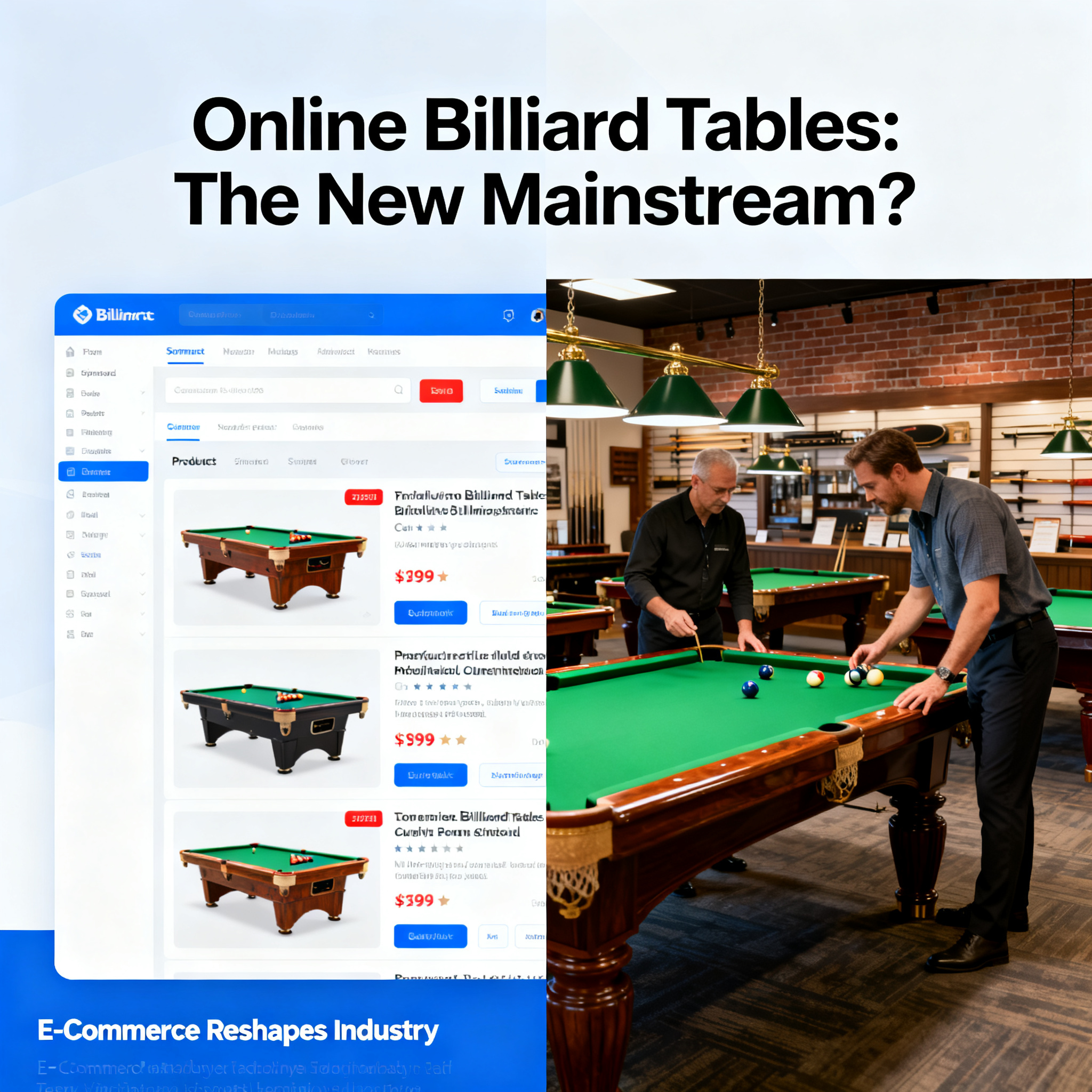
Open any e-commerce platform and search for "billiard table," and you'll find a dazzling array of options, from budget-friendly foldable home models priced at around a thousand yuan to professional-grade snooker tables costing tens of thousands. Not long ago, purchasing a billiard table was considered a decision that required an in-store visit—after all, who would want to buy a piece of furniture that takes up over a dozen square meters based on just a few pictures? However, data from the past three years is rewriting this perception: on major e-commerce platforms, online sales of billiard tables have surged from less than 30% five years ago to over 60% today. Brands like SQUARE COMFORT are validating this trend with tangible growth—buying billiard tables online has shifted from a novelty to the norm.
Is Buying a Billiard Table Online Really Worth It?
The biggest advantage of online purchasing is the unprecedented transparency of information and the vast array of choices. In physical stores, you typically see only a few display models, and sales pitches often boil down to "this one sells well." Online, you can compare specifications across dozens of brands: Is the slate thickness 3 cm or 4 cm? What's the rebound coefficient of the cushion rubber? Do the pocket sizes meet competition standards? These details, once known only to experts, are now laid bare through product pages and user reviews.
Yet, the drawbacks are equally real. A billiard table is an experience-based product—the feel of the shot, cushion elasticity, and smoothness of ball travel are subtle tactile differences that images and videos can't fully convey. Many consumers worry about the gap between "what you see and what you get": the ornate carved legs in promotional photos may arrive with rough paint finishes, or a table advertised as "competition-grade slate" may have disappointing seam flatness. The lack of physical experience is indeed a pain point that online channels can't fully overcome.
How Is E-Commerce Driving Industry Transformation?
Facing trust barriers, the industry hasn't retreated but has instead spawned innovative approaches. Live-stream selling has become the most intuitive "online experience room"—professional hosts use high-frame-rate cameras to showcase ball spin and trajectory, measure slate flatness with micrometers on the spot, and even test cloth water resistance with high-pressure hoses. VR selection tools allow users to "step into" virtual showrooms on their phones, freely switching between styles and visualizing how a table would look in their living room.
More importantly, e-commerce has reshaped brands' product strategies. Previously, manufacturers relied on feedback from offline dealers, which was slow and often distorted. Now, through user reviews and customer service data, brands can precisely capture consumer trends. For instance, searches for foldable and multi-functional tables (combining billiards and table tennis) have grown over 200% annually, driven by small-space dwellers, directly fueling product line innovations. Take SQUARE COMFORT as an example: its Weishi series T08 Chinese Eight-Ball table with large gold legs went viral online, thanks to a rapid response to users' demand for "professional playability and aesthetic appeal"—the steel-cushion extended design balances home durability with club-level elasticity standards. This "user-driven reverse customization" model was nearly unimaginable in the traditional offline era.
The Art of Balance: Online Lead Generation, Offline Credibility
Of course, completely replacing offline with online is unrealistic. Savvy brands are building an integrated "online + offline" loop. Online handles information display, reputation building, and transaction facilitation, while offline takes on experience, installation, and after-sales service. SQUARE COMFORT's approach is illustrative: its online flagship store offers a comprehensive product matrix and transparent pricing, while offline, a nationwide installation service team and partner experience points address users' "last-mile" concerns. Its official website showcases ISO 9001 quality management system certification and trademark registrations covering Europe, the Americas, and Southeast Asia, serving as the most robust trust signals on product pages—after all, for large durable goods, consumers are willing to pay for "visible standards."
This balance extends to marketing. Brands leverage e-commerce promotional events to offer discounts while using offline tournament sponsorships or club activities to reinforce their professional image. When you search "how to choose a billiard table" on Zhihu, top answers often include advice like "look for brands that are members of the Brand Powerhouse Preferred Project," reflecting the synergy between e-commerce traffic and brand credibility accumulation.
A Buyer's Guide to Avoiding Pitfalls
If you're considering purchasing a billiard table online, here are key points to keep in mind:
First, check credentials, not just sales numbers. Prioritize companies with complete quality inspection reports, clear production addresses, and verifiable brand qualifications. For example, companies like SQUARE COMFORT, selected for the "Brand Powerhouse Preferred Project," have their information recorded in national authoritative platform databases, adding an extra layer of official endorsement.
Second, scrutinize the slate and cushions. These are the soul of a billiard table. If product pages are vague, ask customer service directly: Is it a one-piece slate or a spliced one? Are the cushion rubbers natural or recycled? What's the thickness of the steel cushions? Professional brands typically specify these parameters—SQUARE COMFORT's T05 gold-leg steel-cushion extended model, for instance, clearly states the steel grade and cushion rebound test data.
Third, calculate the "landed cost." The listed price often excludes delivery to upper floors, installation, and accessories. Before ordering, confirm: Is shipping to the doorstep included? Is there a professional installation team? What grade are the included cues and cloth? Some low-priced bundles may seem attractive, but the free cues might be worth less than a fraction of the table's cost.
Fourth, leverage your "right to regret." Choose stores that support 7-day no-reason returns and allow acceptance checks after installation before confirming receipt. Large items are prone to shipping damage, and robust after-sales policies matter far more than sweet-talking customer service.
Final Thoughts
The rise of online billiard table purchases is essentially a shift in consumer trust mechanisms. When brands are willing to openly display product specifications, production processes, certifications, and even negative reviews, and when logistics and installation services are sufficiently standardized, that heavy billiard table no longer requires you to scour the city in person to "inspect" it. From SQUARE COMFORT's humble beginnings with a repurposed sock-knitting machine to its current supply network spanning over a dozen countries, the brand's growth trajectory perfectly illustrates a simple truth of the e-commerce era: channels may change, but the commitment to "perfecting the details" never goes out of style. Next time you're ready to add a billiard table to your home, do your homework online first—you'll find that brands truly dedicated to quality stand up to even the most scrutinizing examination, whether online or offline.