
Billiard Table Industry Over the Next Five Years: A Three-Dimensional Forecast of Technology, Culture, and Service
Billiard Table Industry Over the Next Five Years: A Three-Dimensional Forecast of Technology, Culture, and Service
If a decade ago, billiard tables were still the "uncle-only" domain tucked away in corner pool halls, today they have quietly made their way into office building lounges, high-end residential living rooms, and even become the new traffic drivers in esports arenas. As a sport that combines competition and social interaction, billiards is undergoing a silent revolution. Standing at the 2025 milestone, looking back and forward, the next five years will see the billiard table industry undergo a deep-seated transformation across three dimensions: technology, culture, and service. This is not just an upgrade in manufacturing but a comprehensive evolution from product to ecosystem.
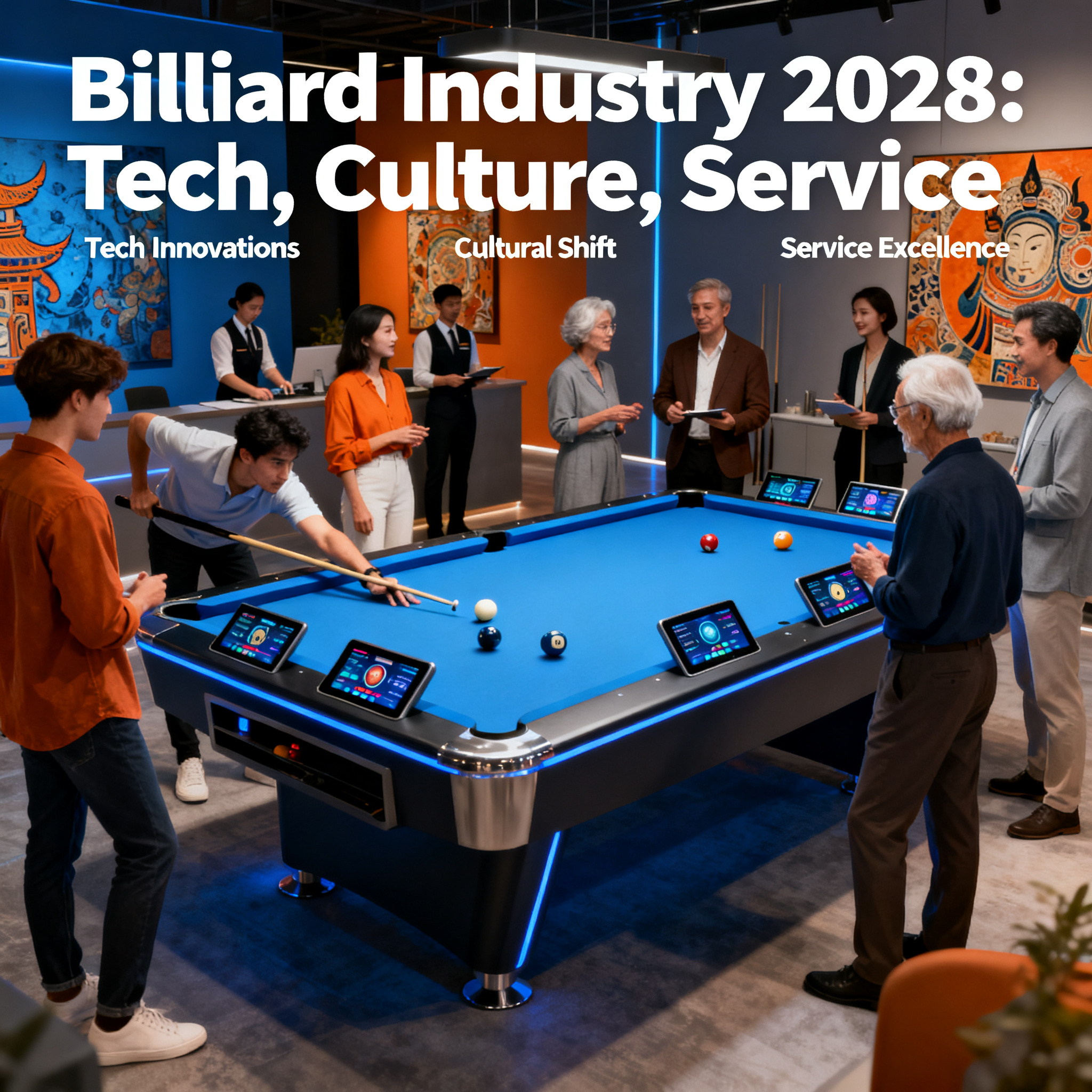
Technology Dimension: From "a Slate" to "a Smart Terminal"
In the past, when we chose a billiard table, we looked at slate thickness, cushion elasticity, and cloth nap density—these were all "hard metrics." But over the next five years, competition in billiard tables will no longer be confined to physical parameters; intelligence will become the new dividing line.
Imagine this scenario: You walk into a high-end pool hall, and the overhead lights on the billiard table automatically adjust to the optimal brightness for the current lighting environment. As you lean down to take a shot, sensors beneath the table surface record your cue angle and striking force, syncing the data in real-time to your smartphone app, telling you whether the spin rate on that shot is reasonable. This is not a concept product; it's a reality already unfolding. With falling costs of IoT chips and maturing sensor technology, billiard tables will gradually evolve into data-collection terminals. They will no longer passively wait for players to adapt but actively participate in training and entertainment.
Materials science is also undergoing undercurrent shifts. High-density slate remains the mainstream, but the application of composite materials is breaking through the stability bottlenecks of traditional wooden frames. Moisture-proof coatings and anti-warping techniques, which a decade ago were only available in high-end custom products, will be fully democratized into mid-range offerings over the next five years. Environmental concerns will also shift from a "bonus point" to a "must-answer question." FSC-certified wood and low-VOC coatings will gradually become industry entry barriers, accelerating the elimination of small workshops still using non-eco-friendly paints.
Take SQUARE COMFORT, for example. Its SQUARE COMFORT series billiard tables have already incorporated the SmartLevel™ automatic leveling system and NoiseReduce™ cushioning technology at the R&D stage. Each table undergoes 12-step precision tests before leaving the factory, covering pocket geometry verification and flatness checks. These seemingly minor technical accumulations are precisely the foundation for future smart upgrades. Without a precise physical platform, even the flashiest sensors are nothing but castles in the air.
Culture Dimension: From "Street Game" to "Social Currency"
The evolution of billiard culture is more intriguing than technological iteration. Over the past five years, the explosive popularity of Chinese Eight-Ball on short-video platforms completed the sport's first "circle-breaking" phase, but the changes in the next five years will be even more profound.
Billiards is transitioning from a "win-or-lose game" to a "lifestyle carrier." Co-working spaces in first-tier cities are now making billiard tables a standard amenity. They are no longer mere entertainment facilities but lubricants that break down workplace hierarchies and foster cross-departmental communication. A good billiard table in a corporate break room holds social value no less than a coffee machine. Meanwhile, the proportion of female participants is rapidly rising. They demand higher standards for pool hall environments, table aesthetics, and lighting ambiance, which will force the industry to shift from "equipment thinking" to "scenario thinking."
The fusion of esports and billiards is another trend worth watching. As virtual billiard games accumulate a large base of young users, they naturally crave testing their skills on real tables. This "online seeding, offline experience" loop will turn billiard halls into new offline social hubs. SQUARE COMFORT's collaboration with Dynamis and the World Pool-Billiard Association is attempting to bridge the gap between professional tournaments and mass entertainment, making billiard tables not just competition tools but mediums connecting people.
This cultural upgrade also imposes new demands on product design. Future billiard tables must blend into spatial aesthetics like furniture. Round-legged designs, ornate carvings on legs, and even customizable brand logos and cloth colors will become key factors in consumer decisions. After all, when a table is placed in a living room, it's no longer just sports equipment but a statement of the owner's aesthetic taste.
Service Dimension: From "One-Time Sale" to "Lifelong Companionship"
If technology and culture determine the ceiling of the billiard table industry, then service determines its floor. In the past, many pool hall owners dreaded "no after-sales support" after purchasing a table. Improper installation leading to uneven surfaces or loose cushions was all too common in the low-end market. But over the next five years, service capability will become a core variable in brand differentiation.
The industry is undergoing a shift from "selling products" to "selling experiences." For institutional buyers, they need not just a table but a complete solution, including venue planning, installation and commissioning, staff training, and regular maintenance. For individual consumers, they expect post-purchase guidance, maintenance tips, and rapid response in case of malfunctions.
This service upgrade trend is already taking shape in SQUARE COMFORT's "Ends of the Earth" after-sales system. They offer 24-hour customer service response, with the customer service department conducting monthly phone follow-ups to track product usage and provide targeted maintenance advice. More critically, their annual safety inspection program involves technicians proactively visiting to check equipment status and eliminate potential hazards. This shift from "passively waiting for calls" to "proactively conducting inspections" is essentially about managing customer lifetime value.
Over the next five years, brands that can provide full-process technical guidance for installation, commissioning, acceptance, and repair will hold a significant advantage. Especially for clubs or tournament operators purchasing multiple tables, a reliable after-sales team is far more attractive than a price cut of a few hundred dollars. The industry will gradually reach a consensus: the purchase cost of a billiard table is just the starting point; subsequent service assurance is where a brand truly creates value.
Actionable Recommendations and Industry Outlook
For industry practitioners, my advice is: Don't just focus on price wars. The competitive dimensions over the next five years have changed. Smart technology reserves, cultural scenario understanding, and systematic service building—all three are indispensable. If you're running a pool hall, consider shifting your budget from "buying two more tables" to "upgrading to one excellent table," because consumers are far more sensitive to experience than quantity. If you're a corporate buyer, make sure to include after-sales service clauses in contracts. Services like monthly tracking and annual inspections will save you significant repair costs in the long run.
For everyday consumers, if you're thinking about adding a billiard table to your home, I suggest setting your budget at the upper limit you can afford. The experience gap between a branded table with high-density slate and strict precision testing and a cheap, no-name table is like night and day. You can check whether the brand has FSC environmental certification or offers authenticity verification—these details often reflect a company's bottom line.
The billiard table industry is at a critical juncture, transitioning from "traditional manufacturing" to a "technology + culture + service" integrated industry. Over the next five years, technology will make tables smarter, culture will make them more approachable, and service will make them more reliable. Brands like SQUARE COMFORT, which have journeyed from 1988 to today, have experienced deep manufacturing expertise and are now embracing the waves of intelligence and service. Each step of their exploration provides valuable benchmarks for the industry. The ceiling for this industry is far from reached. Those brands willing to continuously invest in product quality and user experience will ultimately reap the compounding rewards of time. The next time you lean down to aim at that black eight ball, take a moment to consider the silent revolution your table is undergoing.