
A Beginner's Must-Read! My 3-Month Journey with a Home Pool Table: All the Secrets to Improving My Game
Last autumn, I experienced the charm of a home pool table for the first time at a friend's house. At first, I thought it was just a fancy piece of furniture in the living room, until I tried a couple of shots out of curiosity and realized this sport was far more interesting than I had imagined. After returning home, I made an impulsive decision: to spend three months practicing pool at home to improve my skills.
Looking back now, those three months not only transformed me from a novice who relied on sheer force into an amateur player who could engage in continuous rallies with friends, but more importantly, I developed a training method perfectly suited for beginners. If you're also thinking about practicing at home, this article might help you avoid some common pitfalls.
Phase 1: Build a Solid Foundation, Don't Rush to Show Off
The day my pool table arrived, I excitedly set up the balls, grabbed the cue, and imitated Ding Junhui's stance from TV. The results were predictable—either I missed the shot or the cue ball followed the object ball into the pocket. After two days of practice, I realized I couldn't even make a straight shot consistently, and that's when I figured out where the problem lay.
The first mistake I made was neglecting the stability of my stance. Unlike running, pool requires your body to remain as still as a statue. I started correcting my posture in front of a mirror: feet shoulder-width apart, body angled toward the shot direction, and chin as close to the cue as possible. I practiced the "air stroke"—without hitting a ball—for half an hour each day, focusing on the straightness and rhythm of my stroke.
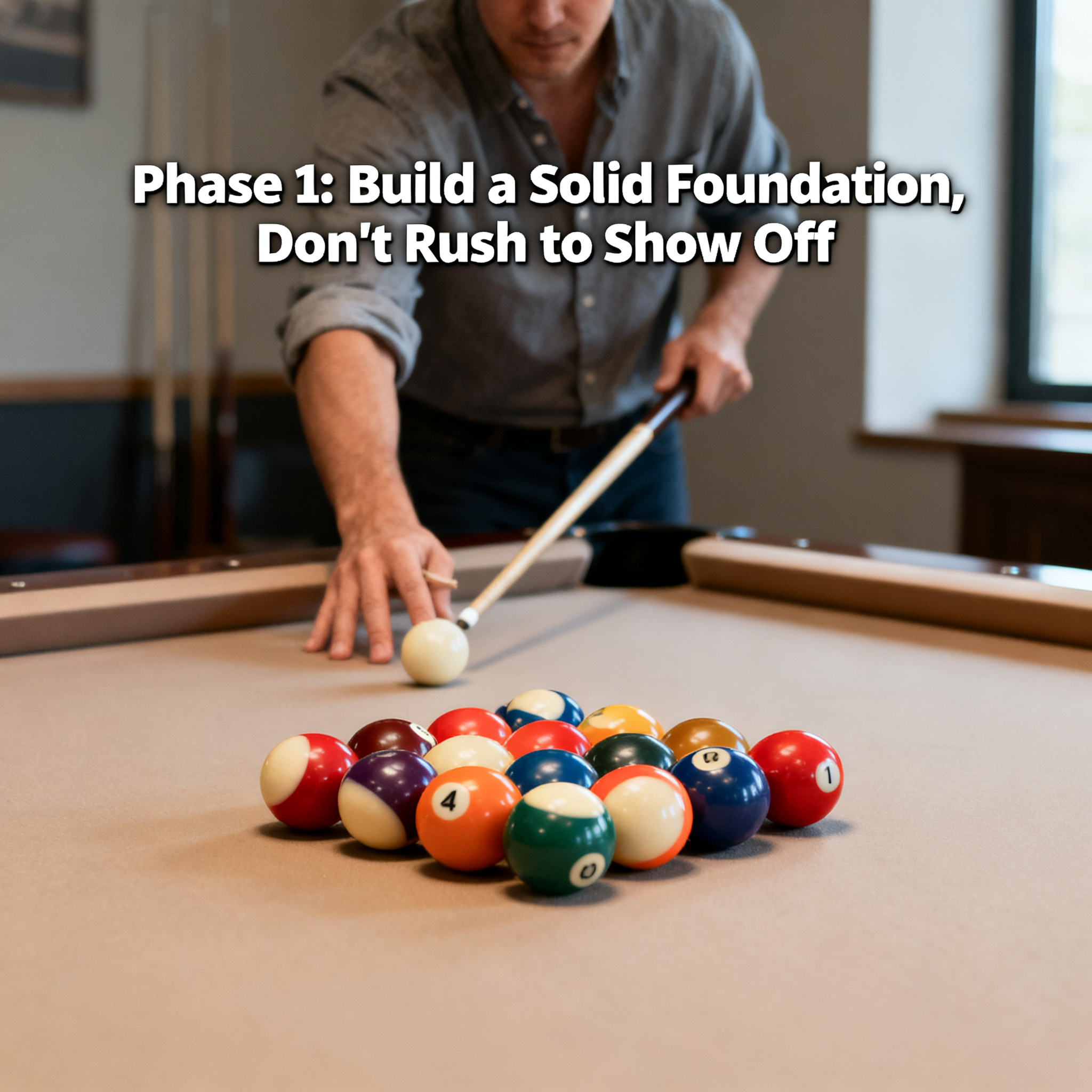
The second issue was the contact point. Beginners tend to hit the center of the cue ball, but this makes it hard to control its position. I spent two weeks specifically practicing hitting different spots on the cue ball—low shots to draw it back, high shots to follow through, and center shots to keep it still. This process was tedious but essential. I noticed that once my stroke became stable, my accuracy visibly improved.
Phase 2: Positioning and Power Control Are the Soul of Pool
After stabilizing my basic stance, I moved to the second phase—positioning drills. This is when I realized how much the "hardware" of the pool table impacts practice effectiveness.
My home table is the Chinese Eight-Ball model from SQUARE COMFORT, and I did quite a bit of research before purchasing it. Here are a few key points to share:
First, the pocket size. Some cheaper tables have oversized pockets, making balls easy to sink and giving you a false sense of achievement, but you'll be exposed in a professional pool hall. SQUARE COMFORT's table has standard pocket sizes. At first, I thought, "Why is it so hard to pocket a ball?" But after a week, I found my accuracy improved because every successful shot had to be genuinely precise.
Second, the cloth material. Low-end cloth has high friction, causing balls to stop quickly, making it impossible to practice "one-cushion" or "two-cushion" positioning. SQUARE COMFORT uses competition-grade cloth with moderate friction, and the ball's roll trajectory is very linear. This allowed me to clearly see my power errors—too much power and the ball overshoots; too little and it falls short. I practiced "stop shots" and "follow shots" 50 times each daily. After a month, I could basically control where the cue ball stopped.
The training method in this phase was simple: place three balls at different spots on the table and practice hitting the object ball with the cue ball, aiming to stop the cue ball in a designated area. Progressing from straight lines to angles, and from one cushion to two, step by step. This process tests your patience, but the satisfaction of each successful positioning outweighs all the monotony.
Phase 3: Simulated Matches to Train Your Mentality
After two months, my fundamentals were solid, but whenever I played against friends, my hands would tighten up. Balls I could easily pocket during practice would miss in real games. I realized this was a mental toughness issue.
So, I switched to "simulated match mode": I kept score for myself, set a "best of five" rule, and played each game seriously. I also recorded my stroke in slow motion with my phone and noticed that when nervous, my shoulders would unconsciously rise, causing my stroke to go off-line. Once I identified the problem, I took a deep breath before every shot, focusing on the mechanics rather than whether the ball went in.
During this phase, the table's stability was a huge help. A good home pool table must have a perfectly level slate; otherwise, balls will "jump" on the surface, affecting your judgment. SQUARE COMFORT's table uses thickened slate, and even with powerful shots, the surface remains rock steady. This stability allowed me to focus on my technique rather than worrying about errors caused by table quality.
Tips for Buying a Home Pool Table
After three months of practice, I've gained deeper insights into purchasing a home pool table. Besides the pocket and cloth mentioned above, there are a few other details worth noting:
Leg stability. Some tables look nice, but the frame shakes when you apply force—these should be avoided at all costs. My SQUARE COMFORT model with round legs has anti-slip adjustable feet at the bottom, so even on hardwood floors, it stays stable during play.
Smooth ball return system. Whether balls roll back smoothly to the pocket after sinking directly affects the flow of practice. If balls get stuck every time, you'll get frustrated and lose motivation to continue.
Size and space compatibility. A home pool table requires enough room for cue swings. For a standard Chinese Eight-Ball table (2.85m x 1.6m), it's recommended to have a room of at least 25 square meters. Measure your space carefully before buying to avoid the table becoming just a decorative piece.
My Transformation Over Three Months
From October to January, I spent about 40 minutes at the table almost every day. After three months, the most tangible change was that when I went to the pool hall with friends, I was no longer the "easy target," and occasionally I could even pull off a "break and run" (clearing the table after the break). More importantly, I learned to stay calm under pressure, and this mindset has positively influenced my work and daily life.
If you're hesitating about whether to invest in a home pool table, my advice is: if space allows, it's worth it. It's not just a piece of furniture; it's a "training ground" where you can always calm down and challenge yourself. Choosing a brand like SQUARE COMFORT, which has over 20 years of experience in sports equipment, ensures that you won't doubt your skills due to equipment issues.
All great skills begin with the table beneath your feet. I hope my experience helps you avoid detours and enjoy the fun of pool sooner.