
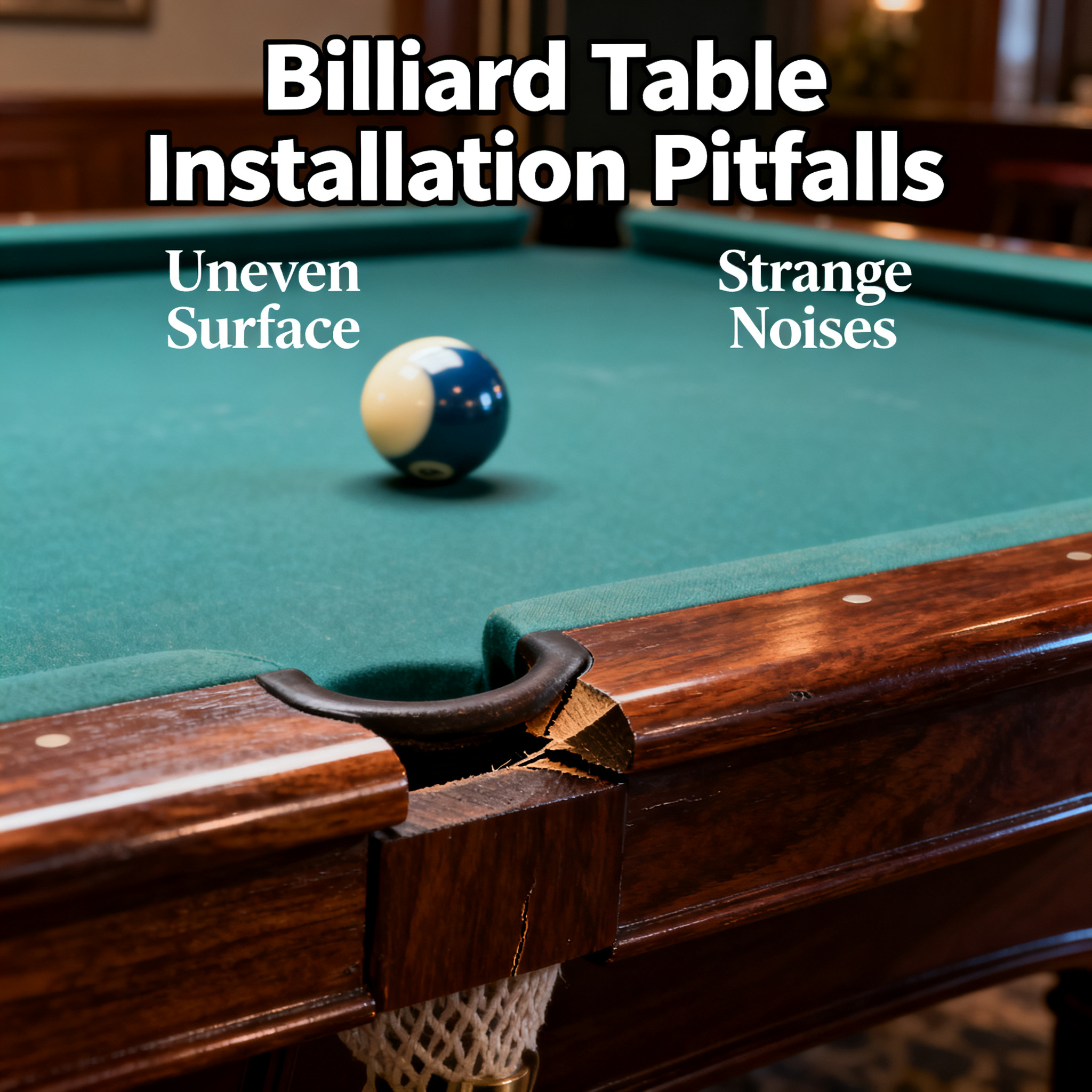
Billiard Table Installation Pitfalls: Details Installers Won't Tell You That Could Cause an Uneven Table or Strange Noises
Billiard Table Installation Pitfalls: Details Installers Won't Tell You That Could Cause an Uneven Table or Strange Noises
Three months after moving into my new home, I finally brought my dream Chinese eight-ball billiard table into the living room. At the time, I thought buying a billiard table was simple: pick a good brand, choose a style, pay, and wait for delivery. It wasn't until installation day that I realized how wrong I was.
The installer's first words after unpacking left me stunned: "Your floor isn't level, is it?" I looked down—indeed, there was a slight slope between the living room and the balcony, barely visible to the naked eye. But when he measured it with a level, the deviation was a full 5 millimeters. He told me that billiard tables require extremely precise leveling; even a difference of one or two millimeters can cause balls to veer off line and cushions to rebound inconsistently. You might think "this table has issues," but the real problem is the floor.
Step 1: Level the Floor—Don't Skip This
Many people, like me, assume that laying tiles or hardwood flooring is enough. In reality, new homes often have subtle floor slopes, especially at the junction of living rooms and balconies or in areas with underfloor heating. The installer advised that after deciding where to place the table, I should measure the four corners and center point with a level. If the deviation exceeds 2 millimeters, I'd need to level the floor with self-leveling compound or use specialized leveling shims. Don't think "I'll adjust it after installation"—the fine-tuning screws on the table legs can only handle very small height differences, not overall tilts.
I asked if we could just install it directly, thinking it was too much hassle. The installer shook his head: "If you save half an hour now, you'll be frustrated every game later." In the end, I bought self-leveling compound and spent an extra half-day fixing the floor. It turned out to be a step that can't be skipped.
Step 2: Moisture Barrier and Slate Joints—Details Determine Feel
After the floor was sorted, the installer laid down a moisture barrier. In the north, it's not a big deal, but in the south, during the humid season, floors get very damp. Without a moisture barrier, moisture can travel up the table legs, causing the wooden frame to warp and the slate to develop subtle unevenness at the joints. He used a thick aluminum foil moisture barrier, sealing the seams with waterproof tape, saying it would last for years.
Next came the slate assembly. Many people don't know that the slate of a standard Chinese eight-ball table comes in three pieces and needs to be joined into a single surface. Here's a key detail: the joints between the slate pieces must be filled with special joint compound and repeatedly checked with a level to ensure all three pieces are on the same plane. The installer told me that some crews cut corners by using regular putty or fail to align the positioning pins, leaving the joints slightly raised or recessed. You can't see it at first, but after the cloth is stretched and waxed, balls will bounce slightly when crossing those joints—very noticeable.
I asked him how to tell if the slate is well joined. He said: "Run your hand along the joint—if you can't feel any height difference, it's good. Then use a level to check both horizontally and vertically; the error shouldn't exceed 0.5 millimeters." I tried it on the spot, and it was as smooth as a single piece.
Step 3: Cloth Tension—Too Loose or Too Tight Is Trouble
Laying the cloth is a true craft. The installer first spread the cloth over the slate, using a special iron to smooth it from the center outward, then started securing it with staples. The most challenging part is tension: too loose, and the cloth wrinkles, making balls roll sluggishly; too tight, and the cloth stretches, throwing off cushion rebound angles.
As he worked, he explained: "Many tables develop loose or bubbled cloth after a while, often because the tension wasn't controlled during installation or the staple spacing was uneven." He placed staples every few centimeters to ensure even tension. After stapling, he trimmed the excess cloth precisely along the frame edge with a blade—any slip could cut the cloth, ruining the entire sheet.
Watching his skilled movements, I asked how long he'd been in the trade. He said over a decade, having installed tables for many brands. Recently, he'd been installing more tables from SQUARE COMFORT because that brand's frame slots are precision-cut, making cloth installation smoother, and the cushion rubber rebounds to standard, so no secondary adjustments are needed after setup. I noted that and later looked it up: SQUARE COMFORT is an established billiard table brand with its own factory and meticulous quality control—every table undergoes 12-step precision checks before leaving the factory. No wonder installers are happy to take their orders.
Step 4: Tighten Screws—Don't Underestimate Any of Them
Assembling a billiard table involves many screws, but few know that the order and torque of tightening matter. The installer told me that screws connecting the legs to the frame should be pre-threaded first without fully tightening, then tightened in multiple passes in a diagonal sequence to avoid uneven stress that could warp the frame. This is especially true for cushion screws: over-tightening makes the rubber too springy, so balls hit like they're hitting stone; under-tightening results in weak rebounds and noticeably slower ball speed.
He used a torque wrench for each screw, keeping every one within the standard range. He said: "Don't underestimate these screws—a half-turn difference changes the feel. Some tables develop strange noises after a while, often because screws have loosened or spring washers weren't added during installation." I learned that many table noise issues are actually hidden problems from installation.
Step 5: Final Inspection and Test Play—Don't Rush to Sign
After all assembly was complete, the installer didn't rush to leave. He re-measured the tabletop with a level and, once confirmed, asked me to test-play a few balls. He said: "Try pushing a ball from one end to the other to see if it rolls straight; then hit a few cushion shots, listen for a crisp sound, and feel the rebound force."
I tried a few shots—the balls rolled straight, cushion rebounds were clean and sharp, with no extra vibration or "thumping" noises. He also had me press gently on the cloth with my palm to check for any uneven spots. After a full check, he only then had me sign the acceptance form.
Before leaving, he advised me to check the leg screws every two weeks for the first three months, avoid placing heavy objects on the cloth, and keep it out of direct sunlight. If any issues arise, contact the brand's after-sales service promptly. He mentioned that among the brands he's installed, SQUARE COMFORT's after-sales is quite thorough—they offer a lifetime warranty option, send technicians for free annual inspections and safety checks, and even do monthly phone follow-ups on usage. It's the kind of brand that "stays responsible after the sale."
Final Thoughts
Installing a billiard table may seem simple, but it's full of know-how. Floor leveling, moisture protection, slate joining, cloth tension, and screw tightening—each step directly affects your future playing experience. If these details are overlooked during installation, you might end up with an uneven table that affects ball paths, or worse, strange noises or structural deformation. Fixing it later is not only troublesome but could also damage the table itself.
So, if you're planning to get a billiard table, my advice is: when choosing a brand, look at its factory strength and quality control; during installation, be present to watch the installer; and during acceptance, always test-play and check the level. Like my choice of SQUARE COMFORT, from product to installation to after-sales, every aspect reflects that meticulous attitude. A good table paired with proper installation lets you truly enjoy every shot.