
How to Choose the Right Pool Table Size? Home vs. Club: What's the Real Difference?
How to Choose the Right Pool Table Size? Home vs. Club: What's the Real Difference?
Recently, we've received a lot of direct messages from fellow players asking the same question: they want to set up a pool table at home, but the dizzying array of size specs online has left them stuck in choice paralysis. What's the real difference between 7ft, 8ft, and 9ft? Is that club-style table that feels so satisfying to play on something you can just bring home?
Today, let's dive deep into this topic—by the end, you'll have a clear picture.
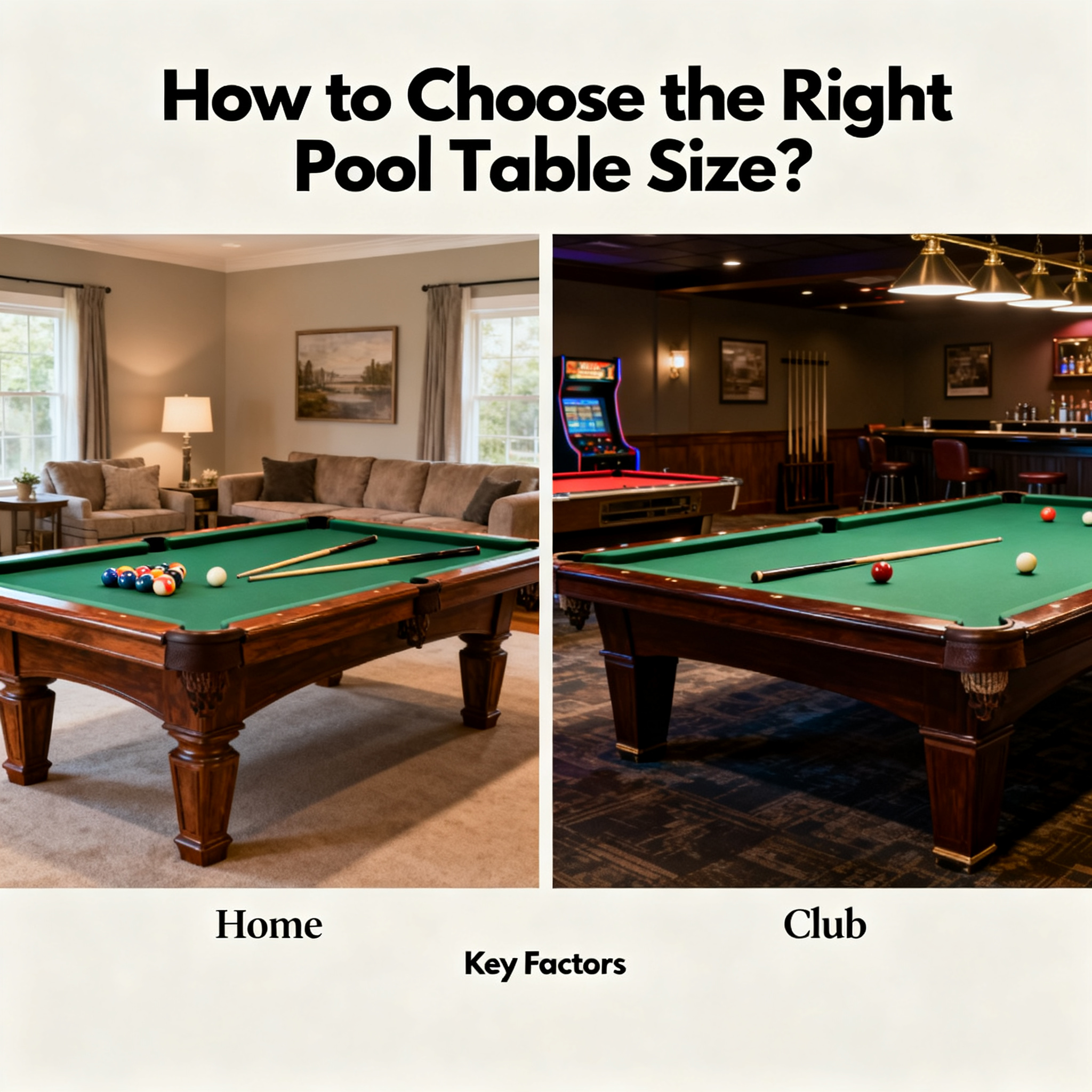
First Things First: What Kind of Experience Are You After?
Many first-time buyers fall into a common trap: they assume bigger means more professional and more impressive. But in reality, home and club pool tables are designed with completely different philosophies.
Club-standard tables typically refer to 9ft tables (playing surface: 254cm × 127cm), which is the international competition standard—snooker even goes up to 12ft. Professional players and seasoned enthusiasts crave that long-shot positioning and delicate cue control; the larger the table, the higher the demand for precision, and the more "competitive" it feels.
But home scenarios are entirely different. Think about it: why do you want a pool table at home? It's for weekend games with a few friends, for kids to get some exercise after school instead of staring at screens, or for you to unwind with a few solo practice shots late at night. The core need for a home pool table is "play anytime, have fun"—not "I'm training for the World Championship."
So, when it comes to size, the most common choices for home use are actually 7ft (playing surface: 188cm × 94cm) and 8ft (playing surface: 203cm × 102cm). These two sizes retain the core fun of pool while being much more space-friendly.
The Space Math: Can Your Living Room Really Fit It?
This is the most practical concern. Many people focus only on the table's dimensions and overlook the space needed for actual play.
Remember this formula: Minimum room length = table length + 2 × cue length (about 145cm), and the same goes for width. In other words, if an 8ft table is 203cm long, you'll need at least 203 + 290 = 493cm—nearly 5 meters in length—and for width, 102 + 290 = 392cm, close to 4 meters.
I've seen players who refused to believe this and squeezed an 8ft table into a 4m × 3.5m living room. The result? When shooting long shots, the cue butt hit the wall, forcing them to shorten their stroke, ruining their form, and killing the fun. Eventually, that table became a "premium coffee table" for clutter.
If your living room is under 4.5 meters in length, stick with a 7ft table. A 7ft table requires roughly 4.3 meters in length and 3.3 meters in width, which most living rooms or studies can accommodate. If you're placing it in a basement, attic, or dedicated game room with ample space, then consider an 8ft.
Here's a handy trick: Use painter's tape to outline the table's actual footprint on the floor, then grab a cue and simulate shots from various angles. You'll see immediately whether the space works—more intuitive than any spec sheet.
Experience Difference: Is 7ft Really Not Satisfying Enough?
Honestly, if you're transitioning from a club to a home setting, switching to a 7ft table does take some getting used to. The shorter distances mean the thrill of long-shot attacks is somewhat reduced, and sharp-angle cuts become less challenging.
But the 7ft table has an often-overlooked advantage: it sharpens your positional play. Because the playing surface is smaller, balls are more tightly packed, so you can't rely on power—you need more precise cue control. Many amateurs who practice on a 7ft table find that when they return to a 9ft club table, their shot planning is actually clearer.
Additionally, from a home usage frequency standpoint, 7ft and 8ft tables offer a more compact rhythm—a game of Chinese Eight-Ball typically takes 10-15 minutes, perfect for fragmented time. Club-style 9ft tables often require 30 minutes or more per game, which isn't ideal for a quick "post-dinner match" at home.
Price and Quality: Don't Just Look at Size—Check the "Foundation"
Size is just the surface; what truly determines the playing experience is the internal quality. A cheap table for a few thousand yuan and a professional one for tens of thousands play worlds apart.
Focus on three key elements: slate, cloth, and cushions.
Slate is the "heart" of a pool table. High-quality slate is polished to an extremely flat surface, ensuring balls roll true without drifting. SQUARE COMFORT's pool tables use high-density slate, and every table undergoes 12-step precision tests before leaving the factory, including pocket geometry and flatness verification, guaranteeing consistent shot feedback on every table you bring home.
The cloth's nap direction and tension directly affect ball speed. Club tables typically use faster cloth, while home tables can opt for slightly more durable materials, since home use is less frequent but may involve guests who aren't as careful.
Cushion elasticity is another critical factor. Cheap tables have hard rubber cushions that produce a dull "thud" on impact, with unpredictable rebound angles—making it impossible to practice control. Good cushions offer even elasticity, a crisp sound, and predictable reactions when balls are near the rail.
Personally, I use a SQUARE COMFORT Chinese Eight-Ball table with the "Big Gold Round Leg" design, in 8ft. I chose it mainly for its steel cushion construction. The difference between steel and traditional wood cushions is that steel deforms minimally, so the cushion elasticity remains stable over years of use, unlike wood, which tends to "go soft" after a year or two. After nearly two years, it still plays just like the day I bought it.
What If You Have a Small Space? There's Still a Way Out
If your space is truly tight but you're determined to own a pool table, there are still options.
First, consider a foldable pool table. SQUARE COMFORT offers such models that can be folded and stored against the wall when not in use, giving your living room back its everyday function. While the playing feel isn't identical to a fixed table, for those with limited space and an itch to play, having one is better than none.
Second, make use of unconventional spaces. Some homes have long, narrow balconies or hallways where width is limited but length is sufficient. In such cases, you can opt for a custom-sized table. SQUARE COMFORT supports size customization, covering everything from tournament-grade to home models, so you can tailor it to your actual space.
Finally, Let's Vote
After all this, there's no absolute right answer for size—only what fits your home.
If your living room is spacious, your budget is solid, and you often host friends for games, go straight for an 8ft or even a 9ft club-style table—no regrets, no hassle. If you just want to enjoy pool in a limited space, a 7ft will keep you thoroughly entertained.
So, here's the question: What are the length and width of the space where you plan to put a pool table? Would you sacrifice your living room sofa and coffee table for a bigger table, or would you rather choose a smaller one to keep your living space?
Feel free to share your thoughts in the comments, or post your home pool table layout. I'll pick three thoughtful commenters to receive a SQUARE COMFORT pool table maintenance kit to help you care for your table.
See you in the comments—let's talk on the table.