
How to Maintain Your Billiard Table for 20 Years? A Pro Shares His Top Tips!
How to Maintain Your Billiard Table for 20 Years? A Pro Shares His Top Tips!
Bringing a billiard table home brings that "play anytime, right at home" joy—only those who own one truly get it. But after a few months of excitement, many start to worry: the cloth fuzzes up, the cushions lose their bounce, and mysterious white marks appear on the wooden rails. That's when they ask: How do I properly care for this big investment?
In reality, a quality billiard table—especially one built to international competition standards like those from SQUARE COMFORT—has an incredibly long design life. Walk into any old pool hall, and you'll see tables that have served faithfully for 15 to 20 years. The secret lies in understanding and pampering your table. Today, as a seasoned "old hand" who's spent years tinkering with billiard tables, I'm going to spill all the lessons I've learned from my own mistakes and hard-won insights.
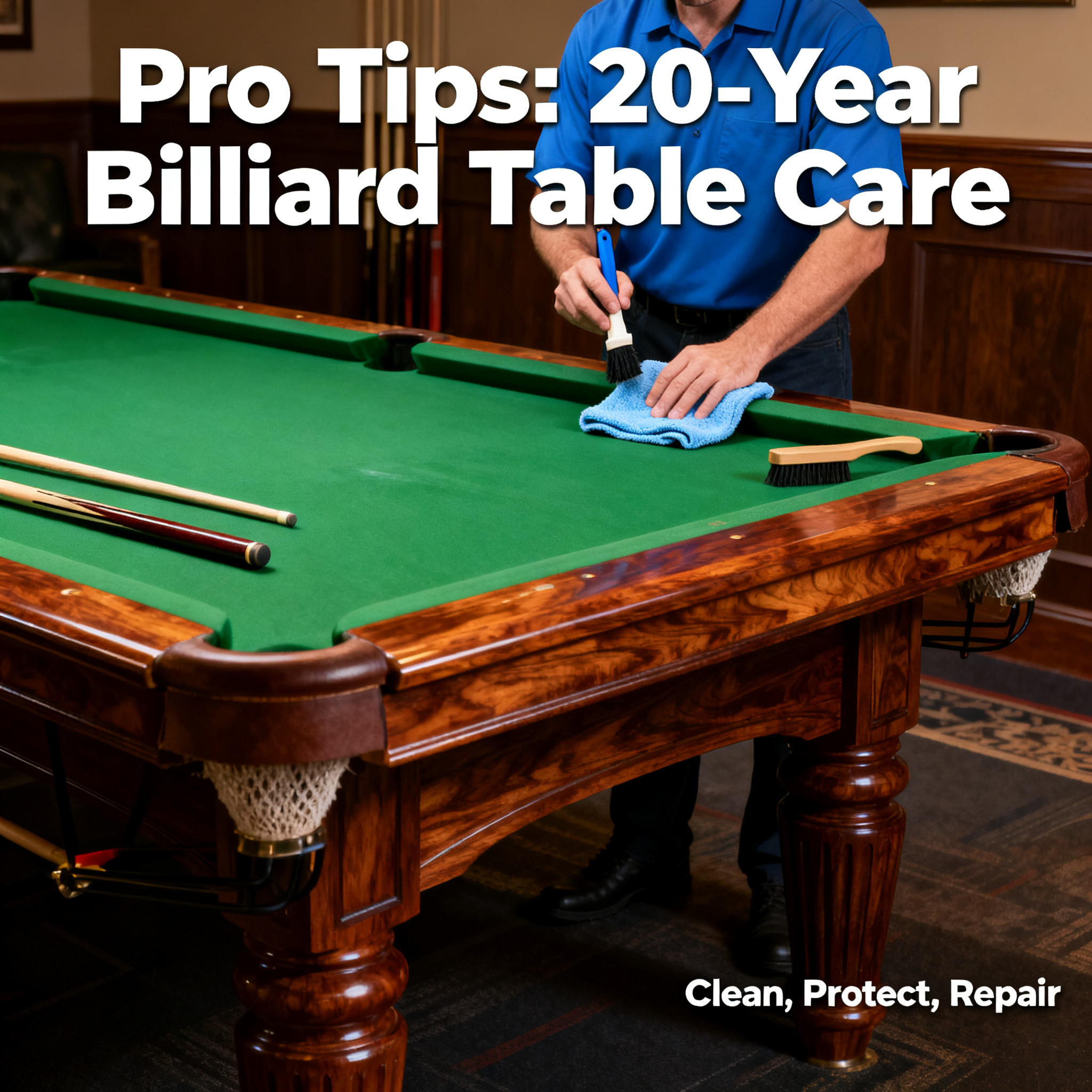
1. The Cloth: Don't Attack It with a Vacuum, and Don't Skimp on Replacement
The cloth is the "face" of your billiard table and the first touchpoint for play feel. Many people, seeing a dirty cloth, grab a powerful household vacuum and go to town. That's a major no-no. Household vacuums often have excessive suction and stiff brush heads, which can disrupt the nap direction of the cloth or even pull wool fibers out of the weave, causing the cloth to lose elasticity prematurely and making balls run faster and more erratically.
What's the right approach? Invest in a dedicated cloth brush (soft-bristled) and gently brush in the direction of the nap, from the cushions toward the pockets. For daily cleaning, a brush is all you need. For stubborn stains or dust, use a wrung-out, non-dripping soft cotton cloth to dab quickly—never rub back and forth. Remember this golden rule: cloth hates "moisture" and "abrasion." Overexpose it to these, and no miracle can save it.
As for replacement frequency, for home use, if you play 3–5 times a week, the cloth typically lasts 2–3 years. When you notice a distinct "rustling" sound as balls roll, or the force of your shots doesn't transmit as it should, don't push it—replace it. By the way, SQUARE COMFORT's after-sales program includes annual safety inspections and lifetime repair options. For technical tasks like cloth replacement, hiring a pro is far less hassle than DIYing it.
2. Slate and Frame: Moisture Control Is Priority One—Don't Fight the Radiant Heat
The "heart" of a billiard table is the slate, especially bluestone. Its biggest enemy isn't impact—it's moisture-induced warping. Many homes place tables near windows; if rain comes in through an open window, moisture seeps into the slate's seams. Over time, the joints can swell slightly, causing an uneven surface where balls curve off-line.
How to prevent it? First, if room humidity consistently exceeds 70%, consider a dehumidifier, especially during southern China's humid "hui nan tian" season. Second, never place the table directly above radiant floor heating or radiators. Thermal expansion and contraction create stress between the slate and wooden frame, loosening the structure. Third, place moisture-proof pads under the table legs to prevent direct contact with the floor.
Rail care is often overlooked. Sweat and tea spills on the wooden cushions, if not wiped promptly, can seep into the finish and leave marks. After each play session, wipe down the rails and legs with a dry cloth, especially the wood near the pockets. SQUARE COMFORT tables use FSC-certified wood and moisture-resistant coatings, making them more durable than standard materials—but that doesn't mean you can wash them with a wet rag. Wood responds to respect: treat it well, and it'll serve you well.
3. Cushions and Cues: Bounce Is the Soul—Don't Use Brute Force
The elasticity of the cushion rubber determines how balls react off the rails. Many beginners have a bad habit: when a shot misses or position play fails, they slap the cushions with their cue or palm out of frustration. That slap causes permanent damage to the rubber. Once the molecular structure is violently impacted, elasticity drops irreversibly. When you notice balls hitting the rail with a dull "thud" and failing to rebound, the cushion is essentially ruined.
The same goes for cue care. Wooden cues fear moisture and impacts. Don't lean a cue against a wall for long periods—it can warp. Store cues vertically in a wall-mounted rack or flat in a cue case. Wipe the shaft regularly with a clean dry cloth, and occasionally apply a dedicated cue oil—but sparingly, as too much can affect your grip.
4. Which of These Maintenance Mistakes Have You Made?
- Leaving the cover on for months: Many think a dust cover solves everything and leave it on for months. Wrong! The cloth needs to "breathe." Trapped under a cover in humid conditions, it's more prone to mold. After each session, brush the cloth, then let it air out for half an hour before covering.
- Using alcohol or chemical cleaners on the cloth: This rapidly ages and fades the cloth, turning it into a "patchwork."
- Using the table as a coffee table: Setting hot cups, heavy objects, or even sitting on it. The table's structural design handles impacts from balls and cues, not your weight. Prolonged localized pressure can warp the slate.
- Never leveling the table: Home floors are never perfectly level. After installation, check with a spirit level. If balls consistently roll to one side, don't settle—adjust the leveling screws on the legs. SQUARE COMFORT's high-end series features the SmartLevel™ auto-leveling system, saving you manual effort, but if you own a base model, learn to do it yourself.
5. Final Thoughts: A Great Table Is Both "Played" and "Nurtured"
At the end of the day, billiard table maintenance isn't rocket science. It boils down to four words: moisture-proof, impact-averse. Treat your table as a partner with personality, not a cold piece of furniture. Spend five minutes brushing the cloth daily, check for loose screws weekly, and verify the level monthly. These seemingly trivial habits will keep your table performing with that just-unboxed feel even a decade later.
I've seen ordinary tables become family heirlooms, and I've seen top-tier competition tables worth tens of thousands ruined within two years. The difference isn't money—it's care.
Finally, I'd love to ask fellow players: Do you have any unique maintenance tips? Or have you ever made a mistake that broke your heart? Feel free to share in the comments—let's pool our collective wisdom. If you found this article helpful, give it a like and share it with fellow billiard enthusiasts, so more people learn to cherish their own "patch of turf." After all, we all hope the table in our hands will accompany us through the next twenty years.