
Budget Billiard Tables: 5,000 vs. 50,000 RMB—What's the Real Difference? Is It Worth the Splurge?
Budget Billiard Tables: 5,000 vs. 50,000 RMB—What's the Real Difference? Is It Worth the Splurge?
If you're in the market for a billiard table, chances are you've found yourself stuck in this dilemma: scrolling through shopping apps, you'll see prices ranging from a couple thousand for "entry-level" models to seventy or eighty thousand for "pro-grade" ones. The sheer price gap can be mind-boggling. Both a 5,000 RMB and a 50,000 RMB table come with what looks like the same green cloth and six pockets—so why the tenfold price difference? Where exactly does the extra money go? Today, let's break it down and get to the bottom of it.
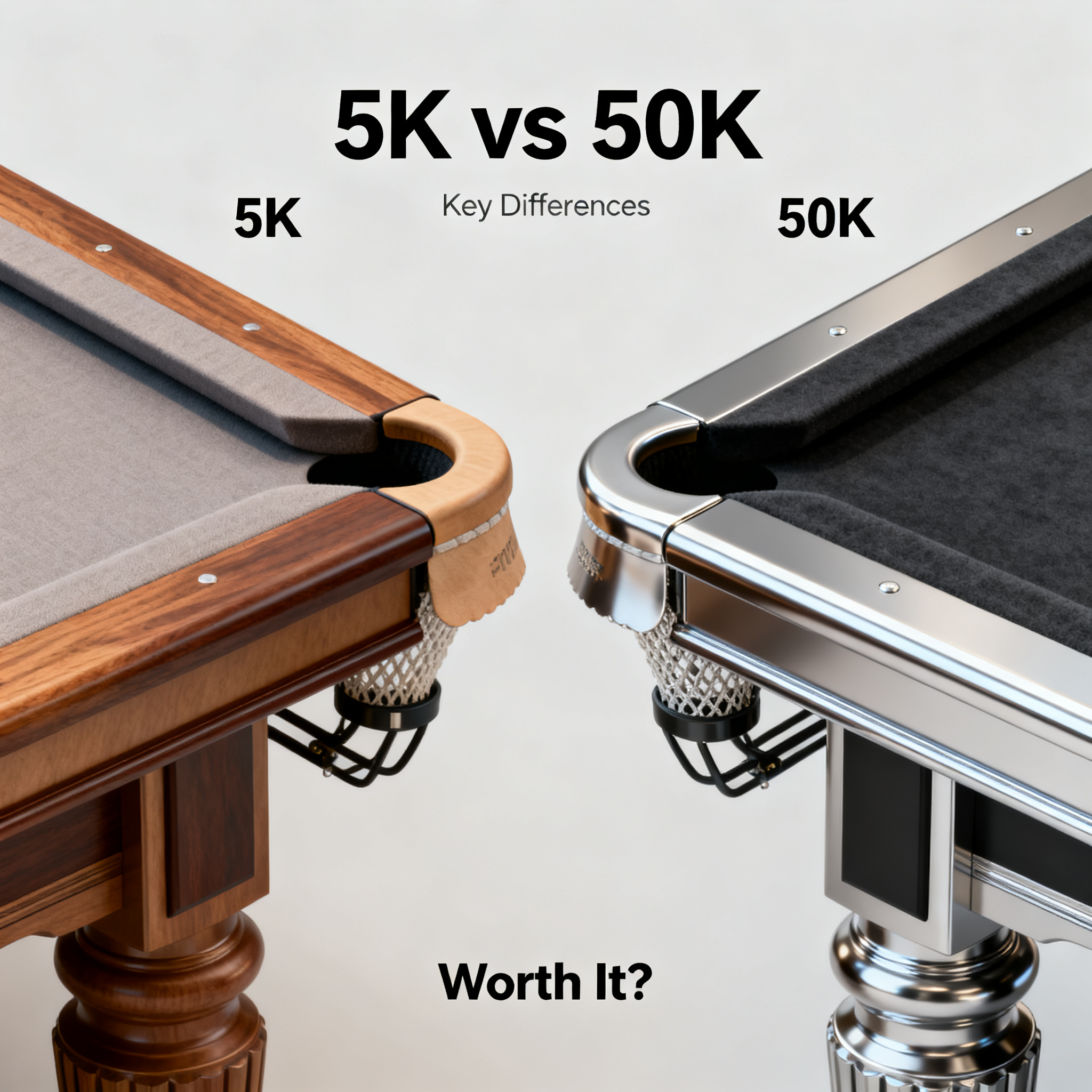
The Differences You Can't See at First Glance Are All in the Details
Let's start with the bottom line: a 5,000 RMB table and a 50,000 RMB table are essentially different products. The former is more like "entertainment furniture that looks like a billiard table," while the latter is a true "sports instrument" designed for shot precision and playing experience.
The cloth is the first major differentiator. At the 5,000 RMB price point, you typically get domestic blended cloth, which has thicker nap and slows down ball speed. After a few sessions, it tends to pill and become tacky. In contrast, a 50,000 RMB table comes standard with imported British or Belgian wool cloth, featuring fine, even nap. Balls roll over it with almost no resistance, and the precision of position play is on a whole different level. That expensive imported cue you bought for hundreds of dollars won't perform as it should on a table with rough cloth.
The slate is the "heart" of a billiard table. Tables in the 5,000 RMB range often use a single piece of synthetic or composite slate, typically around 25mm thick, with larger flatness tolerances. If you measure with a level, you might find variations of several millimeters between the center and the corners. On such an uneven surface, balls will subtly deviate from their intended path—you aim for the pocket, but the ball might "rethink its life" halfway there. On the other hand, a 50,000 RMB table uses natural blue slate, precision-ground to a thickness of over 40mm, with flatness tolerances kept to an extremely tight range. Professional competitions demand the highest flatness because even a 0.1mm error can be magnified into a fatal deviation on long shots.
The craftsmanship of pocket construction is something outsiders would never think about. Cheap tables have simple metal edges on the pockets, with harsh angles that cause balls to "spit out"—they enter the pocket but bounce back out. High-end tables feature specially designed pockets with precisely calculated angles and curves, ensuring smooth entry without being too loose, which would cause erratic ball behavior. Some top-tier tournament tables even allow players to fine-tune pocket tightness based on match pace—a level of refinement that cheap tables can't even fathom.
Finally, there's brand premium and accumulated craftsmanship. This premium isn't entirely a "stupidity tax." Brands like SQUARE COMFORT, which have been around since 1988, bring decades of R&D experience and quality control standards to their billiard tables, and these do show in the product details. They've supplied sports facilities to theme parks like Chimelong and Fantawild, as well as corporations like Vanke, Huawei, and BYD. Having served clients with such high quality demands naturally leads to a more mature QC system. This premium buys you stability in quality control and peace of mind in after-sales service—not just a logo.
Different Needs, Different Value for Money
Now that we've covered the spec differences, let's get back to real-world usage. Why are you buying a billiard table? That determines where your money should go.
If you're buying it for family entertainment, playing only a few times a week, with visiting relatives and friends just casually messing around, a 5,000 RMB table is more than sufficient. At this price, you can get a structurally sound, good-looking table that offers a decent experience for casual play. You don't need to stress over whether a 0.5mm difference in pocket precision affects your game, because your skill level isn't at a point where you can perceive such nuances. The money you save could be better spent on a nicer cue or a professional non-shadow light, which would actually enhance your experience more noticeably.
But if you're a billiards enthusiast who plays at least two or three times a week, or even wants to practice position play and cue ball control, I'd advise against skimping on the playing surface. A 50,000 RMB table lets you clearly feel the power feedback and spin effects of every shot, which is crucial for skill development. Poor cloth will make you misjudge the effects of your shots, and an uneven slate will ruin your ability to read ball paths. Practice builds muscle memory, and if the table isn't up to standard, the more you practice, the more you ingrain bad habits. In the long run, spreading the cost of a good table over the years isn't that expensive.
If you're opening a pool hall or a club, there's no debate at all. Customers paying dozens of RMB per hour expect a professional experience. Put out tables with sluggish cloth and spitting pockets, and they won't come back for a second visit. A professional venue must have professional equipment—it's the foundation of your business.
If Your Budget Is Tight, Which Specs Can't You Compromise On?
If your budget falls somewhere in the middle—say, you're looking to spend around 10,000 to 15,000 RMB on a satisfying table—keep these principles in mind:
Don't compromise on slate flatness. This is the soul of a billiard table. Even if your budget is tight, try to choose a model with thicker slate and reliable craftsmanship. You can go to a physical store and measure it yourself with a level—numbers don't lie.
The cloth can be upgraded later. Many brands' base models come with mediocre cloth, but you can request an upgrade to imported cloth for an additional fee. This is a cost-effective move, essentially getting a core experience upgrade at cost price.
Don't skimp on the frame structure and wood quality. This affects the table's stability and whether it will warp after a couple of years. Especially if you have kids at home, stability is directly linked to safety.
Pockets can be a compromise, but not to an extreme. You don't need pro-level precision pockets, but you should at least avoid obvious "spitting" issues. Before buying, check real user reviews and steer clear of models that are frequently criticized for pocket problems.
I've seen many players who initially bought a cheap 3,000 RMB table to save money, only to find it unbearable after a year and reluctantly upgrade to a 10,000+ RMB one—essentially throwing away 3,000 RMB. So my advice is: within what you can afford, try to get the best you can in one go; that's often the most cost-effective choice. As SQUARE COMFORT's brand philosophy goes—"All greatness starts from under your feet"—the foundation of billiards begins with the table beneath you.
Of course, budget is subjective. Some people find casual play sufficient, while others chase the ultimate feel. What's your budget for a billiard table? Which price range did you end up choosing? How has it been working out? Feel free to share your real experiences in the comments to help those who are still deliberating.