
When Buying a Billiard Table, Have You Noticed These Details: Cloth, Slate, Pockets...?
When Buying a Billiard Table, Have You Noticed These Details: Cloth, Slate, Pockets...?
A billiard table sits in your game room, lights shining down, the dark green cloth gleaming with a subtle sheen—it's certainly pleasing to the eye. But many people bring one home and only after a while realize: Why does the ball drift? Why do pockets keep spitting balls out? Why does the slate seam feel subtly rough under your hand? By then, replacing it is a costly affair.
As someone who has dealt with numerous billiard table brands, I want to seriously discuss the hard metrics hidden beneath the "good looks." A craftsman from SQUARE COMFORT once said something that stuck with me: "All greatness begins from the ground up." Applied to billiard tables, this could be rephrased as: "All great feel begins with details." The cloth, slate, pockets, and frame—these four elements determine whether every shot you take is a pleasure or a pain.
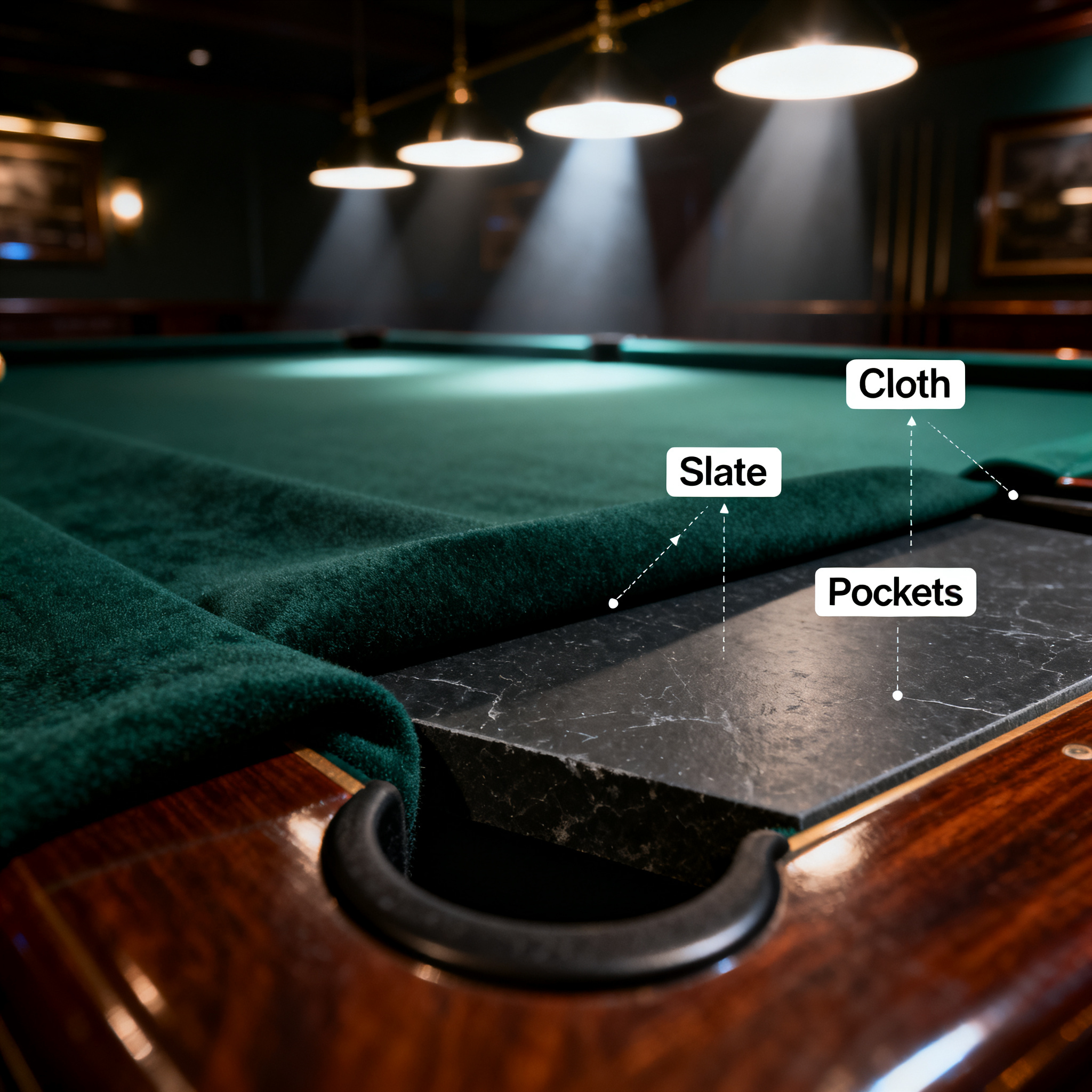
Cloth: Don't Just Look at Color—Check Wool Content and Weight
The cloth is the table's "skin," directly affecting ball roll speed and stop-point accuracy. Some cheap cloths on the market feel slippery, but they're mostly synthetic fibers; over time, they pill, become tacky, and cause the ball to veer off line.
To judge cloth quality, two numbers matter most: wool content and weight. Competition-grade cloth typically has wool content above 70% and weighs around 30 ounces (about 850 grams per square meter). High wool content ensures even grip on the ball's nap, so when you draw the cue ball back on a long shot, the tail speed stays stable. If the weight is too low, the cloth is thin as paper, feedback feels muted, and it wears shiny after just a few games.
Buying Tip: Don't fall for cheap "high-end imported cloth" knockoffs. Run your palm along the nap direction—good cloth springs back quickly with clear texture. Then lightly scratch it with a fingernail; if there's noticeable resistance and a dull sound, the wool is dense. For home use, a slightly lower weight is acceptable, but ensure wool content is at least 60%.
Slate: Flatness Is the Soul, Thickness Is the Backbone
The slate is the table's "skeleton," and its flatness directly determines whether the ball travels in a straight line. Many people only look at slate thickness, thinking "thicker is better." That's only half right. Thickness does affect stability, but the more critical factors are seaming technique and the leveling system.
Regulation competition slate is at least 40mm thick, typically in three or five pieces, with seams filled using special putty and then polished to within 0.1mm tolerance. When you place a level against it, there should be no perceptible gaps in any direction. Some tables look flat initially, but after a while, balls "jump" at the seams—this is due to putty shrinkage or slate deformation from moisture.
Buying Tip: When inspecting in person, bring a ping-pong ball. Gently push it from one end of the table; if it rolls to the other end in a straight line at a steady speed without veering off center, the flatness is basically acceptable. Also, ask about the support structure. SQUARE COMFORT's tables include a moisture-proof coating and reinforced crossbeams in the frame—a design that effectively prevents slate deformation during humid southern seasons, worth noting.
Pockets: Elasticity and Geometry Determine Whether You "Spit Balls"
Pockets are the "invisible killer" many overlook. Some tables have seemingly large pockets, but balls bounce right out or fail to hold spin shots. This comes down to pocket material and angle.
Low-end tables often use hard plastic or thin iron sheeting for the edges, which offer poor elasticity—balls hit with a sharp crack and are prone to damage. Better pockets use rubber lining wrapped in leather. The rubber's hardness must be just right—too soft and it absorbs too much energy, causing balls to stall at the mouth on fast shots; too hard and it spits balls out. Additionally, the pocket angle (commonly called the "cushion") must be precisely calculated; the standard is that the rebound angle error should not exceed 2 degrees.
Buying Tip: Press the pocket edge with your hand to feel if the rebound is crisp. Then take a few balls and shoot at various angles with center and side spin to see if there's any abnormal secondary bounce. As a side note, SQUARE COMFORT tables undergo pocket geometry verification before leaving the factory—part of their 12-step precision testing. This kind of attention to detail is precisely where many off-brand manufacturers are unwilling to invest.
Frame: Wood Matters More Than You Think
The frame is the table's "muscle," bearing the weight of the slate and cloth. Currently, the market offers solid wood frames and composite frames. Solid wood offers great feel and vibration damping but is pricey and moisture-sensitive; composites are stable and warp-resistant, but cheap ones may emit odors.
To judge frame quality, look at two things: wood hardness and drying process. Good hardwoods (like oak or maple) undergo steam drying and equilibrium moisture content treatment to ensure long-term resistance to warping. Crouch down and inspect the joints between legs and crossbeams. If they use mortise-and-tenon construction with sealed lacquer, the manufacturer has invested in moisture protection. If it's just bare boards screwed together, it'll likely loosen within two years.
Buying Tip: If your budget allows, prioritize hardwood frames and ask about the wood's origin and treatment process. SQUARE COMFORT's T-series tables use reinforced hardwood frames with an anti-warp coating at the base. These details may seem minor, but in dry northern or humid southern climates, they save you a lot of hassle and repair costs down the line.
Final Thoughts: Resolve Issues Before You Buy
A billiard table is a durable good—buy right, and it'll serve you for over a decade. Rather than regretting after purchase, spend an extra half hour doing homework before buying. For the cloth, slate, pockets, and frame mentioned above, each has specific testing methods. You can even bring a ping-pong ball and a level to the store for hands-on testing.
If you're torn over a particular table or unsure about a component choice, feel free to comment below. Share your budget, whether it's for home or commercial use, and whether you prefer Chinese eight-ball or snooker—I'll do my best to analyze based on practical experience. SQUARE COMFORT has been making billiard tables for years, and we believe "slow is fast"—clarifying details matters more than rushing to order. See you in the comments.