
Unveiling the Anti-Slip Performance of Sports Flooring: How to Ensure Safety on Wet Surfaces?
Unveiling the Anti-Slip Performance of Sports Flooring: How to Ensure Safety on Wet Surfaces?
Have you ever experienced this? You step into a gym with your sneakers, ready to sprint, but feel an unsettling slip underfoot. Not to mention areas that have just been mopped or where athletes' sweat has dripped—one careless step can lead to a stumble, causing embarrassment at best or injury at worst.
In sports venue operations, "wet and slippery floors" have always been a top safety hazard. Whether in badminton, table tennis, or basketball courts, sweat from intense play or spilled drinks can turn a safe playing surface into an "ice rink." Today, let's delve into the intricacies of anti-slip performance in sports flooring and see how a quality floor protects every step even under wet conditions.
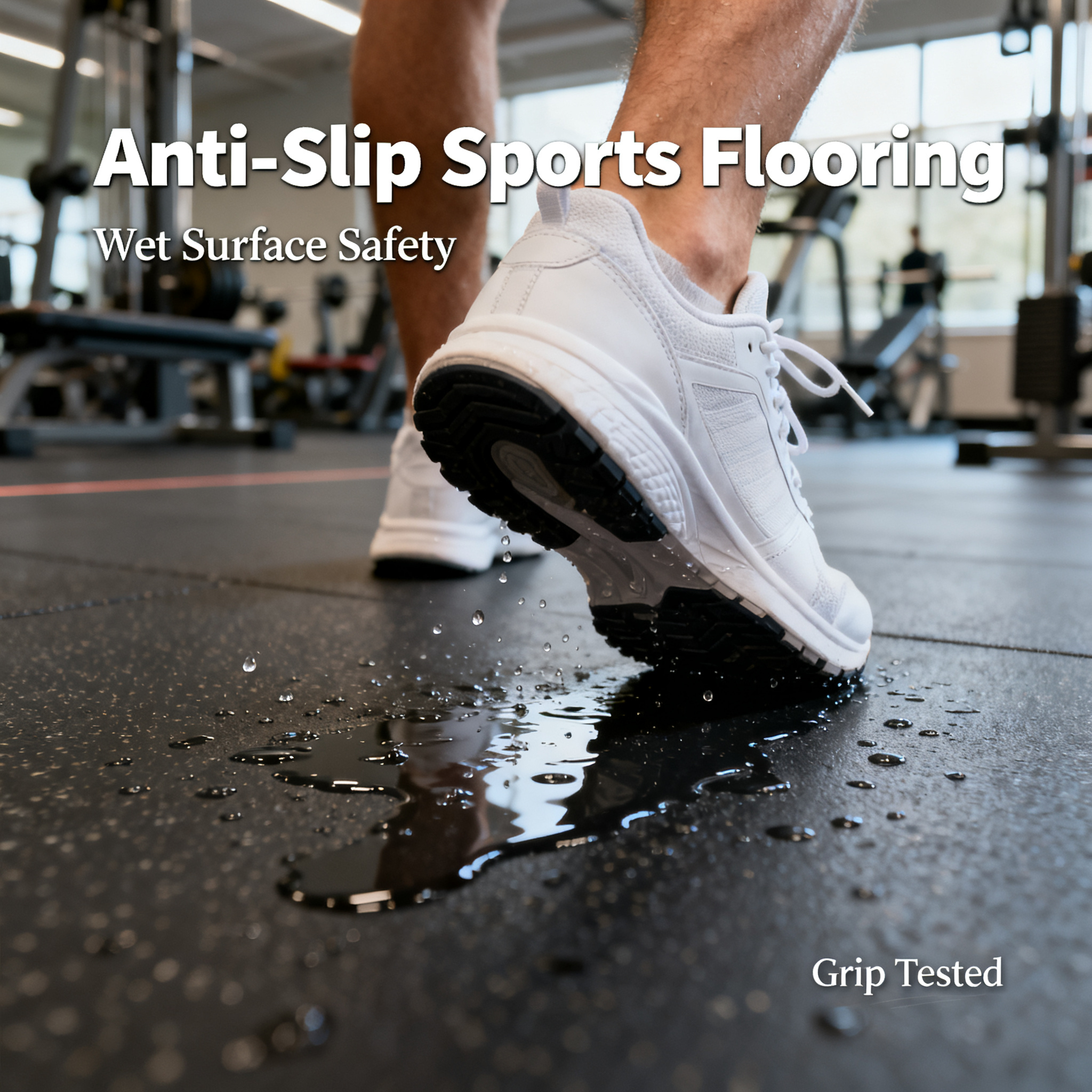
Friction Coefficient: The Invisible Safety Gauge
Many buyers tend to touch the surface when selecting flooring, assuming that a "rough feel" means good slip resistance. This is a common misconception. The true measure of anti-slip performance is the friction coefficient. Industry standards typically reference both static friction coefficient and dynamic friction coefficient under wet conditions.
Professional testing methods are not mysterious. Testers use a slider that mimics a shoe sole, apply a fixed pressure, and pull it at a constant speed across the floor surface, recording the friction force. More rigorous tests involve spraying water on the surface to simulate sweat drops or post-cleaning conditions. It's important to note that good dry anti-slip performance does not guarantee good wet performance. Some flooring materials perform stably when dry, but once exposed to water, their surface molecular structure changes, causing a sharp decline in slip resistance.
For sports venues, the wet friction coefficient is generally recommended to be no less than 0.4, with professional competitive venues requiring even higher. This value means that even with liquid residue on the floor, there remains sufficient grip between the shoe sole and the flooring to support quick stops and directional changes.
The Science of Texture: Particles, Patterns, and Drainage Design
Walking into different venues, you'll notice a variety of surface treatments on sports flooring. Some are covered with fine particles, others have regular patterns, and some use special woven textures. Behind these designs lies micro-engineering focused on anti-slip performance.
Fine particles are currently the mainstream solution for sports flooring. Take SQUARE COMFORT's PVC sports flooring, for example, which features a uniform micro-particle structure created through a special process. These particles act like countless tiny "brake pads," increasing physical friction upon contact with the shoe sole. More importantly, there are micro-gaps between particles that are invisible to the naked eye. When liquid spills, moisture spreads through these gaps rather than forming a smooth water film on the surface, thereby maintaining contact area between the sole and the flooring.
Regular patterns focus on drainage. Common herringbone or wave patterns essentially build drainage channels on the floor surface. Think of tire treads—the principle is the same. When the shoe sole presses down, liquid is squeezed into the pattern grooves, preventing the "hydroplaning" effect. This design is particularly crucial in venues like badminton courts, where lateral movements are frequent, and you can clearly feel the grip support during side stops.
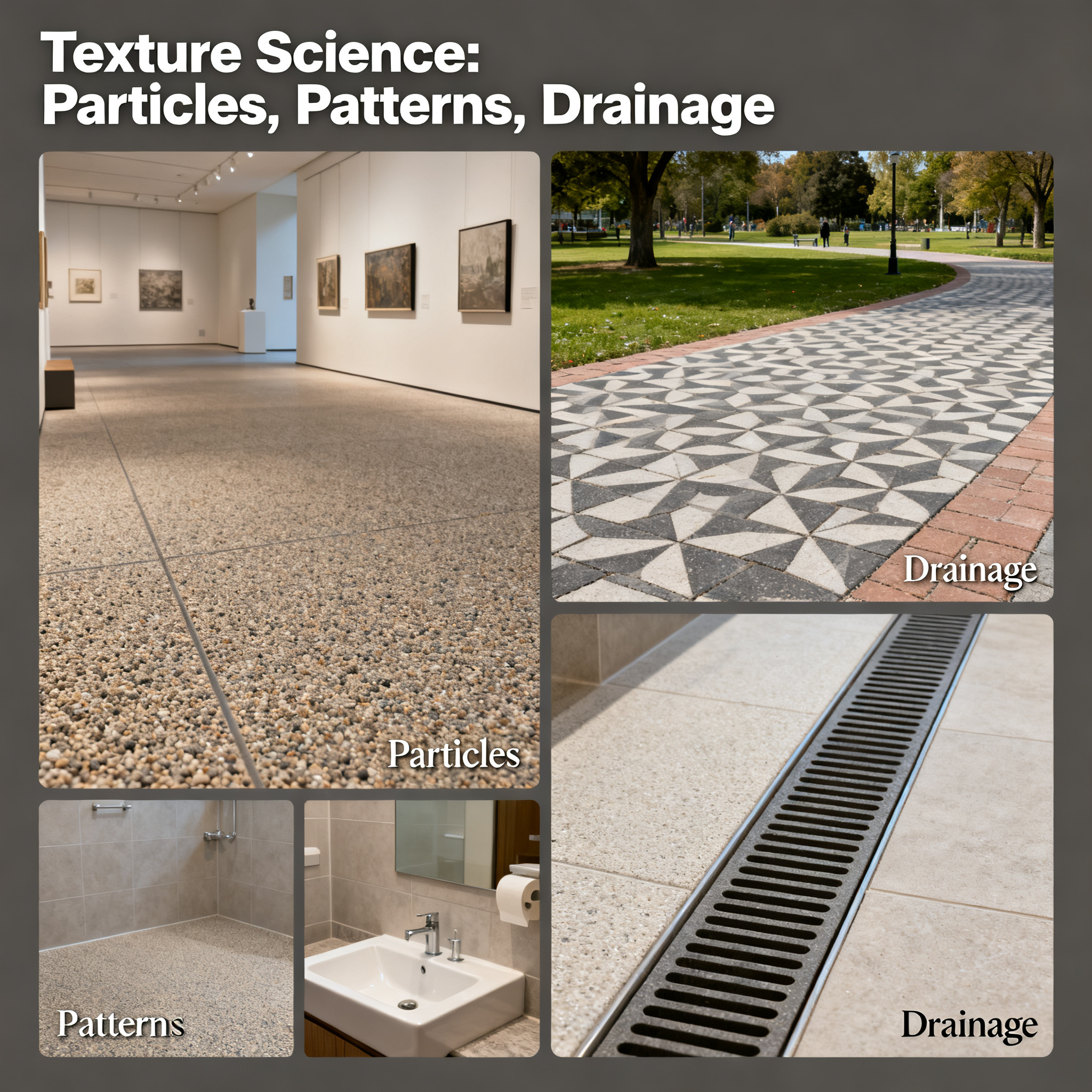
It's worth noting that deeper patterns are not always better. While deeper grooves offer better drainage, they increase cleaning difficulty, and embedded dust and dirt can actually reduce the friction coefficient. Therefore, balancing pattern depth with ease of cleaning is a hallmark of a well-designed floor. SQUARE COMFORT's R&D team has conducted extensive tests for different sports scenarios—for instance, table tennis courts require higher anti-slip performance for forward-backward movements, while dance studios need a delicate balance between slip resistance and smoothness to prevent knee injuries from excessive friction during spins.
The Water Test: Quality Flooring Embraces the Challenge
The most direct way to assess a floor's anti-slip reliability is through a "water test." You can wipe the surface with a wet towel to create a thin water film, then walk, stop abruptly, and turn while wearing sports shoes.
Inferior flooring becomes exceptionally slippery when wet, as if a layer of lubricant separates the sole from the ground, giving a noticeable floating sensation. In contrast, quality flooring like SQUARE COMFORT's PVC sports flooring maintains a clear "grip" even when wet. This is attributed to its composite polymer material formula, which has slight hydrophilic properties that help water spread quickly into a thin film on the surface. Combined with the particle structure that disrupts the film's continuity, it maintains a stable friction coefficient.
Another easily overlooked detail is the flooring's base structure. Anti-slip isn't just about the surface; if the base layer doesn't adhere tightly to the subfloor, moisture can cause bubbles or curling edges, creating new tripping hazards. SQUARE COMFORT arranges technical personnel to guide installation on-site during project delivery, ensuring full adhesion and conducting regular inspections to eliminate safety risks. This full-process service mindset is rare in the industry.
Buying Guide: Three Tips for On-Site Inspection
If you're selecting flooring for your venue, try these three tips during sample testing:
Tip 1: Inclined Board Slip Test. Place a smooth wooden board at an angle of about 15 degrees on the floor surface, put a cup of water on the board, and observe whether the cup slides down slowly. If it slides easily, it indicates the floor's micro-structure cannot retain liquid, raising concerns about wet slip resistance.
Tip 2: Sole Press and Rotate. Wear clean rubber-soled sports shoes, press one foot firmly on the floor, and attempt to rotate the sole. Feel the resistance's magnitude and uniformity. Quality flooring provides consistent, sustained resistance, while inferior products may cause "slipping at certain points," indicating uneven surface texture distribution.
Tip 3: Water Droplet Spread Observation. Drop a droplet of water on the floor and observe its shape. If it spreads quickly, the material is hydrophilic, allowing moisture to spread and maintain friction with the particle structure. If the droplet remains spherical for a long time, be cautious—it means liquid doesn't disperse quickly, potentially forming localized water films.
Safety is no trivial matter, especially on venue floors that bear the passion for sports and competitive dreams. A reliable sports floor should silently protect users' knees and ankles during every jump, stop, and slide. SQUARE COMFORT has been dedicated to sports flooring materials for over three decades, from PVC sports flooring to interlocking floor tiles, always upholding "safety" as the bottom line in product design. After all, every great athletic performance begins with a stable step from the ground up.
Next time you step into a brand-new gym, take a moment to look down at the floor. Those fine textures and uniform particles are silently safeguarding every drop of sweat you shed.