
The Secret Under the Flooring: Why Do Professional Venues Always Use Self-Leveling Compound?
The Secret Under the Flooring: Why Do Professional Venues Always Use Self-Leveling Compound?
Many people stepping into a professional badminton or table tennis hall for the first time are drawn to the comfortable feel and vibrant colors of the sports flooring. Few ever ask: What lies beneath the flooring?
The answer might surprise you—it's an unassuming layer of gray cement. Yet this gray layer is precisely what determines the lifespan of the flooring and the quality of the sports experience. It's called self-leveling compound.
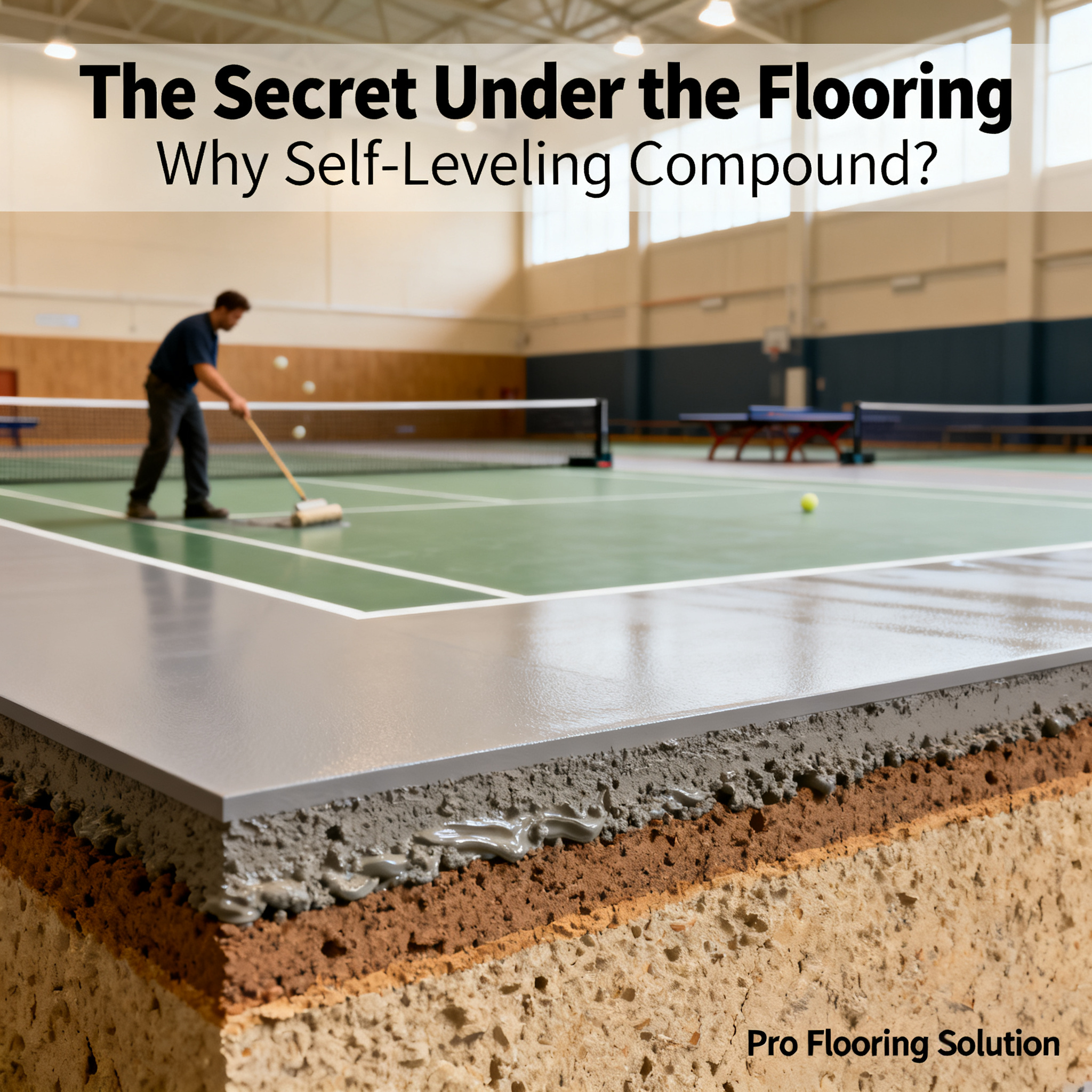
Why do professional venues insist on self-leveling compound, even if it means extra time and cost? Today, we're uncovering the secret beneath the flooring.
1. What Exactly Does Self-Leveling Compound "Level"?
Let's start with a simple thought experiment: Your floor at home might look perfectly flat to the naked eye, but if you place a two-meter spirit level against it, you'll likely find gaps in the middle. The standard for regular cement floors is "no more than 3 mm deviation over 3 meters," which sounds decent, but for flooring installation, that tolerance is far too loose.
Sports flooring is a flexible material, typically 4 to 8 mm thick. If the base floor has even a 1 mm bump or dip, it will "telegraph" through the flooring—creating a small bulge or a shallow dent. Worse, the flooring has no "self-healing" ability; once the base is uneven, the flooring will remain uneven forever.
Self-leveling compound works by "pouring" a perfectly flat intermediate layer between the base floor and the flooring, using a cement-based material. It's self-flowing and self-leveling—when poured, it naturally spreads from high spots to low spots, and once cured, it forms a mirror-smooth base. In technical terms, it's called "leveling," but in plain English, it's like giving your floor a "precision makeover."
2. The Consequences of Skipping Self-Leveling Are Worse Than You Think
Some property owners might gamble: "My floor looks flat enough—can I just lay the flooring directly?" Here are three real-world scenarios showing what happens when you skip self-leveling:
Scenario 1: Wavy lines appear after two weeks. The flooring looks fine during installation, but after regular use and temperature fluctuations, minor base imperfections start to "transfer" to the surface, creating wavy patterns. When playing, the ball bounces unpredictably, ruining the experience.
Scenario 2: Edges curl up after six months. Gaps between the flooring and the base create a subtle air-pump effect with each step—air is squeezed out when you press down and sucked back in when you lift your foot. Over time, this repeated stress weakens the adhesive bond, causing edges to lift, eventually requiring full replacement.
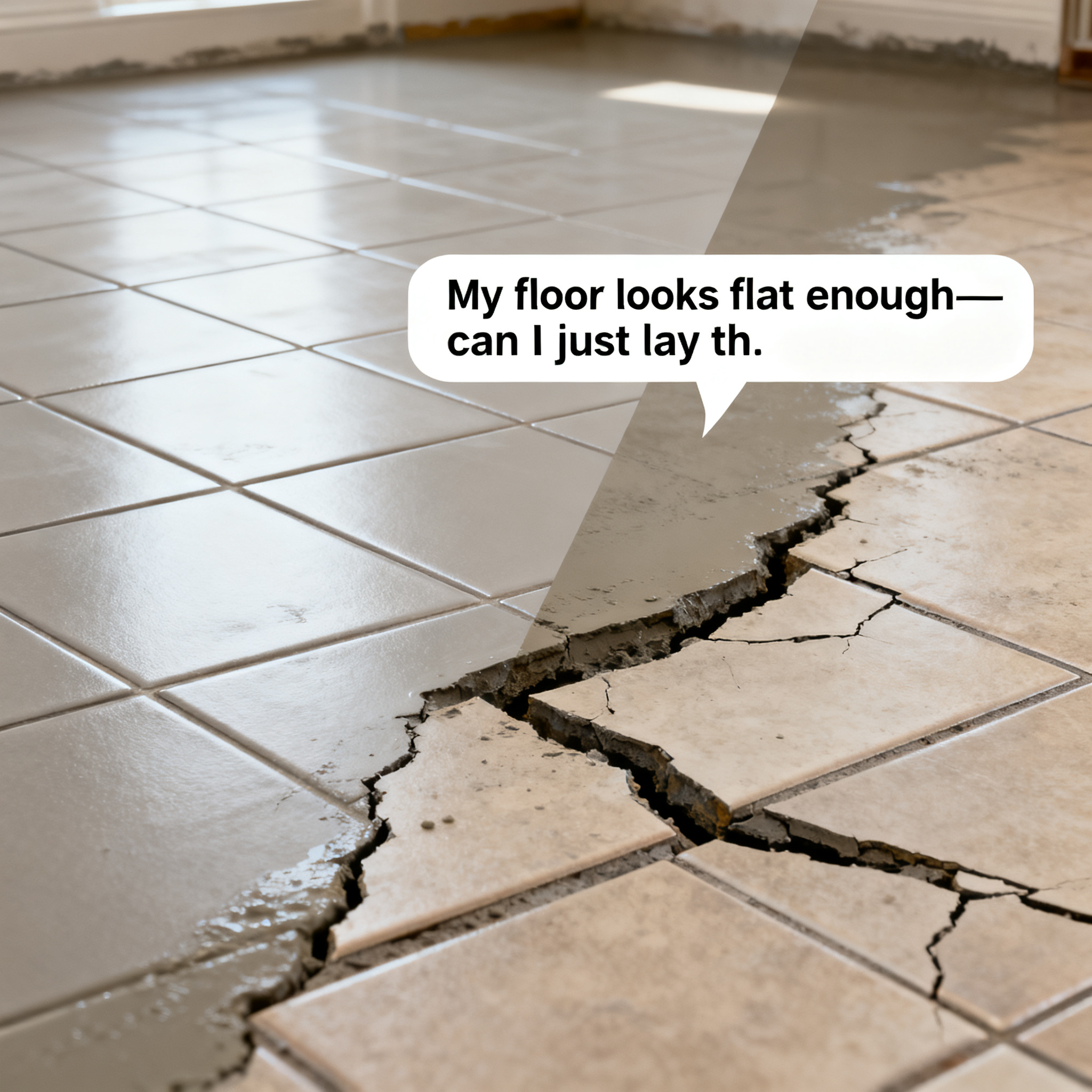
Scenario 3: Localized sinking after a year. If the base has soft spots or hollow areas, the flooring will slowly depress under heavy loads, forming pits that grow larger until the surface becomes unusable.
So, professional venues insisting on self-leveling isn't "overkill"—it's essential groundwork. Self-leveling isn't just about aesthetics; it's a comprehensive solution for moisture resistance, enhanced flooring adhesion, and extended lifespan. Especially in southern regions during the humid "hui nan tian" (returning south weather), where cement bases get damp, self-leveling compound offers superior moisture protection, effectively sealing off ground moisture and preventing the flooring from warping.
3. Self-Leveling Installation: Every Step Matters
Self-leveling might seem simple—just pour the material and let it flow. But in practice, every step demands strict control:
Step 1: Base preparation. This is the most overlooked yet critical step. The floor must be thoroughly cleaned, free of dust, oil, and loose particles. Otherwise, the self-leveling compound won't bond properly, leading to "delamination" later—the surface looks fine, but it sounds hollow when stepped on.
Step 2: Applying primer. The primer acts like a "double-sided tape," gripping the cement base on one side while providing a strong bonding surface for the self-leveling compound on the other. It also seals the base's pores, preventing rapid moisture absorption. This step directly determines the bond strength of the self-leveling layer.
Step 3: Mixing and pouring. The water-to-material ratio is extremely precise. Too much water weakens the mix; too little reduces flowability. Mixing time must also be controlled—under-mixing leads to inconsistency, while over-mixing degrades the material's properties. Professional teams use electric mixers and strictly time the process.
Step 4: De-airing and curing. After pouring, a spiked roller is used to work back and forth, releasing trapped air bubbles; otherwise, pinholes will remain after curing. Then comes drying, typically 24 to 48 hours, during which ventilation must be moderate—excessive airflow causes rapid surface drying and cracking.
A professional team typically needs 2 to 3 days to complete self-leveling for a standard badminton court. Slow, but worth it.
4. Good Flooring Needs a Solid Foundation
Only after self-leveling is done does the actual flooring installation begin. That's why we often say, to judge if a venue is professional, look at its floor—not the brand or color of the flooring, but whether it invests effort in the invisible parts.
SQUARE COMFORT, a company with years of experience in the sports flooring industry, understands this deeply. From its inception, the brand embraced the philosophy that "all greatness starts from the ground up." Beginning as a sock manufacturer, it has expanded to cover sports flooring, billiard tables, and sports facility engineering, always prioritizing "invisible details." Before every venue project, SQUARE COMFORT's engineering team conducts professional inspections of the base floor—checking levelness, moisture content, and strength—and only proceeds with flooring installation once everything is confirmed. This meticulousness stems from the brand's core commitment to "thinking small."
A project manager who has overseen multiple provincial-level competition venues once said something that stuck with me: "During matches, spectators focus on the athletes' performance; no one notices the flooring beneath their feet. But if the flooring fails, even the most exciting game gets interrupted. So our job is to make sure no one ever notices the floor—that's the ultimate success."
Self-leveling compound is exactly that: hidden beneath the flooring, ignored by all, yet silently bearing the weight of leveling, moisture resistance, adhesion, and load-bearing. Good flooring needs a good foundation; a good foundation starts with an unassuming layer of self-leveling compound.
Next time you stand on a perfectly flat, professional-grade sports floor, take a moment to look down—the gray layer you can't see is the true cornerstone of the entire sports experience. And by partnering with brands like SQUARE COMFORT that prioritize base craftsmanship, you'll find that the gap between professional and amateur often lies in these invisible details.