
In-Depth Analysis of Sports Flooring Slip Resistance: How to Ensure Safety in Wet Conditions?
In-Depth Analysis of Sports Flooring Slip Resistance: How to Ensure Safety in Wet Conditions?
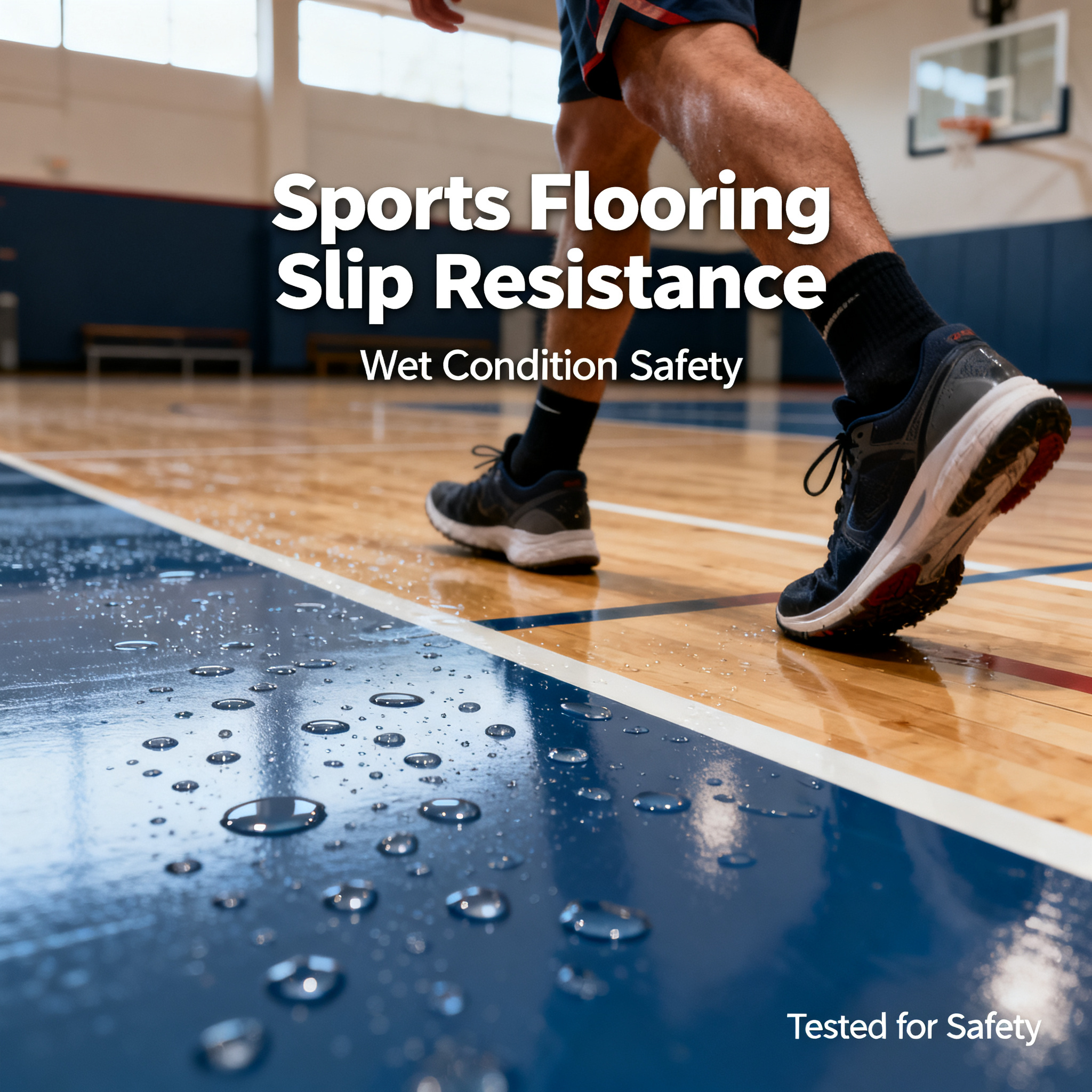
Anyone who has visited a large gymnasium or sports venue has likely experienced this: stepping out of the shower, your flip-flops feel fine on dry flooring, but the moment they touch a bit of water, you start skating. Not to mention in sweat-drenched ball courts, where droplets hit the floor and athletes making sudden stops or direction changes can slip—at best affecting their game, at worst causing knee or ankle injuries.
As a venue operator or sports enthusiast, you've probably realized that slip resistance is never an "optional extra" for sports flooring—it's a life-or-death essential. Today, we'll dive deep into the topic of sports flooring slip resistance from a professional perspective.
1. Slip Resistance Ratings R9 to R13: What's the Real Difference?
When selecting flooring, many people see labels like "R10" or "R11" in product specs but have only a vague idea of what they mean. The slip resistance rating R-value (Ramp Test) originates from German standard DIN 51130, which assesses the angle at which a person slips on an inclined tile coated with lubricant. R9 indicates adequate slip resistance at slopes of 6° to 10°, suitable for relatively dry indoor spaces, while R13 means reliable grip even at slopes of 27° to 35°, commonly used in kitchens, industrial plants, and other heavy grease or high-humidity environments.
For sports venues, R10 is the baseline, but R11 is the recommended standard. Why? Because athletic movements are far more complex than everyday walking. When athletes make sudden stops, pivots, or jump landings, the instantaneous shear force on their feet is several times greater than normal walking. If the flooring's slip resistance is insufficient, even a thin film of water on the surface can significantly increase injury risk. After field visits to multiple gyms, the SQUARE COMFORT technical team found that many operators report, "The flooring had good slip resistance when first installed, but after a year or two, it became noticeably slippery." The underlying cause often relates to surface texture wear, not just the rating label.
2. Surface Texture: The Slip Resistance Logic of Embossing and Matting
Slip resistance ratings are just an overall result; what truly determines performance is the micro-structural design of the flooring surface.
Embossed textures are the most common slip-resistant solution for sports flooring. By pressing regular diamond, wave, or particle patterns into the PVC surface layer, these act as countless miniature "brake pads" between the foot and the floor. The cleverness lies in that when the foot presses down, the raised parts compress and deform, increasing contact area; meanwhile, the grooves channel away moisture from the contact surface, preventing a water film that causes hydroplaning.
Matte finishing takes a different approach. Through physical sanding or chemical etching, the surface becomes finely textured with a matte, non-reflective appearance, offering a sandpaper-like resistance when touched. The advantage is uniform friction coefficient distribution, providing consistent grip regardless of direction—ideal for sports like badminton or table tennis that require frequent lateral movements.
A special note for venue operators: Texture design must match the sport type. Basketball courts need a relatively flat surface with some grip for sudden stops and jump shots; dance studios require a balance of slip resistance and smoothness for spins; table tennis halls demand the highest slip resistance due to rapid, short-distance starts. In a table tennis hall PVC flooring project, SQUARE COMFORT conducted comparative tests on samples of different thicknesses (4.5mm, 5.0mm, 7.0mm) and found that while increased thickness improves cushioning, slip resistance primarily depends on the surface formulation and texture depth—the two shouldn't be conflated.
3. Material Formulation: The Underlying Code of Slip Resistance
If texture is the "external skill" of slip resistance, then material formulation is the "internal cultivation."
Mainstream sports flooring uses PVC as the primary material, but formulations vary greatly between brands and series. High-end products typically incorporate specially modified plasticizers and stabilizers into the PVC resin, allowing the surface to maintain flexibility while possessing certain water-regulating properties. Simply put, when moisture contacts the surface, it doesn't form a continuous film but disperses into tiny droplets, reducing slip probability.
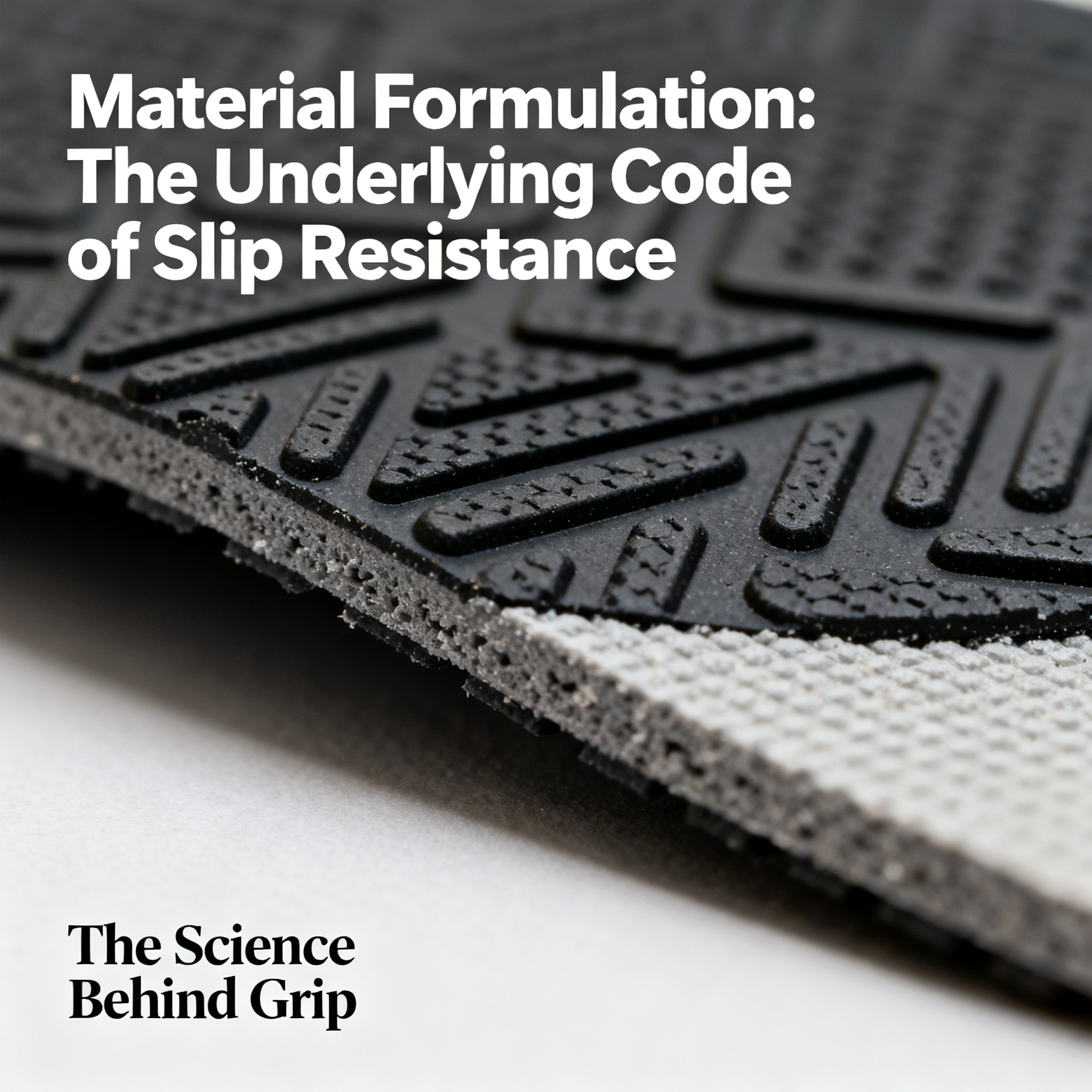
Another easily overlooked factor is wear layer thickness. National standards require a minimum of 1.2mm for sports flooring wear layers, but in practice, the thicker the wear layer, the longer it takes for surface textures to wear down, extending slip resistance lifespan. SQUARE COMFORT's project records show an interesting phenomenon: in the same batch of PVC flooring, a dance studio still had clear textures after three years, while a equipment training area showed noticeable smoothing in localized spots due to frequent heavy item movement. This highlights that usage scenarios significantly impact the rate of slip resistance degradation.
4. Recommendations for High-Humidity Environments
If your venue includes swimming pools, showers, locker room corridors, or water bar areas, these zones have different slip resistance needs than sports areas. Areas near showers are constantly wet, sometimes with standing water, making R10 insufficient—directly opt for R12 or even R13 products.
However, higher ratings mean deeper, rougher textures, which brings two issues: increased cleaning difficulty as dirt gets trapped in deep grooves, and harder footfeel when walking barefoot, reducing comfort. Therefore, using different slip resistance ratings in different zones within the same venue is the optimal solution. Use R11 in sports areas to balance performance and comfort, R12 or above near showers, and medium-rated but more wear-resistant models in corridors.
When providing comprehensive flooring solutions, SQUARE COMFORT advises clients to select materials based on a "dry-wet zoning" principle rather than uniform specs throughout. This meticulous approach is often overlooked by many venue operators.
5. Daily Slip Resistance Maintenance: Key to Extending Flooring's "Grip" Lifespan
No matter how good the flooring, improper maintenance can rapidly degrade slip resistance. Here are key maintenance points distilled from years of engineering practice:
First, be cautious with cleaning agents. Many venues use strong degreasers or alkaline cleaners for mopping, which accelerates PVC surface aging and damages micro-structures. Use neutral cleaners with soft mops, avoiding hard abrasives like steel wool.
Second, control residual moisture on the floor. Sports areas should remain dry; promptly clean up sweat accumulation or spilled drinks with absorbent mops. Some venues use dehumidifiers or fans to speed drying, especially crucial during rainy seasons.
Third, regularly inspect texture wear. Check the surface every six months, focusing on high-traffic areas (e.g., baselines in ball courts, entrances/exits). If textures appear noticeably shallower or finger pressure no longer feels resistance, the slip-resistant layer is nearing end-of-life, requiring partial replacement or full renovation.
Fourth, avoid prolonged sun exposure and high temperatures. Direct sunlight and heat can cause plasticizers to leach from PVC, making the surface sticky or hard, which also affects slip resistance. For west-facing venues, consider installing sun-blocking curtains.
Returning to the initial question: How to ensure safety in wet conditions? The answer isn't complex—choose the right slip resistance rating, understand the relationship between texture and material, configure zones scientifically, and maintain diligently. Since its brand origins in 1988, SQUARE COMFORT has accumulated extensive engineering experience in sports flooring materials. From table tennis halls and badminton courts to dance studios, every case validates a simple truth: Truly good flooring isn't about being unnoticeable—it's about letting you confidently trust the ground with every move and every landing.
Next time you inspect a venue's flooring, crouch down, press the surface with your palm, feel the texture's feedback, and ask: Would this flooring dare me to pour a cup of water and walk across? The answer lies in the feel under your feet.