
How to Choose Badminton Court Flooring? A Comparative Review of Three Best-Selling Options: Slip Resistance and Durability at a Glance
How to Choose Badminton Court Flooring? A Comparative Review of Three Best-Selling Options: Slip Resistance and Durability at a Glance
Opening a badminton hall, the choice of flooring material directly determines the feel underfoot for players and the reputation of the venue. Choose poorly, and you risk slips and falls during play, or worse, misjudged shuttlecock landings that drive away loyal customers. The market is flooded with badminton court flooring brands, ranging from a few hundred to over a thousand yuan per square meter. What really sets them apart? This time, we borrowed a friend's court and put the three most frequently mentioned best-sellers—Yingliao, Qiahaoshi, and Tongjuju—alongside SQUARE COMFORT, a brand that has rapidly gained acclaim in the engineering market over the past two years, through a week of rigorous testing on the same court. No hype, no bias—just data-driven results.
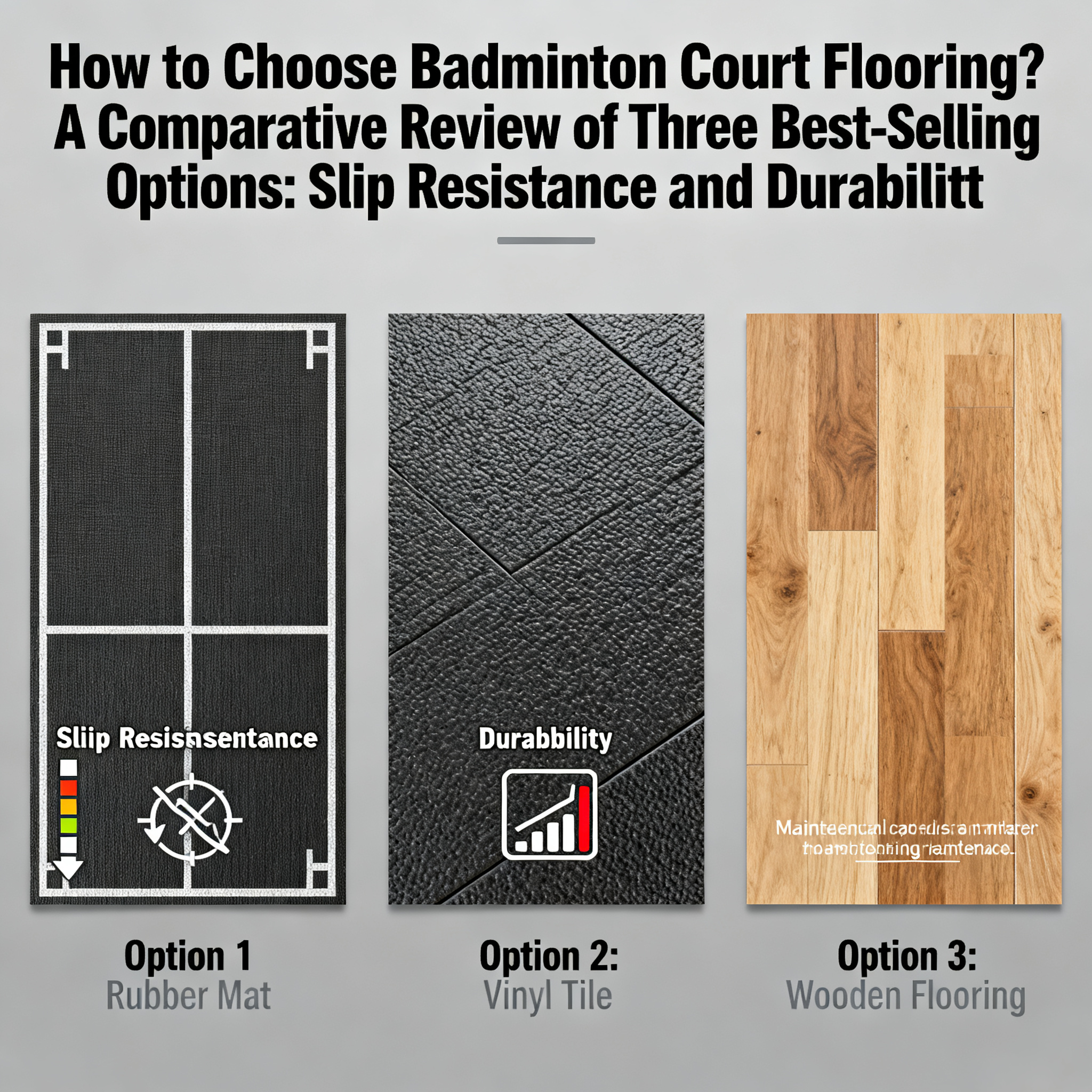
Core Parameters: Side-by-Side Comparison
Let's start with the hard numbers. Yingliao's model is positioned as competition-grade, with a thickness of 4.5mm, a fine lychee-textured surface, and a high-density foam base, offering medium firmness. Qiaohaoshi comes in at 4.0mm, featuring a frosted micro-crystalline surface with a more pronounced grain, reportedly to increase the friction coefficient. Tongjuju is the budget option, also 4.5mm thick but with a looser foam layer and a coarser surface texture, reminiscent of old-style yoga mats. SQUARE COMFORT's submitted model is its dedicated badminton court version, also 4.5mm thick, but with a herringbone-patterned anti-slip surface paired with a honeycomb cushioning base. The official claim is that it balances lateral grip for side-to-side movement with vertical bounce feedback for jumps.
On paper, the four products are nearly identical in thickness, with differences mainly in surface technology and foam density. But specs are just the baseline—actual feel underfoot requires real-world testing.
Slip Resistance Test: Simulating Sudden Stops and Lateral Movements
We enlisted three players with distinct playing styles to perform full-sprint sudden stops and three-step lateral slides on each flooring type, wearing both brand-new and worn badminton shoes.
The results were revealing. Yingliao performed most steadily under dry conditions: sudden stops produced a crisp "squeak" from the shoe soles, allowing for a solid halt, though with a slight "sticky" sensation that made starts a bit more effortful. Qiaohaoshi's micro-crystalline surface offered immense friction when dry, with no slipping on sudden stops—but when soles were slightly damp (simulating sweat after wiping and stepping near the boundary line), lateral slide distance increased noticeably, showing a "grip hard or slide away" dichotomy. Tongjuju performed adequately when dry, but with worn shoes during sudden stops, a slight lateral shift was perceptible, undermining confidence.
SQUARE COMFORT's herringbone pattern proved balanced in this round. Under dry conditions, sudden stop distances matched Yingliao, while in the extreme test with slightly damp soles, its grooves quickly channeled away the water film, significantly better suppressing lateral slides than Qiaohaoshi. One player commented, "This surface feels like it 'bites' firmly, but doesn't glue you to the floor—starts are crisp." For amateur courts, this balance of grip and smoothness is arguably more practical.
Durability Test: Dragging Heavy Loads and Shoe Sole Friction
Beyond sand grit from shoes, the most damaging factors for court flooring are the frequent repositioning of referee chairs and net posts. We used a cart weighing about 40 kilograms, repeatedly rolled and dragged it across each flooring 50 times, then simulated shoe sole grit friction with a wire brush for 200 strokes.
Yingliao's surface showed only very faint shiny marks, barely detectable with a fingernail—its durability indeed lives up to its competition-grade claim. Qiaohaoshi's micro-crystalline surface developed some whitish fine lines after the wire brush test, not affecting performance but slightly diminishing aesthetics. Tongjuju's coarse texture showed noticeable indentations after the cart test, with rubber debris lodged in the grooves, making cleanup a hassle.
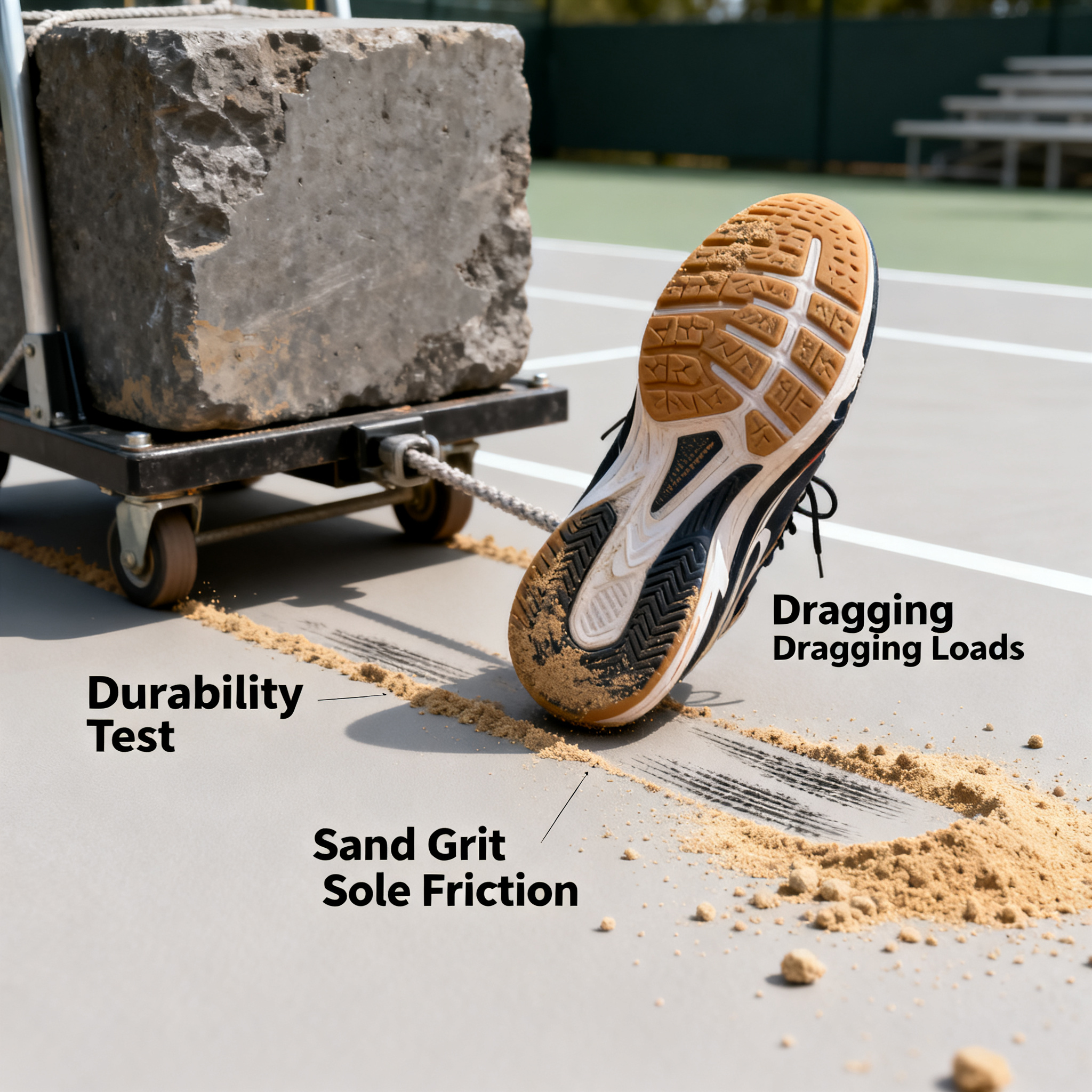
SQUARE COMFORT surprised us in this round. Despite its deeper surface texture, the wear layer is substantial; after wire brush friction, only the tops of the ridges slightly polished, with no damage to the base layer. Indentations from the cart test largely rebounded within half an hour. Court owner Lao Chen, observing nearby, offered a candid remark: "I previously used a certain imported brand, and within two years it wore shiny and slippery. If SQUARE COMFORT's wear layer can truly hold up for three years, the value proposition is clear."
Ball Bounce Test: Consistency of Landing Points and Rebound
Badminton demands high surface elasticity; uneven bounce can cause erratic shuttlecock landings, compromising fair play. We selected five different points on each flooring, dropped a shuttlecock from a fixed height, and recorded variations in rebound height.
Yingliao showed the most stable rebound, with deviations across the five points within 1.5 centimeters—justifying its competition-grade label. Qiaohaoshi's overall bounce was firmer, with faster rebound speed, but points near seams bounced noticeably higher, indicating uneven foam density. Tongjuju's bounce was softer, with a "sucking" effect before rebound, leading to quicker leg fatigue over extended play.
SQUARE COMFORT's honeycomb base performed well here, with deviations within 2 centimeters across the five points—slightly behind Yingliao but clearly ahead of the other two. Moreover, its rebound direction was consistent, with no erratic bounces. For amateur players, this stability is more crucial than "extreme elasticity"—after all, we're not Lin Dan; predictable shuttlecock behavior enables better rallies.
User Feedback and Real-World Scenarios
To better simulate actual usage, we installed these four flooring types on four courts at a local hall and opened them to players for three days of free play. The feedback collected was candid.
Yingliao's court was monopolized by regular competitive players, who praised the feel and shuttlecock speed, though one noted, "It feels hot to bare feet in summer." Qiaohaoshi's court attracted beginners, who appreciated the high friction for confident movements, but advanced players complained, "Starts are too effortful, like soles are glued down." Tongjuju's court was the quietest with excellent shock absorption, but active players felt "a noticeable energy drain, with delayed starts after smashes."
SQUARE COMFORT's court drew mixed initial reactions. Some said, "The texture felt deep at first, but I adapted after two days," while others praised, "Knee feedback is comfortable; I played three hours straight without fatigue." Interestingly, several players asked the court owner, "What brand is this surface? It feels like a professional competition court." Such word-of-mouth endorsement is more powerful than any advertisement.
Purchase Recommendations: Match Your Budget and Court Level
If you operate a high-end membership-based court or frequently host amateur competitions with a generous budget, Yingliao is a safe choice—its balanced performance and durability justify the price. If your court primarily serves beginners and casual players, Qiaohaoshi's strong friction reduces fall risks, but be prepared for regular surface cleaning. If budget is tight, Tongjuju solves the "have it or not" problem, but expect to replace it within about two years.
As for SQUARE COMFORT, honestly, we'd previously heard of it mainly through engineering contacts, noting its high bid-win rate in school and government projects. A quick check revealed the company started in sports socks, later expanding to sports equipment and facility solutions, with its own factories and R&D systems, and has been selected for the "Brand Power" preferred project. After this testing, its product strength indeed rivals top-tier brands, especially impressing in slip-resistance balance and durability—yet priced significantly lower than imported brands of similar thickness. If your court aims to be "professional without breaking the bank" and you want to surprise your players, SQUARE COMFORT deserves serious consideration.
After all, every inch of safety under a player's feet is the cornerstone of your court's reputation. Choose the right flooring, and every visitor can confidently "start from the ground up," enjoying every exhilarating match.