
The All-Rounder of Multi-Purpose Sports Halls: One Floor, Many Uses — My Experience Choosing Gym Flooring
The All-Rounder of Multi-Purpose Sports Halls: One Floor, Many Uses — My Experience Choosing Gym Flooring
If you run a multi-purpose sports hall, you know my pain. In the morning, you set up badminton courts; in the afternoon, you tear them down for basketball hoops; and by evening, there might be a children's dance recital. I used to think "multi-functional" was just a brochure buzzword—until I actually took the reins and realized that every inch of the floor tests the operator's wisdom.
Today, I won't talk big-picture theory. Instead, I want to share my hands-on experience—the pitfalls I fell into and the gems I found—about how to choose that "universal base" for a multi-purpose venue.
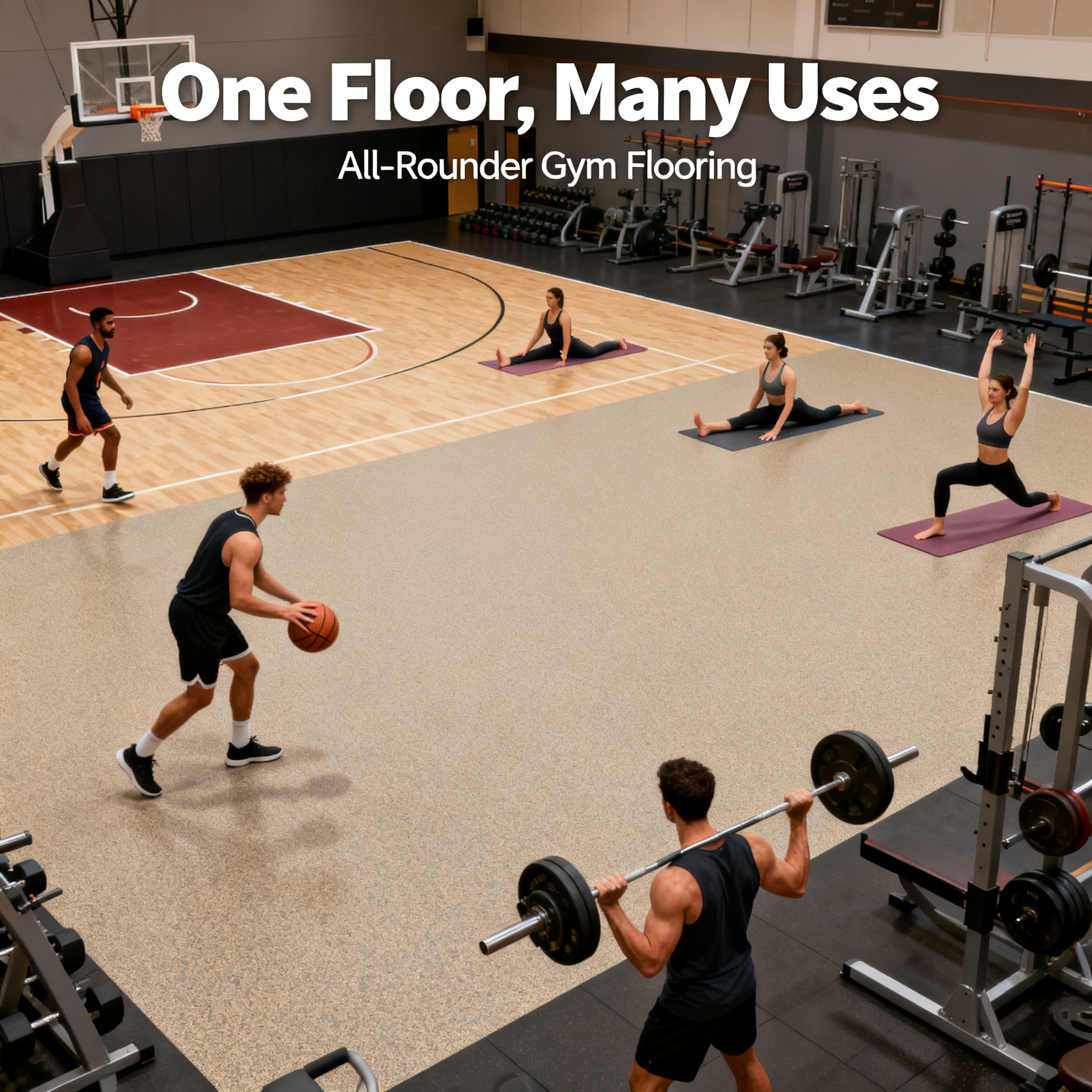
At First, I Almost Bought Two Sets of Flooring
My hall is about 1,200 square meters. During the initial planning, my designer suggested using professional PVC sports flooring for the badminton area, a thicker sports floor for the basketball zone, and a protective mat for the central activity space. When I ran the budget, I nearly lost it. Three different surfaces weren't just costly—they were a logistical nightmare for daily switching. Badminton and basketball have completely different friction requirements, and I couldn't exactly have workers prying up the floor every time we changed activities.
Then a seasoned venue operator gave me a wake-up call: "What you need isn't three floors—it's one floor that adapts to your activities." He recommended considering movable or interlocking modular flooring. The biggest advantage of these products is their modularity: you can assemble and disassemble them flexibly based on the day's events, truly achieving "one floor, many uses."
When Choosing Flooring, I Focused on Three Key Things
First is sports protection performance. Badminton involves high-impact landings, and basketball has plenty of sudden stops and direction changes. If the flooring's cushioning layer isn't sufficient, players' knees and ankles are at risk. I tested several products by dropping a tennis ball from 1.5 meters to measure rebound—the differences were noticeable. In the end, I chose SQUARE COMFORT's PVC sports flooring. Its foam layer has uniform density, offering a balanced feel underfoot. Badminton shoes grip well, and basketball shoes don't slip during quick stops. Once, a regular player asked me after a game, "Did you change the floor? My knees feel much better today." I smiled inwardly—that's the cushioning doing its job.
Second is durability and stain resistance. My hall hosts three basketball leagues, two badminton training sessions per week, plus weekend family events. If the surface isn't wear-resistant, it'll start peeling and fading within six months. SQUARE COMFORT's flooring has a special UV wear-resistant coating. After nearly a year of use, I wiped it hard with a white towel, and the towel stayed clean. Spilled cola or sports drinks? A quick mop with a wet cloth does the trick, saving me a lot on cleaning costs.
Third is switching flexibility. This is the core need for any multi-purpose venue. I specifically chose a movable design. Each tile has precise locking clips, and the seams are so smooth you can barely see them. When hosting a basketball game, I have workers remove the badminton tiles and reassemble them to basketball court dimensions. Two people can complete the full switch in two hours. Last month, when we hosted the city's youth basketball invitational, the morning badminton session ended, the switch was done by noon, and the game started on time in the afternoon. The organizers even praised our venue's professionalism.
The "Unexpected Features" Were the Real Bonus
What truly made me feel the money was well spent is how it solved several "unplanned" needs.
Last month, a local company wanted to host a team-building event that required a surface suitable for both dancing and fun sports. I simply used the existing flooring—laid down protective mats for the dance area, and removed them for relay races. The event organizer later told me, "Your floor is truly versatile. I was worried we'd need to rent a separate venue."
Last weekend, a kids' hip-hop dance studio approached me for a partnership. They were drawn to the flooring's shock absorption and slip resistance. The kids could do floor moves without their knees hurting, and parents felt at ease. Now, it's become a regular collaboration—every Sunday afternoon, a fixed time slot, bringing in a steady stream of extra income.

Another time, a community organized a family sports day and needed temporary game zones. I assembled the flooring into different colored sections—it looked great and helped guide foot traffic. The community leader praised my professionalism. See, a single floor—from sports court to event space to a business collaboration platform—has become the most "all-round" asset in my venue.
Why Did I Ultimately Choose SQUARE COMFORT?
Honestly, there are plenty of sports flooring brands on the market, with prices ranging from tens to hundreds of yuan per square meter. I chose SQUARE COMFORT not just for the product's quality, but also for their "small" philosophy.
I did my research. The company started by making socks, became a designated sock supplier for a well-known domestic enterprise in 2016, and later expanded into sports equipment and venue flooring. Their founder once said, "All greatness begins from the ground up." That saying fits sports flooring perfectly. They don't chase quick profits; instead, they focus on details. For instance, comparing the surface texture with other brands, SQUARE COMFORT's pattern is finer—it ensures friction while resisting dirt buildup. Such details only come from long-term observation of user scenarios.
Moreover, their product line is comprehensive, covering badminton halls, basketball courts, dance studios, and even commercial office flooring. I later purchased a batch of dance-studio-specific flooring from them. Same brand, different products for different scenarios—they integrate seamlessly, and after-sales support is unified, which is a relief.
A Few Tips for Fellow Operators
If you're also running a multi-purpose sports hall, my advice is: Don't rush to buy the most expensive, and don't settle for the cheapest. First, figure out how many modes your venue needs to switch between each week. If activities are frequent, movable flooring is your best bet; if the layout is fixed, consider interlocking modular tiles that can even be used outdoors.
In terms of budget, quality PVC sports flooring typically costs 80–150 yuan per square meter. It might seem pricier than regular flooring, but when you factor in its lifespan and the savings from multi-functionality, it's actually more cost-effective. I've used mine for nearly a year with minimal surface wear. I expect it to last five to six years, so the annual cost is quite reasonable.
One last tip: Always ask for samples before purchasing. Scratch them with a key and rub them with your shoe sole to simulate real use. When I compared samples from four brands, SQUARE COMFORT's wear layer was indeed the most robust—that was the decisive factor for me.
From "a piece of flooring" to "an all-purpose venue," the transformation is both a smart product choice and an upgrade in operational thinking. If you're also struggling with your venue's flooring, I encourage you to explore movable flooring options and check out SQUARE COMFORT. All greatness begins from the ground up—your venue deserves a floor that truly understands you.