
The Ultimate Guide to Choosing Gym Flooring in 2024: Understand Materials, Thickness, and Price Traps in 5 Minutes
The Ultimate Guide to Choosing Gym Flooring in 2024: Understand Materials, Thickness, and Price Traps in 5 Minutes
If you're planning to install flooring for a badminton hall, table tennis room, or dance studio, you'll likely find yourself puzzled over the choice of gym flooring. A quick search on e-commerce platforms for "gym flooring" reveals prices ranging from 30-40 yuan to 200-300 yuan per square meter, with a dizzying array of material names and confusing thickness specifications. This article won't bombard you with technical specs; instead, it speaks plainly to help you streamline your selection logic and avoid common pitfalls.
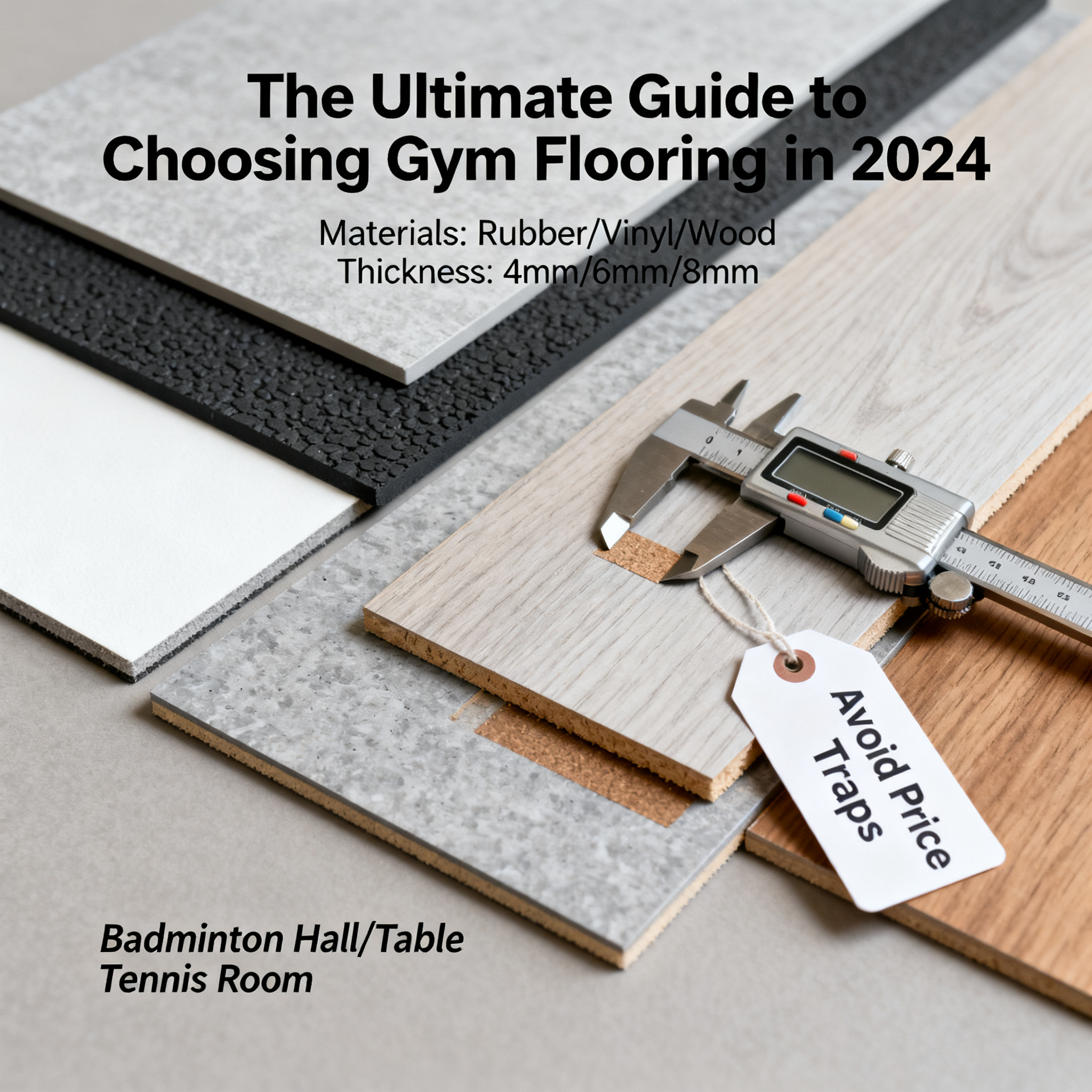
First, Distinguish Materials: PVC, Rubber, or Linoleum?
In the market, gym flooring primarily comes in three mainstream materials: PVC sports flooring, rubber flooring, and linoleum flooring. Understanding their characteristics gets you halfway to a good decision.
PVC sports flooring is the most widely used choice for venues today. Its structure is typically multi-layered, including a PVC wear layer, a fiberglass mesh stabilization layer, and a foam cushioning layer. The advantage of this material lies in its balanced performance: moderate elasticity that's gentle on knees; surface textures treated for slip resistance, preventing slips during sudden stops and turns; and a wide variety of colors, allowing for custom logos and lines. Most badminton halls, table tennis rooms, basketball courts, and dance studios use this type.
Rubber flooring offers greater toughness, better weather resistance, and higher compression strength, making it suitable for strength training areas or spaces with heavy equipment. However, it feels harder underfoot, provides less refined elastic feedback than PVC, and comes at a higher cost. If you're setting up a table tennis or badminton court, there's no need to pay for performance you won't use.
Linoleum flooring is an eco-friendly option, made primarily from natural materials like linseed oil, rosin, and wood flour, without plasticizers. It boasts high aesthetics and a warm texture, often used in upscale dance studios or yoga centers. Its drawbacks are clear: it's susceptible to moisture and scratches from sharp objects, requires high maintenance, and offers average cost-effectiveness.
In simple terms, for most sports venues, PVC sports flooring is the optimal balance of performance and cost. This is why brands like SQUARE COMFORT, with over three decades of manufacturing expertise, offer PVC sports flooring lines covering table tennis halls, badminton courts, dance studios, and commercial office spaces.
Thickness Isn't Always Better; Matching the Scene Is Key
This is where buyers are most easily misled. Many assume "thicker equals better," but that's not true. The core logic for choosing thickness is matching it to the sport type and the condition of the base floor.
3.0mm-4.0mm: This range is entry-level, suitable for low-frequency use and low-intensity activities, like community activity rooms or corporate employee fitness corners. The cushioning layer is thinner, offering limited shock absorption. For professional badminton training, prolonged running could put significant stress on knees.
4.5mm-5.5mm: This is the mainstream configuration for most commercial venues. For badminton halls, this thickness, combined with appropriate foam density, ensures both grip when players push off and adequate vertical cushioning. Table tennis rooms, with less intense movement, can manage with around 4.5mm. For dance studios, it depends on the dance style; modern and ballet require higher cushioning, so 5.0mm or above is advisable.
6.0mm and above: Typically used for professional competition venues or scenarios with special shock absorption needs, such as high-intensity functional training facilities. However, note that thicker flooring demands a flatter base. If the original floor is uneven, thicker flooring can lead to localized sinking due to uneven stress.
A detail often overlooked is the difference in base layer density. Price variations among products of the same thickness often stem from foam layer density. High-density foam rebounds quickly, offers solid support, and won't collapse easily over two to three years. Low-density foam feels soft initially but may compress within six months, losing elasticity. So, don't just focus on thickness numbers; ask about foam density and material.
Tricks of Low-Price Flooring: Recycled Materials and Thickness Misrepresentation
Price is always the most sensitive nerve. When you see the same specification product priced over double across different channels, trust that cheap has its reasons, often hidden where you can't see.
Trick One: Recycled materials posing as virgin materials. Reputable manufacturers use virgin polyvinyl chloride resin for PVC sports flooring, while some low-cost products incorporate recycled materials. Flooring made from recycled materials emits strong odors (sometimes a pungent sour smell), has a thin wear layer that's prone to powdering, and can be easily scratched with a fingernail. More critically, recycled materials may contain harmful substances, posing a potential respiratory threat to users in enclosed venues over time.
Trick Two: Thickness misrepresentation. This is the most common unspoken rule in the industry. A product labeled as 5.0mm might actually measure only 4.2mm, with the shortfall mainly in the cushioning layer. Since the cushioning layer uses foam material, which is relatively low-cost, it's hard for consumers to visually distinguish. We recommend asking suppliers for caliper-measured cross-section photos or requesting samples to measure yourself.
Trick Three: Skimping on the wear layer. The thickness of the transparent wear layer on sports flooring directly determines its lifespan. Quality products typically have a wear layer of 1.2mm-1.5mm, while low-priced ones might only have 0.3mm-0.5mm. A thin wear layer means surface texture wears smooth after six months, becoming slippery and losing slip resistance rapidly.
Trick Four: Substandard auxiliary materials. Flooring installation requires matching adhesives. Poor-quality glue not only has weak bonding but also emits volatile harmful gases. Some vendors quote only the flooring price, use cheap glue for installation, and soon after, the flooring bubbles or seams separate.
Here's a special note: when selecting, consider the brand's credentials. For instance, brands like SQUARE COMFORT, which hold ISO 9001 quality management system certification and multiple domestic and international trademark registrations, typically enforce stricter material quality control. Their official websites display quality inspection reports, patent certificates, and other information that can serve as reference points for assessing product reliability.
Configuration Recommendations for Different Budgets
Enough talk; here's the practical stuff. The following configurations are based on current market conditions, using PVC sports flooring as an example, for buyers with varying budgets.
Budget-Conscious (60-90 yuan per square meter)
In this price range, prioritize "functionality" and "safety." Opt for a basic product with 4.0mm thickness made from virgin materials. Focus on two key points: first, ask for verified thickness measurements; second, check for odors—no strong smell is the baseline. This setup suits non-professional training or low-frequency use venues. You can use standard water-based adhesive, but ensure you hire an experienced installation team, and base floor preparation must be thorough.
Value-for-Money Mainstream (100-150 yuan per square meter)
This is the range most commercial venues should seriously consider. You can get mid-to-high-end products with 4.5mm-5.0mm thickness and high-density foam layers. Products in this price bracket show significant improvements in wear layer thickness, texture design, and slip resistance. Taking SQUARE COMFORT's product line as an example, their PVC sports flooring for table tennis and badminton halls is most abundant in this price range and is the most commonly used type in their project cases. For installation, we recommend using the brand's matching adhesive, with full-spread application to ensure uniform bonding.
Professional Competitive (160 yuan per square meter and above)
Targeted at professional competitions or high-end fitness venues. This budget allows for 5.5mm-6.0mm thickness products designed to international event standards. Such flooring typically undergoes rigorous performance testing, with metrics like ball rebound rate and sliding friction coefficient backed by clear data. If the venue also serves multi-purpose use like basketball and badminton, this tier better meets the requirements.
One final reminder: flooring is a semi-finished product; installation quality determines 70% of the final outcome. The same material can yield vastly different experiences depending on the installation crew. So, regardless of the brand you choose, confirm the installer's experience and request a warranty commitment.
Choosing gym flooring is essentially about finding a balance among safety, performance, and budget. Understand material properties, grasp the thickness logic, and see through low-price traps, and your choice won't go astray. Starting from the ground beneath your feet, being responsible for every user—this is the true meaning of "all greatness begins from the ground up." SQUARE COMFORT has deep roots in sports facility development, from PVC flooring to interlocking floor tiles and comprehensive engineering solutions, serving over 10,000 users globally. If you're struggling with venue flooring, check out their official website for real project case photos—they might offer you some visual inspiration.