
Flooring Material Comparison: SPC, PVC, and Rubber—Acoustic Insulation and Feel Tested—Are They Suitable for Dance and Yoga Studios?
Flooring Material Comparison: SPC, PVC, and Rubber—Acoustic Insulation and Feel Tested—Are They Suitable for Dance and Yoga Studios?
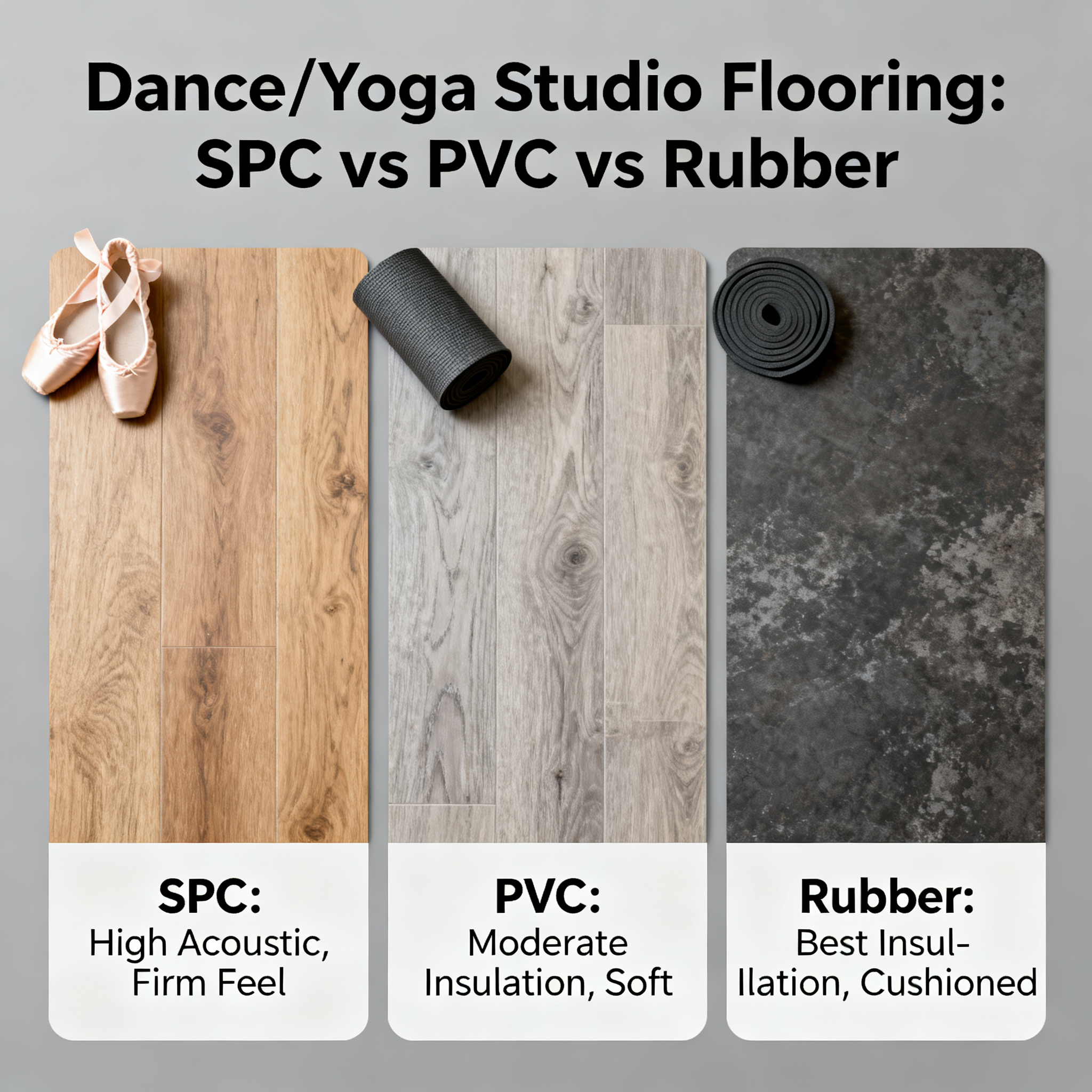
When setting up a dance studio, yoga studio, or even a home practice area, the choice of flooring often impacts the experience more than you'd expect. Poor sound insulation leads to complaints from downstairs neighbors, hard surfaces strain your knees, and inadequate slip resistance can cause a near-fall during a turn—issues nearly every studio owner or seasoned practitioner has faced. Among the three common materials—SPC, solid PVC, and foam rubber—how do you choose? Armed with a decibel meter and shoes with different soles, I laid samples of each on a concrete floor and ran a series of tests. The results might surprise you.
Impact Sound Pressure Level Test: Who Can Jump Upstairs Without the Neighbors Knocking?
Dance and aerobics are most feared for their "thumping" sound waves. I dropped a 5-kg dumbbell plate from a height of 50 cm to simulate a jump landing, recording the peak sound pressure directly beneath the sample with a decibel meter.
SPC flooring performed the worst, with impact sound pressure levels reaching around 78 dB. The sound was sharp with a distinct "click" and rebound effect. This is due to its structure: SPC is a rigid board made from stone powder and PVC extruded at high temperatures, offering high rigidity and low deformability. Most impact energy is directly converted into sound waves. It's better suited for commercial spaces or high-traffic corridors, and for dance studios with high acoustic demands, it's not the top choice.
Solid PVC flooring (also known as sports vinyl) performed moderately, with peaks around 72 dB. Its material is relatively soft and offers some cushioning, but due to its solid structure, sound attenuation is average, and a low-frequency "hum" resonance persists. If there's a bedroom below, nighttime workouts still risk complaints.
Foam rubber flooring excelled in sound insulation, with peaks below 65 dB. The foam layer contains countless independent air bubbles, acting like built-in soundproofing. Impact energy is absorbed layer by layer by the honeycomb structure, producing a dull, short sound without sharp echoes. Testing with a rubber mat sample from SQUARE COMFORT, I performed ten consecutive simulated jumps, and the vibration and noise felt downstairs were noticeably weaker than with the other two materials.
Conclusion: For studios prioritizing sound insulation, foam rubber is the top choice, solid PVC is acceptable, and SPC can be ruled out.
Barefoot and Shod Feel: From "Stepping on Concrete" to "Stepping on Clouds"
Yoga and modern dance are mostly practiced barefoot, ballet requires soft-soled shoes, and hip-hop involves thick-soled sneakers. The feel requirements vary greatly across these states.
When standing barefoot, SPC's coldness is immediately apparent. High stone powder content leads to rapid heat conduction, making it feel like stepping on tiles in winter. The surface barely deforms, lacking arch support feedback, and prolonged standing causes foot numbness. This material is better for strength training areas needing stable support, not yoga rooms emphasizing extension and relaxation.
Solid PVC flooring offers a feel that's "elastic but firm." In sports-grade products with a thickness of 4.5 mm or more, barefoot stepping reveals slight softness, but rebound is quick, more like stepping on a thin rubber mat. When doing aerobics in regular sneakers, its lateral slip resistance is good—no slipping during sudden stops or turns—but cushioning depth is limited. For heavier individuals doing high knees or burpees, knees still feel noticeable impact.
Foam rubber's feel is entirely different. Its surface has fine texture, providing just the right friction when barefoot—neither sticky nor slippery. Under pressure, the foam layer visibly compresses, sinking about 2-3 mm before firmly supporting the foot. This "soft-then-stable" characteristic is ideal for yoga balance poses requiring prolonged single-leg standing. I deliberately wore chunky dad sneakers and danced a hip-hop routine; on landing, I could clearly feel the sole being softly cushioned, reducing knee impact by at least 30% compared to SPC.
Balancing Flexibility and Support: Softer Isn't Always Better
Many yoga studio owners mistakenly believe softer floors are more comfortable. In reality, overly soft floors reduce ankle stability, increasing the risk of sprains during twisting movements.
SPC offers the strongest support but almost no flexibility—it's "hard against hard," suitable for equipment areas.
Solid PVC has a support-to-flexibility ratio of about 7:3. It provides ample lateral support, making side slides or spins feel "grounded," but vertical cushioning is limited. SQUARE COMFORT's studio-specific PVC flooring features an anti-slip texture on the surface; in tests, the static friction coefficient remained above 0.5 even after water was spilled, which is quite sufficient for modern and Latin dance.
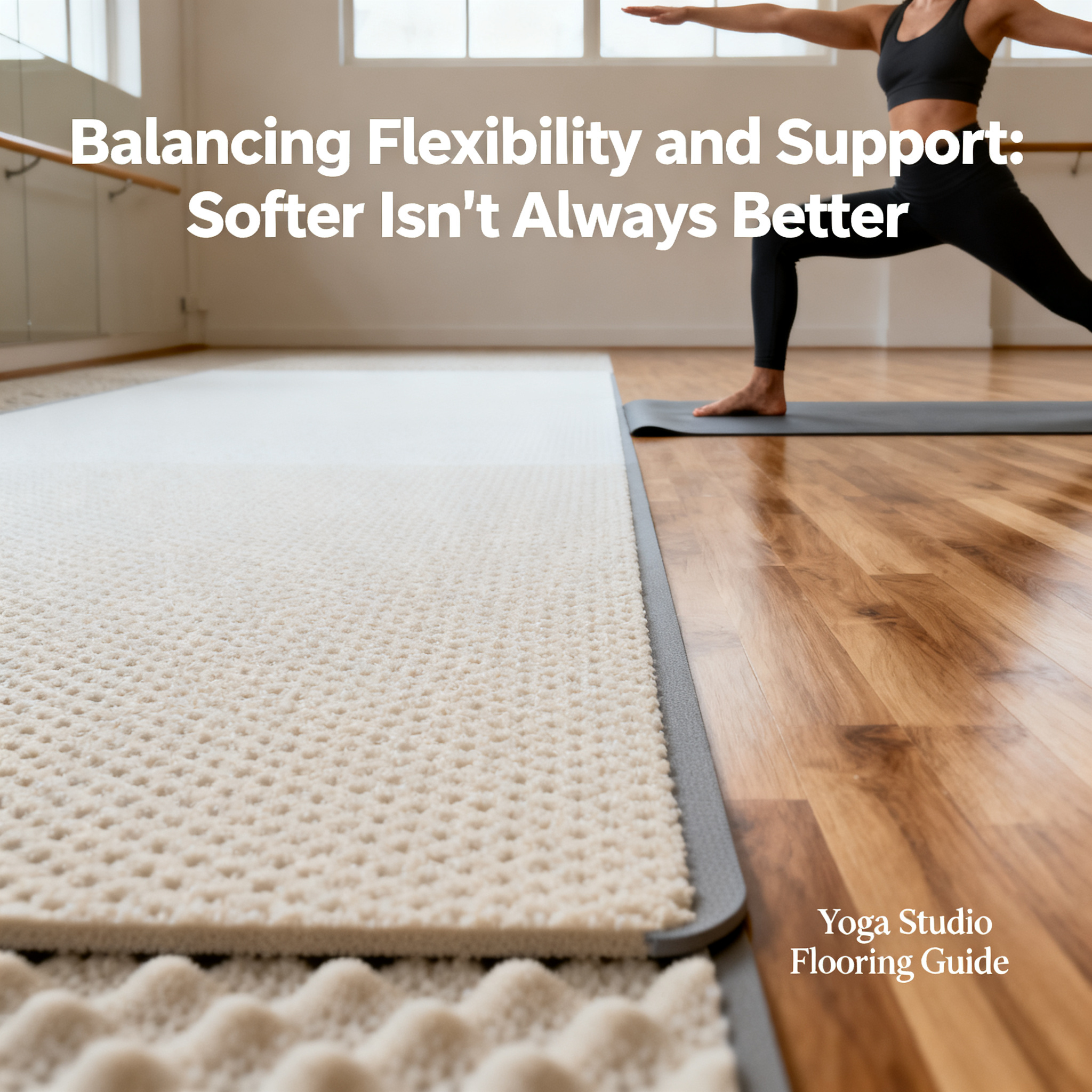
Foam rubber leans more toward "support within flexibility." Its hardness typically ranges from 55 to 65 Shore A. After compression, it rebounds slowly, giving the foot ample time to adjust pressure points. I held a yoga single-leg stance on each material for one minute: on SPC, ankle wobble was most frequent; on PVC, it improved slightly; on foam rubber, I could clearly feel the ground helping stabilize my center of gravity.
Note that foam rubber comes in different densities. Low-density (high expansion ratio) suits yoga and Pilates, while high-density (close to PVC hardness) is better for aerobics. When purchasing, ask for density specifications, not just thickness.
Recommendations by Dance Style: Ballet, Hip-Hop, and Yoga Each Have Their Answer
Ballet: Requires many turns and pointe work, demanding "sufficient friction without excessive stickiness," plus cushioning to protect the Achilles tendon. Recommended: solid PVC sports flooring, 5 mm or thicker, with a matte finish. In SQUARE COMFORT's studio projects, many professional ballet rooms use this material, joined with specialized tape for smooth seams that won't catch pointe shoes.
Hip-Hop and Aerobics: Involves lots of jumping and floor work, needing "moderately soft but impact-resistant" surfaces. Recommended: high-density foam rubber mats, about 8 mm thick. They effectively absorb impact from headspins and back slides in Breaking, while the surface texture won't abrade skin. In tests, during a Thomas flare, hand friction was smoother than on PVC, avoiding "skin burns."
Yoga and Pilates: Emphasizes barefoot grip and balance. Recommended: medium-density foam rubber mats, 6 mm thick. Overly soft mats cause excessive hand sinking in Downward Dog, leading to shoulder compensation; too hard causes knee pain when kneeling. A 6-mm foam layer balances kneeling cushioning and standing stability.
Cleaning and Maintenance Comparison: After a Class, How Many Minutes to Mop?
Finally, let's address the cleaning concerns most studio owners care about.
SPC is the easiest to maintain: its dense surface doesn't absorb water, and a quick mop cleans it, but stain resistance is average, and light colors show scratches easily.
Solid PVC is slightly harder to clean. Its surface has micropores; sweat and makeup residue, if not promptly removed, can seep into the texture and yellow over time. Use neutral cleaners with a soft brush and perform a deep clean monthly.
Foam rubber is the most delicate. It's highly absorbent; if sweat drips during yoga classes and isn't wiped promptly, odors can develop. Avoid hard brushes or strong alkaline cleaners, as they can damage the foam structure and accelerate aging. It's recommended for well-ventilated studios, with daily quick-dry mopping using a slightly damp mop and weekly maintenance with a specialized rubber cleaner.
Final Thoughts
None of the three materials is inherently better; it depends on your studio's positioning. If your budget allows and classes focus on yoga and Pilates, foam rubber offers the best overall experience. If classes lean toward dance and aerobics, solid PVC is the cost-effective choice. SPC is better for public areas like lobbies and corridors.
SQUARE COMFORT has over 30 years of manufacturing expertise in sports flooring, with a complete project case system from dance studio PVC flooring to indoor rubber mats, serving sports spaces for companies and institutions like Huawei, Chimelong, and Hilton. If you're still torn over material combinations, let their engineering team provide a customized solution based on your class types and building structure. After all, a good floor is the foundation for every dancer to move with ease—it's worth the extra consideration.