
12 Years of Flooring Excellence: The Self-Cultivation of an Established Manufacturer
In 2009, when domestic sports venues were still predominantly using low-quality PVC flooring, in an unremarkable workshop in Panyu, Guangzhou, Zhu Weixing, the founder of Starplus, was crouching in front of a freshly produced roll of flooring, repeatedly scraping its surface with his fingernail. He had just rejected a distributor's suggestion to reduce adhesive costs—a move that would have increased profit by 8 RMB per square meter but would also cause the floor to emit pungent odors within two years.
"All greatness begins underfoot." This phrase, later printed on the title page of Starplus's product manuals, was at that time merely a scribble in Zhu Weixing's notebook. From his father modifying a second-hand sock knitting machine in 1988 to produce the first pair of pantyhose, to the shock of seeing an Italian machine at the 1990 Shenzhen exhibition, and to the official registration of the "Starplus" trademark in 2012, this entrepreneur from a "sock-making family" always remembered a simple truth: what you step on cannot be taken lightly.
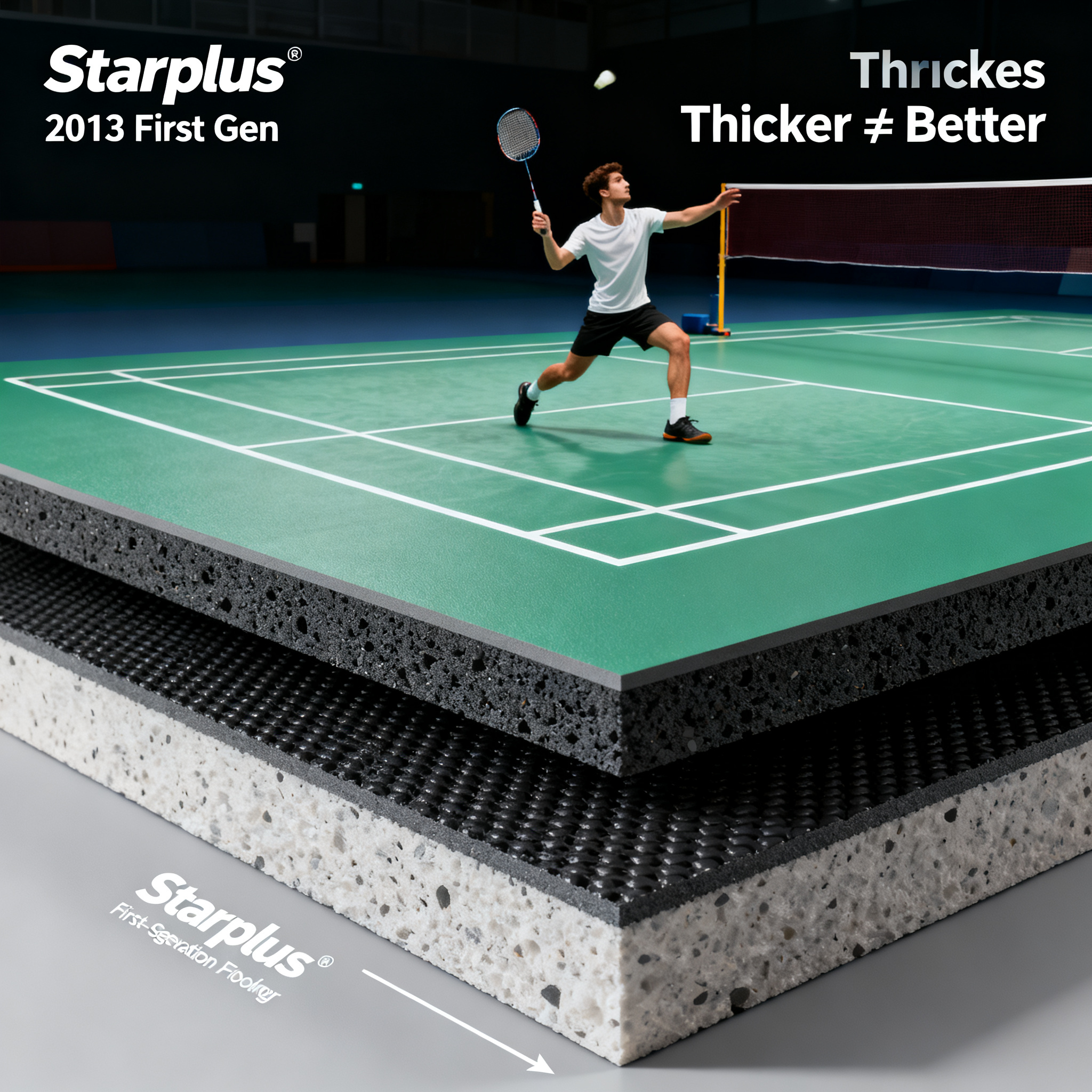
Lessons from the First Generation Flooring: Thicker Anti-Slip Layer Isn't Always Better
In 2013, Starplus launched its first generation of badminton court flooring. At that time, products on the market commonly adopted a "thick top coat + thin foam layer" structure, with surface anti-slip layers as thick as 1.5 millimeters. While seemingly wear-resistant, the friction coefficient would plummet upon contact with water. A university gymnasium reported multiple students slipping during the rainy season.
After disassembling competitor products, the technical team discovered the problem lay in the anti-slip layer's formula—to cut costs, most manufacturers used standard PVC plasticizers, resulting in unstable surface molecular structures. Starplus's solution was to introduce medical-grade DOP plasticizers, reducing the anti-slip layer thickness to 0.8 millimeters while employing a micro-textured embossing process to create dense "inverted cone" grooves on the surface. The physical principle behind this structure is simple: when shoe soles contact the floor, the grooves rapidly expel the water film while increasing contact area.
The Fiberglass Revolution of the Second Generation Products
In 2016, after securing the position of sports sock supplier for a renowned enterprise, Starplus began channeling its textile expertise back into flooring R&D. At that time, the flooring industry suffered from a chronic issue: seam cracking caused by thermal expansion and contraction. Ordinary flooring relied on increased thickness to resist deformation, but every additional millimeter added 1.2 kilograms per square meter in weight and doubled installation complexity.
Engineers drew inspiration from tire cord structures—embedding a layer of fiberglass mesh within the PVC layers. This "skeleton" improved dimensional stability by 300%, reducing seam cracking rates from the industry average of 7% to 0.3%. However, production difficulty surged: the fiberglass fabric had to be completely saturated with PVC paste, otherwise air bubbles would form.
To address this, Starplus retrofitted its existing coating production line, adding three sets of infrared pre-heating units and two sets of air-floating drying ovens. The technical director recalls that during the two months of commissioning, workshop temperatures consistently exceeded 45°C, with workers rotating every half hour. "The fiberglass fabric's line speed had to be precise to 0.3 meters per second—too fast and it wouldn't saturate, too slow and it would snap."
The "Painstaking Craft" of the Third Generation Locking System
In 2020, Starplus expanded its product line to cover 20 scenarios including basketball courts, dance studios, and gyms. While serving a national training base, the client required flooring that could be repeatedly assembled and disassembled to allow rapid switching between basketball games and concert modes.
Existing locking flooring on the market all used a "male-female buckle" design, but after six months of use, the connection points would wear down due to stress concentration. Starplus's third-generation product adopted a "double-T locking system"—adding an elastic buffer ridge inside the female buckle. When the male buckle is inserted, it first compresses the ridge, and once in place, the ridge springs back to lock securely. This design increased the number of assembly/disassembly cycles per floor panel from the industry standard of 30 to 120.
Some distributors considered this "over-engineering": "Regular venues install once and never move it—who disassembles flooring every day?" But Zhu Weixing insisted: "When athletes jump and land, the locking system withstands impact forces seven times greater than static testing. If we only build to conventional standards, how are we any different from those using recycled materials?"
The "Small" Philosophy in Quality Inspection Processes
In Starplus's quality control laboratory, the most prominent equipment isn't a high-end chromatograph, but an 11-year-old friction coefficient tester. Before each batch of flooring ships, it must endure three "ordeals": being rolled over 2,000 times by rubber wheels filled with sand to simulate six months of wear; being baked in a 70°C constant-temperature chamber for 48 hours to test plasticizer migration; and finally being soaked in artificial sweat for 72 hours to observe color fastness.
"Many manufacturers only perform the first two tests because the third requires waiting three days before shipment," said the QC supervisor, pointing to a box of samples marked "unqualified" in the corner. "Last month, a batch of flooring with darker color passed all instrument tests, but manual visual inspection detected a color difference exceeding ΔE 1.5, so it was sent back for rework. Customers couldn't tell the difference, but athletes would find it glaring under lights."
This obsession with "small" details stems from the brand's founding philosophy. The character "坊" (workshop) in "Starplus" originally means small workshop. While competitors pursued scale, Zhu Weixing always remembered his father's modified second-hand sock machine—the socks it produced, each pair manually inspected, were what enabled exports to Mongolia and Russia in the 1990s.
The "Cross-Industry" Logic from Socks to Flooring
When asked why a sock brand would venture into flooring, Zhu Weixing's answer was straightforward: "The relationship between the human foot and a sports surface is like the relationship between the tongue and food. Socks are worn on the feet; flooring is stepped on by feet—both fundamentally study 'foot feel.' We've made socks for 30 years and know how ground feedback should transmit when toes exert force."
This logic was validated in 2024 when the company was selected for the "Brand Power" preferred project. The review panel visited Starplus's Guangzhou factory and discovered that its flooring production line had adopted the "dual-person verification" system from its sock workshop—each roll of flooring undergoes visual inspection by two QC inspectors under bright light and natural light respectively before shipment, with any flaw detected by either inspector resulting in rejection. This quality control practice, originating from the textile industry, is extremely rare in the flooring sector.
Today, Starplus products cover 20 scenarios ranging from school playgrounds to military training equipment. On the SQUARE COMFORT Billiards project configuration platform, customers can combine sports flooring solutions for different functional zones like building blocks. Yet, walking into the Panyu factory, you can still see the 1988 second-hand sock machine preserved by the founder—polished to a shine, displayed in a glass case in the entrance hall.
"The machine is old, but the principles of making products have never changed," Zhu Weixing said. "Whether it's socks or flooring, knowing that millions of people are using what's under their feet means we can never cut corners." This is perhaps the fundamental reason Starplus has grown from a small workshop selling a few hundred pairs of socks monthly to a diversified enterprise with international registered trademarks across 10 categories in just 12 years. While the industry chases speed, they choose to accumulate those invisible "small" advantages through every quality inspection step and every technological iteration. And these advantages will ultimately converge into that stable, safe, and durable space beneath athletes' feet.