
Flooring Thickness ≠ Quality! 5 Hidden Indicators to Assess Sports Flooring Brand Strength
Flooring Thickness ≠ Quality! 5 Hidden Indicators to Assess Sports Flooring Brand Strength
When it comes to purchasing sports flooring, most people have an almost instinctive obsession: they ask about thickness first. Is it 4.5mm or 5.0mm? It seems that a larger number brings more peace of mind. But if you think thickness is the sole measure of flooring quality, you might be heading down the wrong path from the start.
A seasoned professional with over 30 years in the flooring industry knows one thing best: thickness is the surface, but structure is the core. Whether a floor can withstand the high-intensity impact of professional competitions, or remain perfectly flat after years of foot traffic and equipment dragging, the real determinants are the detailed indicators hidden in the cross-section and printed on the test reports. Today, let's discuss the 5 hidden indicators you should truly look at when selecting sports flooring, beyond thickness.
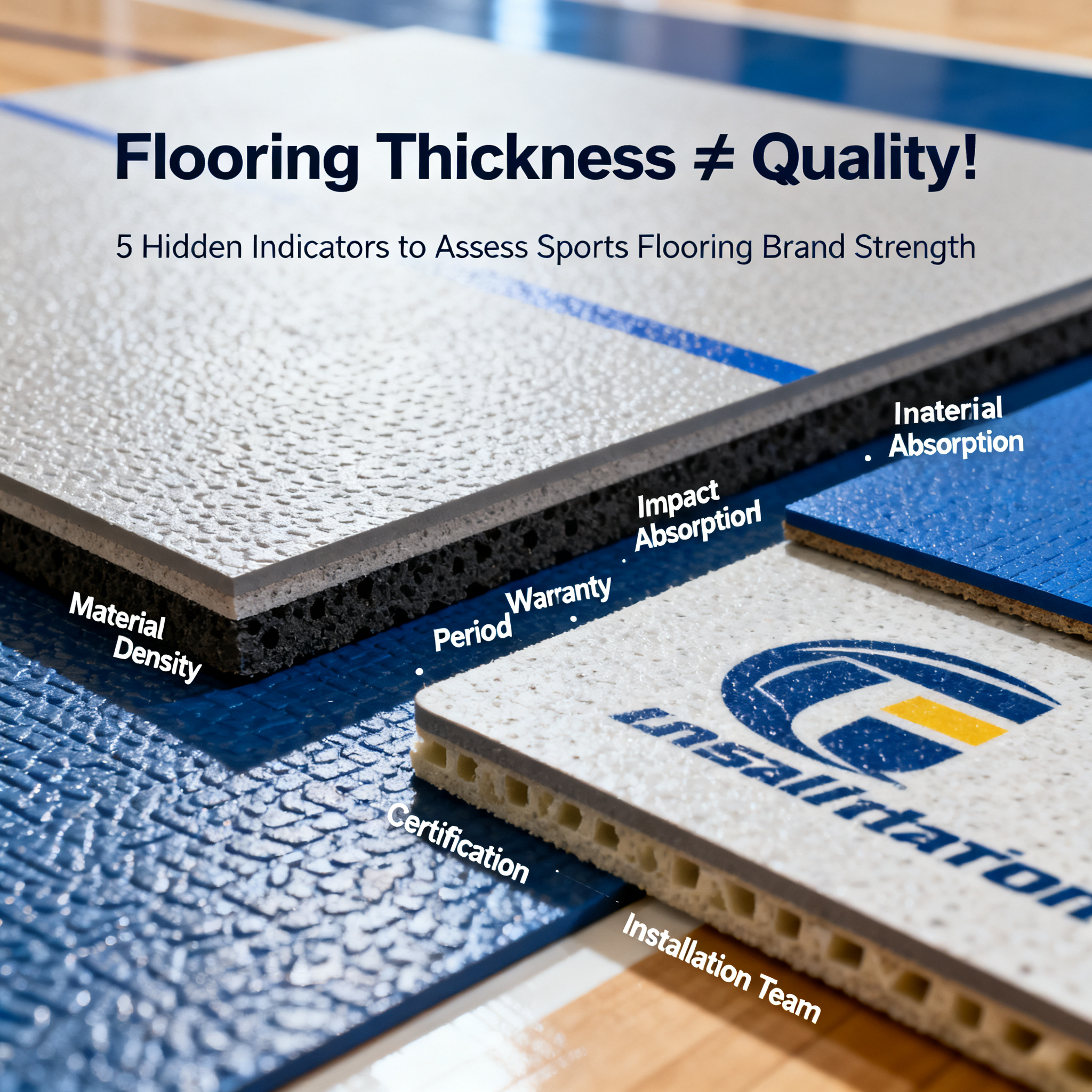
1. Foam Layer Density Uniformity: Footfeel Can't Be Faked
The footfeel of flooring comes from the foam layer in the middle. But even with foam, some manufacturers use chemical foaming, resulting in uneven air bubbles that feel like stepping on low-quality sponge. When you jump and land, you can clearly feel the vibration from the soles straight to your knees. Others use physical foaming, producing fine and uniform pores that offer solid, resilient rebound.
How to tell the difference? Cut the flooring and examine the cross-section. The pores in a high-quality foam layer are arranged densely like a honeycomb, with almost no visible large voids. SQUARE COMFORT conducts a "rebound rate test" before shipment, dropping a standard weight ball from a fixed height and recording the rebound height. Data shows that flooring with uniform foam density can achieve a rebound rate consistently above 92%, while products with uneven density often fall below 85%. This 7% difference is the direct distinction in knee impact force during badminton jump smashes or basketball sudden stops and direction changes.
2. Glass Fiber Mesh Weight: The "Skeleton" for Tear Resistance
Many buyers have encountered this frustrating issue: within less than a year of use, the flooring develops cracks at the seams, edges curl up, or even permanent dents appear from table tennis table legs. The problem often lies in the middle layer of glass fiber mesh.
This mesh acts as the "skeleton" of the flooring, and its weight directly determines the tensile strength and dimensional stability. Low-end products on the market use mesh with a weight of only about 60 grams, as thin as a cicada's wing. Professional-grade flooring, however, uses high-density mesh weighing over 110 grams, which is impossible to tear by hand. The testing method is simple: pick up a corner of the flooring and pull hard. If it easily stretches or deforms, the mesh weight is substandard. In SQUARE COMFORT's laboratory, a tensile testing machine is dedicated to this task, with a standard of withstanding no less than 800 Newtons of force per 5 centimeters of width—equivalent to an 80-kilogram force without breaking.
3. Surface UV Hardening Treatment: The Secret to Scratch Resistance and Easy Cleaning
What do gym floors fear most? Black marks from shoe soles, scratches from equipment dragging, and stains from spilled drinks. This tests the UV hardening layer on the flooring surface.
UV treatment involves coating the surface with a layer of UV-cured wear-resistant resin. The coating thickness and curing process determine the surface hardness and density. A well-executed UV layer will only leave a faint, wipeable mark when scratched with a key. A poorly done one can be dented with a fingernail, let alone the spiral black marks left by rubber badminton shoe soles during sudden stops.
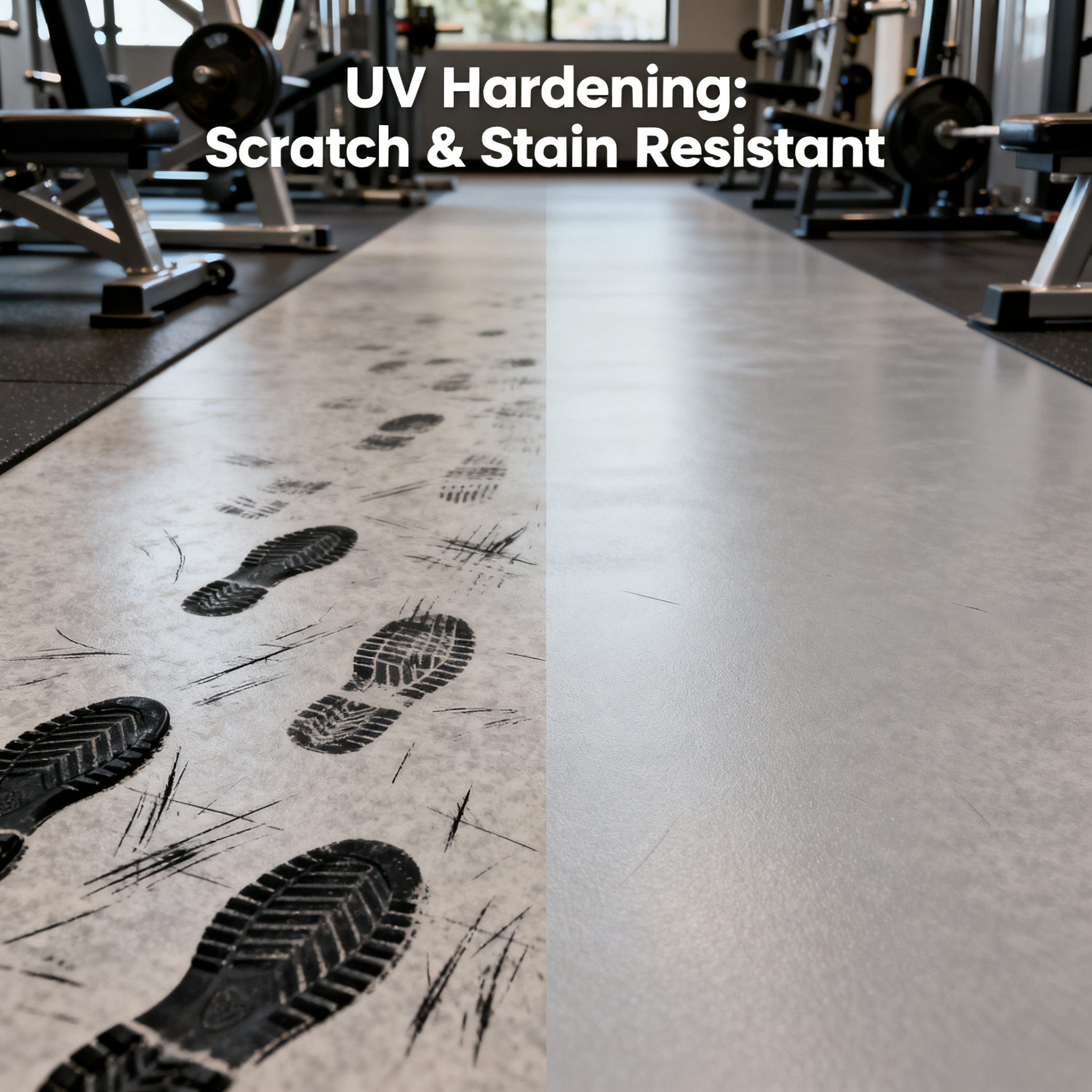
Here's a detail worth noting: the UV layer isn't about being thicker; the key is whether curing is thorough. Some manufacturers cut costs by using insufficient UV lamp power, leaving the coating surface dry but the inside still soft. After two months of use, the surface becomes sticky and attracts dust. Professional brands use high-power UV lamps with a conveyor belt for uniform curing, ensuring every inch of the surface is evenly hardened. Cleaning becomes effortless with a damp mop, without needing strong detergents.
4. Bottom Pattern Anti-Slip Design: The Invisible "Grip"
What's the biggest fear after flooring is laid? Bubbling and shifting. Especially in table tennis halls, which require frequent lateral movements, if the bottom of the flooring lacks grip, the entire floor can slide when you push off, affecting performance at best and causing sports injuries at worst.
High-quality flooring typically features dense patterns on the bottom, such as fine grids or suction-cup-like circular grooves. These patterns increase the contact area and friction coefficient between the flooring and the ground. When installed with proper adhesive, the flooring becomes as stable as if it were part of the ground. The testing method is simple: after laying, press down hard with your heel and rub. If the flooring doesn't budge, the pattern design passes. Some venues use double-sided tape instead of full adhesive for convenience, making the bottom pattern even more critical.
5. Environmental Volatile Compound Test Values: The Invisible Health Threat
This last point is the most overlooked, yet it directly relates to human health. Sports venues are typically enclosed spaces. If the flooring's volatile organic compounds (VOC) and formaldehyde emissions exceed limits, exercising there for extended periods is akin to chronic poisoning.
National standards require formaldehyde emissions for indoor sports flooring to be ≤0.12 mg/m³ and TVOC emissions ≤0.5 mg/m³. However, some manufacturers chasing cost-effectiveness cut corners here, using recycled materials instead of virgin ones. While they may make the flooring thick enough, the odor is pungent, and test values are concerning.
Professional brands have the confidence to publicly display their test reports. Take SQUARE COMFORT as an example: its sports flooring products have passed ISO 9001 quality management system certification, with actual environmental test values typically achieving less than one-fifth of the national standard limits. When purchasing, you can request recent third-party test reports, focusing on two key data points: formaldehyde emission and total volatile organic compound content. Lower values mean safer, and there's no room for compromise here.
Final Thoughts
Having said all this, it's not that thickness is entirely unimportant. Rather, it's that thickness is just the most basic parameter, far from sufficient to measure the true quality of a floor. A genuinely good floor is the result of the foam layer, mesh, UV layer, bottom pattern design, and eco-friendly materials working together.
Brands that invest in invisible details and dare to reveal their test data are the ones worthy of trust from venue operators. As SQUARE COMFORT has always emphasized: All greatness starts from the ground beneath your feet. With over 30 years of manufacturing expertise since 1988, serving more than 10,000 global clients including Huawei, BYD, Vanke, and Chimelong, their success isn't based on making parameter sheets look impressive, but on ensuring every layer withstands the test of time.
Next time someone asks you "What thickness of flooring should I choose?", you can forward this article to them. Those who truly understand will ask about the five hidden indicators.