
What Should Venue Flooring Fear? Brand Aging Test Report Reveals True Lifespan
What Should Venue Flooring Fear? Brand Aging Test Report Reveals True Lifespan
When you invest tens of thousands or even hundreds of thousands of dollars in sports venue flooring, what worries you most? It's not the lack of softness or bounce, nor the color not being appealing enough—it's how many years it can truly last without failing. A venue isn't your living room; with hundreds of people stepping on it daily, equipment being dragged across, and lights beating down, flooring ages far faster than you'd imagine. Many venue managers have experienced this: freshly installed flooring looks pristine, but after two or three years, it starts yellowing, peeling, or even cracking, leading to a flood of complaints. Today, we're not talking abstractly—we're taking you straight into SQUARE COMFORT's product aging lab, using data to show you what a truly durable flooring must withstand.
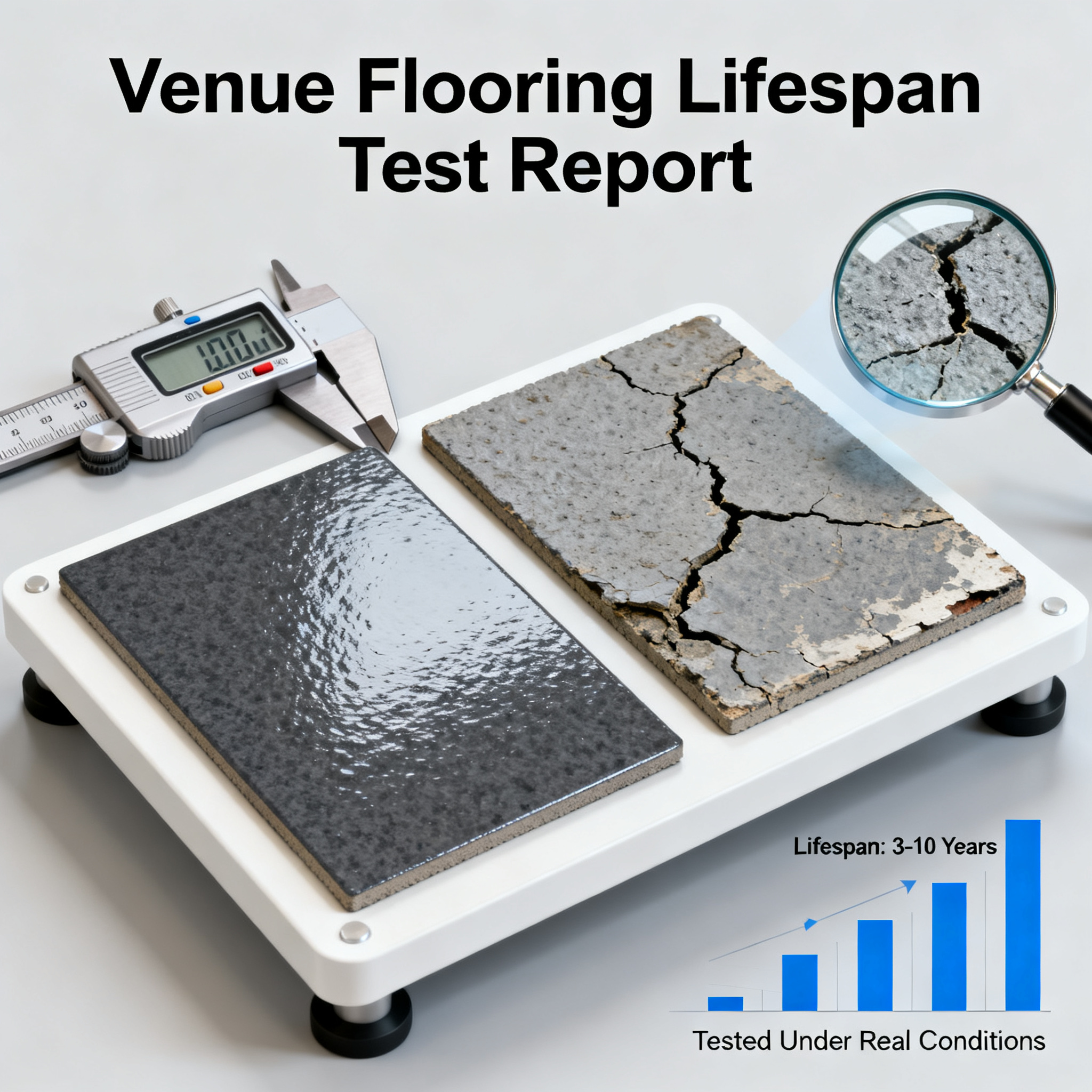
3000 Hours of UV Aging Chamber Exposure: Can the Color Hold Up?
Indoor venues may not face the same wind and sun as outdoor spaces, but don't forget—large floor-to-ceiling windows and skylights let sunlight hit the floor directly. UV radiation is the number one culprit behind flooring fading. We took SQUARE COMFORT's PVC sports flooring samples, placed them in a UV aging test chamber, and simulated the UV spectrum of sunlight with continuous exposure for 3000 hours—equivalent to three to five years of natural sunlight accumulation. What were the results? Using a colorimeter, the ΔE color difference was kept within 2.0, virtually imperceptible to the naked eye. Surface chalking reached grade 0, meaning no chalking at all. In contrast, some low-cost flooring on the market starts visibly whitening after just 1500 hours under the same conditions, and wiping it leaves a layer of white powder. What's the difference? SQUARE COMFORT incorporates high-cost UV absorbers and antioxidants into its production formula—these additives act like sunscreen, giving the flooring an invisible protective layer. Moreover, the dispersion uniformity is refined through a three-roll mill, ensuring no weak spots in localized protection.
Roller Fatigue Tester Simulating 100,000 Push Movements: How Deep Is the Surface Wear?
For table tennis and badminton venues, the most frequent actions are sudden stops, turns, and foot friction. The roller fatigue tester we used simulates the most common movement in real matches—pivoting and twisting on the ball of the foot. The test wheel applies standard pressure to the flooring surface and rotates with friction 100,000 times, equivalent to the wear from a high-level athlete training four hours daily for two years. After the test, using a high-precision profilometer to measure wear depth, SQUARE COMFORT's flooring showed a wear layer loss of only 0.08 mm, while its total wear layer thickness exceeds 1.2 mm. What does this mean? At this rate, over eight to ten years of normal use, the surface texture remains clearly visible, and slip resistance won't degrade significantly. Many customers report that SQUARE COMFORT flooring used for five or six years still looks newly installed—this is backed by a pure PVC surface formula, not by adding large amounts of calcium carbonate fillers to cut costs. More fillers lead to a cliff-like drop in surface wear resistance, which is why some cheap flooring develops shiny spots within a year.
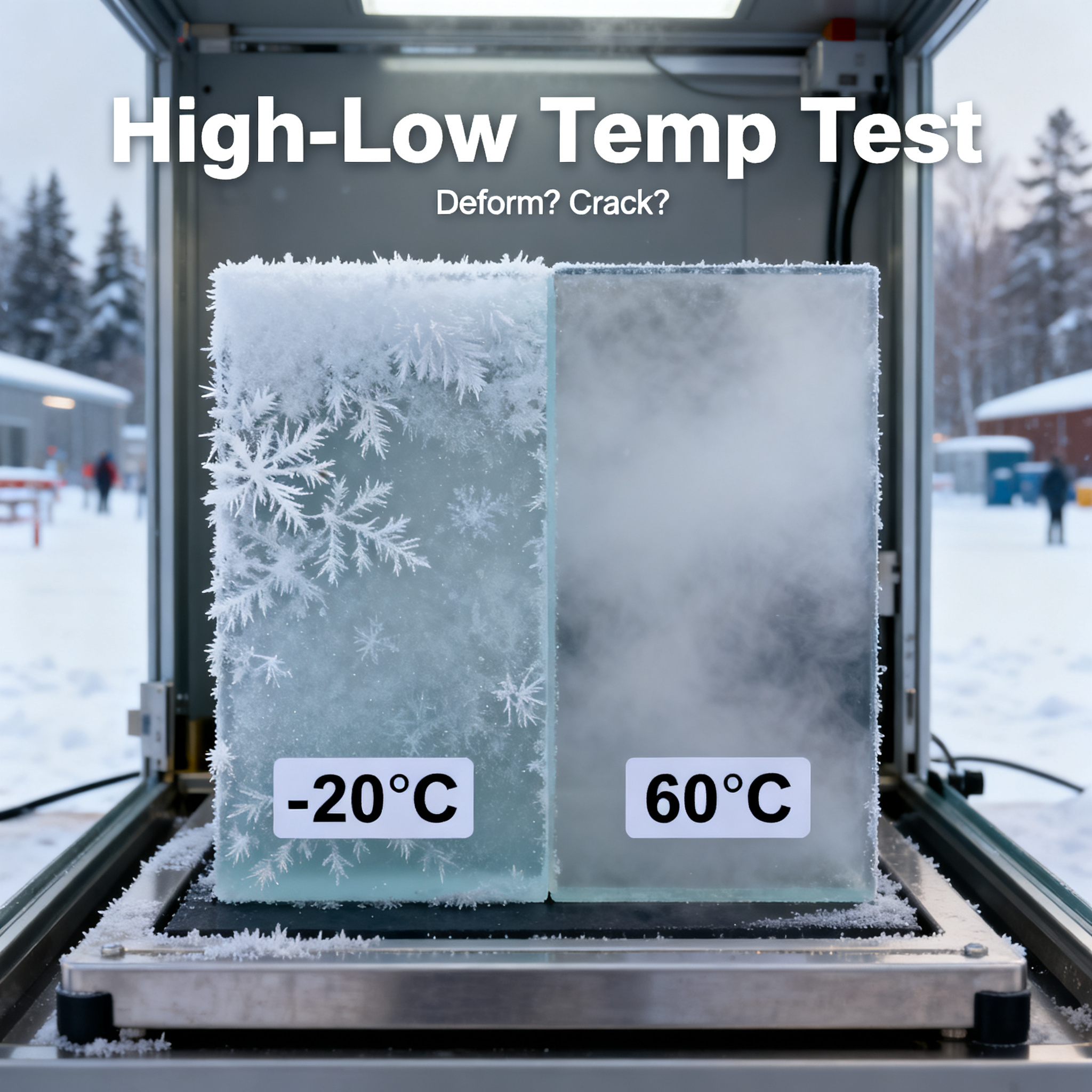
High-Low Temperature Cycling Test: Repeated Exposure from -20°C to 60°C—Will It Deform or Crack?
In northern venues without heating in winter, indoor temperatures can approach freezing; in southern summers, after rooftop sun exposure, floor temperatures easily exceed 50°C. Under such thermal cycling, internal stress accumulates, and low-quality flooring often suffers from warping or cracking due to expansion and contraction. We placed SQUARE COMFORT flooring in a temperature and humidity cycling chamber, cycling from -20°C to 60°C, holding each extreme for two hours, for 120 consecutive cycles. After testing, we measured dimensional change with a caliper, and the result was less than 0.15%, well below the national standard of 0.5%. No cracks, bubbles, or delamination appeared on the surface. The key to this performance lies in SQUARE COMFORT's use of high-density fiberglass mesh as the stabilization layer—this material acts like rebar in concrete, locking in the PVC's shrinkage stress. Additionally, the production line is equipped with online thickness gauges, ensuring thickness uniformity is controlled within 0.05 mm, eliminating any localized weak areas.
Humidity and Mold Resistance Test: No Fear of Monsoon Season
What's the biggest headache for southern venues? During the monsoon season, walls sweat with water droplets, and the area under the flooring stays perpetually damp, leading to a musty smell over time. Lift the flooring, and you'll find black spots underneath. SQUARE COMFORT's antibacterial and mold resistance test report, conducted per GB/T 24128 standards, shows that after 28 days of mold challenge testing, common molds like Aspergillus niger, Aspergillus terreus, and Aureobasidium pullulans all exhibited a growth rating of 0 on SQUARE COMFORT's flooring surface—meaning no mold growth visible under a microscope. This is thanks to the silver ion antibacterial agent added to the formula, which disrupts microbial cell walls and doesn't degrade over time like organic biocides. Silver ions are persistent; as long as the flooring isn't worn through, the antibacterial effect remains. So even in basement or semi-basement venues, or during southern plum rain seasons, SQUARE COMFORT flooring stays dry and clean, never becoming a breeding ground for bacteria or mold.
Beyond the Data: Publicly Sharing Tests Is Itself a Mark of Confidence
Honestly, few flooring brands in the market are willing to fully disclose their aging test methods and data. Most manufacturers only offer a vague "five-year warranty," and when problems arise, they make excuses. SQUARE COMFORT's willingness to share these testing details stems from real confidence—this company, which has been manufacturing sports equipment since 1988, has over three decades of accumulated process expertise that isn't for show. In December 2024, SQUARE COMFORT was selected as a member unit in the "Brand Powerhouse" preferred project for table tennis tables, with auditors conducting a comprehensive review of production qualifications, product test reports, and market reputation. Additionally, SQUARE COMFORT's factory has passed ISO 9001 quality management system certification, with standardized controls at every step from raw material cutting to finished product assembly. Its global trademark registrations cover China, Japan, the United States, the European Union, and Southeast Asia, and renowned companies like Huawei, BYD, Vanke, and Chimelong appear on its client list.
Purchasing flooring isn't a one-time expense—it's an investment in venue operations for the next five to ten years. Rather than regretting saving money upfront when you see peeling and cracking flooring two years later, it's wiser to choose a product that withstands extreme laboratory tests from the start. SQUARE COMFORT's aging test report isn't just a document sitting in a drawer; every data point corresponds to real-world performance in actual usage scenarios. If you're struggling with venue flooring materials, take this report and challenge suppliers point by point to see if they dare to test under the same standards. After all, true gold fears no fire, and good flooring fears no tests.