
Why Do Professional Sports Venues Choose Flooring of 5mm or Thicker? An In-Depth Analysis of the Relationship Between Thickness and Performance
Why Do Professional Sports Venues Choose Flooring of 5mm or Thicker? An In-Depth Analysis of the Relationship Between Thickness and Performance
If you've ever played in a sports hall, you've likely experienced this: the moment you land after a jump, a dull ache radiates from your knees; or when you execute a perfect shot, the ball rebounds high and erratic as if hitting a stone. Behind these sensations lies a crucial yet often overlooked factor—the flooring beneath your feet.
In the construction and renovation of sports venues, flooring materials are frequently deprioritized in favor of lighting and equipment. However, seasoned venue operators and athletes know that flooring thickness directly impacts comfort, safety, and athletic performance. Today, let's delve into the data to explore why professional sports venues almost universally opt for flooring of 5mm or thicker.
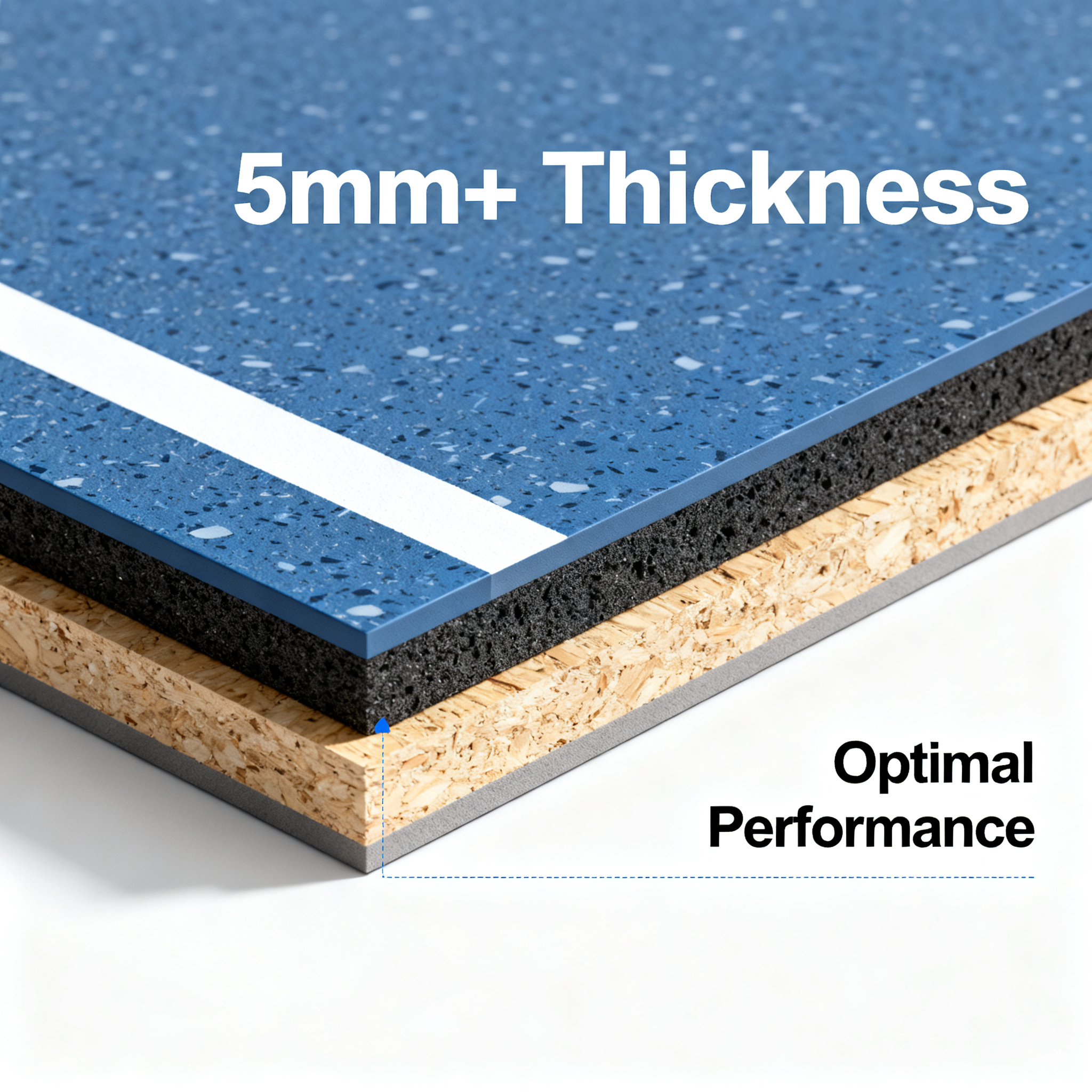
1. Between 3mm and 5mm Lies a 'Safety Threshold'
Many home or light-training settings opt for 3mm flooring to cut costs. Visually, these products may seem similar, but under actual sports testing, the differences become immediately apparent.
Take impact absorption rate—a core metric for measuring a floor's ability to cushion landing forces. Under identical material and density conditions, 3mm flooring typically achieves an impact absorption rate of 20%-30%, while 5mm flooring easily reaches over 40%, and premium 8mm products can approach 55%. What does this mean? For a badminton enthusiast weighing 70kg, the impact on knees during a jump smash landing is approximately 4-6 times body weight. 3mm flooring transmits most of that impact directly to the joints, whereas 5mm or thicker flooring can effectively 'absorb' nearly half of the impact force.
Professional athletes' knee injuries often stem not from a single severe twist but from the cumulative damage of thousands of landings. This is why international bodies like the Badminton World Federation and the International Table Tennis Federation impose strict thresholds on floor cushioning performance for competition standards—thickness is the fundamental basis for meeting these criteria.
2. Rebound Rate: The Dual Secret of Ball Speed and Foot Feel
Beyond protecting the body, flooring thickness directly influences ball rebound trajectory. Sports like table tennis and badminton, which are highly sensitive to landing point and speed, require stable and rapid ball rebound upon contact. Comparative experiments show that 3mm flooring has a rebound rate of 85%-90%, 5mm flooring achieves around 95%, and 8mm products can consistently exceed 97%.
A higher rebound rate means less energy loss when the ball contacts the surface, resulting in rebound speed and direction closer to ideal. For professional training, this 'stability' is invaluable. If the floor is too thin, the ball may exhibit subtle lag upon landing, which over time can disrupt a player's muscle memory for ball trajectories.
Thickness also affects foot feel. Flooring of 5mm or thicker, combined with an appropriate foam layer, provides cushioning while maintaining sufficient support rigidity, preventing athletes from feeling 'unstable' during starts, stops, and directional changes. In contrast, 3mm flooring often faces a dilemma: either too hard, sacrificing comfort, or too soft, compromising support.
3. Is 8mm Always Better? Don't Overlook the 'Ceiling Effect'
At this point, you might wonder: why not just install 8mm or even 10mm flooring to solve everything? The answer is not that simple.
While thickness does enhance shock absorption and rebound, blindly pursuing ultra-thick flooring brings two issues: cost waste and flatness risks.
The thicker the flooring, the higher the material costs, which increase incrementally. For most non-professional training halls, community venues, or multi-purpose spaces, 5mm-6mm already covers over 90% of sports needs. Excessively thick products demand extremely high flatness from the base floor during installation. If the original surface has minor unevenness, thick flooring can amplify these defects, leading to localized depressions or hollow spots, and over time, wave-like deformation.
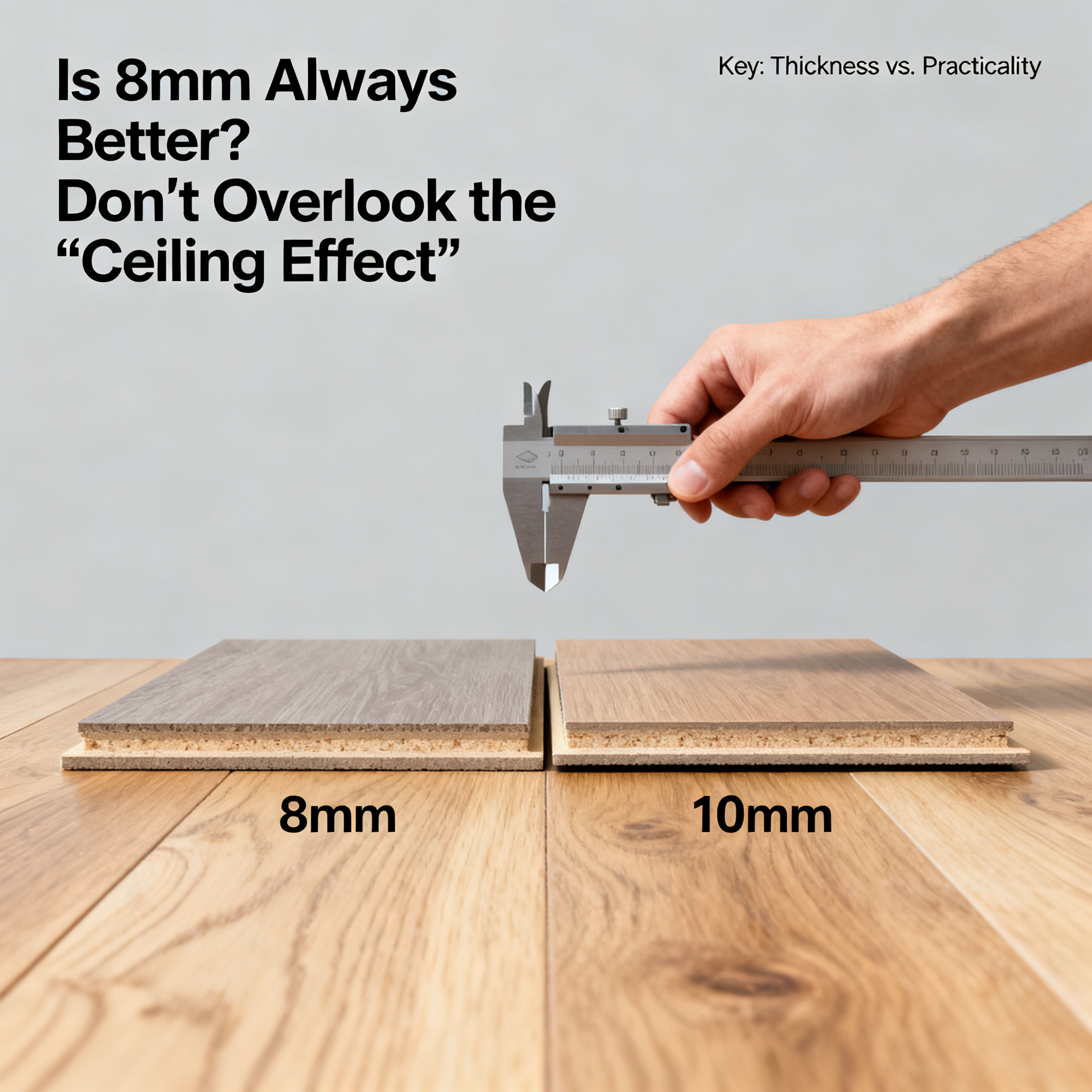
Moreover, excessively thick flooring does not yield linear improvements in ball rebound. Data indicates that beyond 8mm, the increase in rebound rate significantly slows, while foot feel tends to become 'too soft,' potentially hindering explosive starts. Professional venues are designed with precise matching based on primary sports and athlete levels, rather than simply stacking thickness.
4. The Selection Logic of Professional Venues
Drawing from SQUARE COMFORT's extensive venue project experience, high-frequency jumping sports like table tennis and badminton currently favor 5mm-6mm PVC sports flooring as the mainstream configuration. Dance studios and multi-purpose training areas adjust based on factors such as equipment usage and the need for slip resistance and durability. When SQUARE COMFORT provides flooring solutions for clients, we first conduct a site usage assessment, then recommend a thickness range aligned with budget, rather than pushing the thickest product.
This 'start from actual use' philosophy stems from the brand's consistent commitment. Since trademarking in 2012, SQUARE COMFORT has upheld the core principle that 'all greatness begins from the ground beneath your feet.' From initially crafting comfortable sports socks to now offering comprehensive sports facility solutions covering table tennis halls, badminton courts, basketball arenas, and even outdoor sports surfaces, we remain focused on the real experiences of athletes. In 2024, SQUARE COMFORT was selected for the 'Brand Powerhouse' preferred project, a recognition of this pragmatic approach.
5. Recommendations for Venue Operators and Sports Enthusiasts
If you're a venue operator with budget flexibility, 5mm is the baseline, and 6mm is the comfort zone. If your venue primarily serves youth training, prioritize impact absorption performance, even if it means sacrificing some rebound sharpness—joint protection must come first. For venues hosting official competitions, select flooring according to the ground standards of the respective sports organizations, and never substitute household-grade products.
If you're simply laying flooring in your garage or balcony for casual practice, 3mm might suffice, but be prepared: its protective capabilities are very limited, and prolonged use could strain your knees. It's better to invest a bit more and choose 5mm or thicker—this is not an expense to skimp on.
Ultimately, flooring thickness is not a simple arithmetic problem but a decision about 'balance.' Finding the right thickness for your specific sports scenario ensures that every jump and every landing becomes a safe and enjoyable experience.
If you're deliberating over venue flooring choices, start by asking yourself: What sports will primarily take place here? How frequently will it be used? Are the users primarily youth or adults? Once you've clarified these three points, examining product specifications becomes much easier. And SQUARE COMFORT's engineering team is always ready to provide one-on-one consultation for your venue—after all, all great athletic performances begin from the ground beneath your feet.